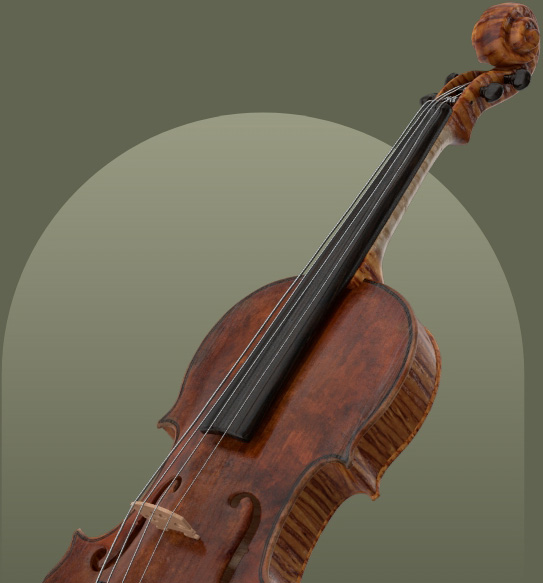
David Murray
Fauldhouse, 1850–1920
David Murray (1850-1920) was a Scottish luthier, violinist, and music teacher who began making violins around 1880, achieving considerable success despite his amateur beginnings and often limited access to premium materials. His instruments, which drew inspiration from Stradivari and Guarneri, were noted for their distinguished workmanship, rich red oil varnish, and a peculiar crisp yet sweet tonal quality. Murray's distinctive features included slanting soundholes and strong purfling with extended mitres, reflecting his meticulous dedication to transforming wood into instruments of "living beauty."
Request an expert valuation or learn how our global auctions achieve the highest prices for your instruments.
Auction Price History
Highest auction price
3 results
| Type | Details | Auction house | Sold | Price |
|---|---|---|---|---|
| Violin | 1897 | — | December 1993 | £396 |
| Violin | 1889 | — | March 1993 | £935 |
| Viola | 40.0 cm 1900 c. | — | April 1987 | £220 |
No results match those filters.
Maker Overview
Life
David Murray (1850-1920) was born in 1850 in Fauldhouse, West Lothian, and passed away in 1920 in Gorebridge, Scotland, UK. He pursued a career as a violinist and music teacher, while also working as a miner. Murray commenced making violins around 1880, initially as an amateur, but achieved considerable acclaim for his craftsmanship., he was an amateur maker of exceptional ability, who, despite often needing to utilize available timber, would dedicate months to meticulously shaping good wood when he acquired it, transforming the inert block into lines of living beauty.
Characteristics
- Instrument Count
- Sources present conflicting information regarding the total number of instruments crafted by Murray. Willibald Leo Lütgendorff indicates he made over 50 violins, while William Meredith Morris states he made approximately sixty. John Dilworth attributes over 100 instruments to him.
- Models
- Murray's creations frequently drew inspiration from the models of Stradivari and Guarneri. William Meredith Morris suggests he worked on an original model, or potentially multiple models, as no two of his instruments were identical, each possessing its own unique individuality.
- Materials and Varnish
- He employed Whitelaw's Öllack. John Dilworth describes his instruments as generally showcasing distinguished work with a rich red oil varnish, which was often artificially darkened in the center of the front. William Meredith Morris observed that Murray frequently had to make do with any timber he could find, but when he secured quality wood, he would devote months to its careful shaping.
- Workmanship
- William Meredith Morris characterized his workmanship as faultless. John Dilworth described his work as generally distinguished.
- Tone
- William Meredith Morris remarked that his instruments possessed a peculiar crisp yet sweet quality that was novel and pleasing.
- Distinctive Features
- John Dilworth highlights that his soundholes were rather slanting and positioned close to the lower corners. He also utilized strong purfling with extended mitres deflected across the upper corners.
- David Murray
Maker
Gorebridge
1892John Dilworth
Further Information
- Workshop Location: David Murray operated his workshop from Gorebridge, Scotland, UK.
- Labels: Examples of his labels include "DAVID MURRAY, MAKER, GOREBRIDGE, 189-" as cited by William Meredith Morris, and "David Murray / Maker / Gorebridge / 1892" as noted by John Dilworth.
Biographies
The overview above is drawn from the following published accounts. Read them in the original:
John Dilworth+
MURRAY, David Born 1850 Fauldhouse, West Lothian, Worked from c.1880, died 1920 Gorebridge, Scotland UK. Violinist and violin maker. Previously employed as a miner. Credited with over 100 instruments. Personal models derived from Stradivari and Guarneri. Generally distinguished work with rich red oil varnish, often artificially darkened in the centre of the front. Soundholes rather slanting and set close to the lower corners. Strong purfling with extended mitres deflected across the upper corners. David Murray / Maker / Gorebridge / 1892
William Meredith Morris+
He was born at Greeburn, Linlithgowshire, Dec. 30, 1850. He is an amateur maker of far more than average ability, and did circumstances but allow him to procure good material, he would turn out work which would be in every way excellent. As matters stand, Murray has often to rest content with any sort of timber he can pick up. When he does secure a piece of good wood, he spends months in fondly shaping it, and in tracing out of the inert block lines of living beauty. He works on an original model, or perhaps it would be more correct to say models, seeing that no two of his instruments are exactly alike. Each violin has an individuality of its own, and yet ” David Murray ” is writ large on the face of every one of them. The workmanship is faultless, and the tone has a peculiar crisp yet sweet quality which is novel and pleasing. He has made about sixty violins. Label : —
DAVID MURRAY, MAKER, GOREBRIDGE, 189-
Willibald Leo Lütgendorff+
Ein Geiger und Musiklehrer, der aus Liebhaberei Geigen macht und darin schöne Erfolge erzielt. Er hat bereits über 50 Geigen nach Stradivari und Guarneri gemacht und verwendet Whitelaw’s Öllack.
Sell your instrument with Amati
Get started by uploading photos of your instrument for our experts to review.
Sell your instrument with Amati
Get started by uploading photos of your instrument for our experts to review.