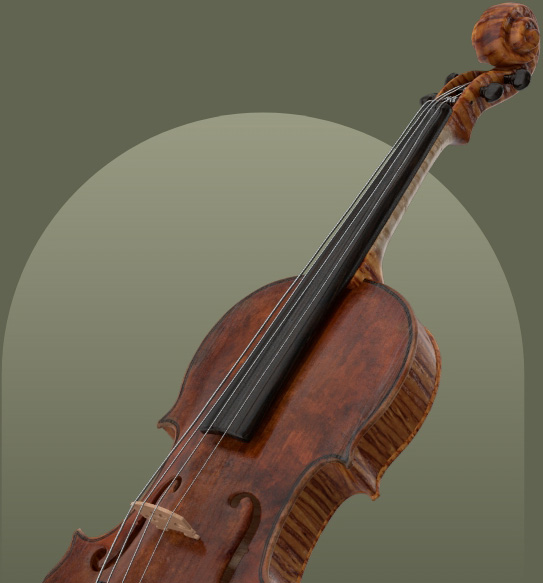
William Nisbet
Stenton, 1828–1903
William Nisbet (1828-1902) was a self-taught Scottish craftsman known for his versatility and mechanical skill. He produced approximately 100 to 120 violins, initially following Maggini models and later developing Amati-derived or original patterns. His instruments featured excellent workmanship and a large, telling tone, though his spirit varnish was sometimes noted as dull. Nisbet was awarded bronze medals at the Edinburgh International Exhibition (sources conflict on 1885 or 1886) and uniquely inscribed his name internally with a pencil rather than using a label.
Request an expert valuation or learn how our global auctions achieve the highest prices for your instruments.
Auction Price History
Highest auction price
| Type | Details | Auction house | Sold | Price |
|---|---|---|---|---|
| Violin | 1870 | — | November 1988 | £550 |
No results match those filters.
Maker Overview
Life
William Nisbet (1828-1902) was born at Stenton on January 5, 1828, and passed away at Lint Mill in 1902. in British Violin Makers, he received no formal school education in his early life, with his father, a labouring man, providing what home teaching he could. Despite this, Nisbet possessed extensive knowledge across various subjects and was distinguished by his mechanical skill. The Reverend G. Marjoribanks, vicar of Stenton, concluded his account of Nisbet's life and work in the Haddington Courier by stating, "It is not too much to say that, in whatever direction he has turned his energies, he has always excelled. Few, indeed, would suppose that the modest-looking yet trim little cottage which stands near the picturesque ruins of the old mill, was occupied by a man possessed not only of rare technical skill, but of such accurate and extensive information, gathered mainly from personal observation and study in the fields of natural history and science, whether as a photographer, wood-carver, carpenter, basket-maker, violin-maker, or in more recent years as a market-gardener, the productions of his genius and labour have been equally admired and appreciated, and this none the less because ac- companied by a singular modesty of character and demeanour, and without his having had the benefit of any special training and education. In short, if the well-known author of ' Self- Help' wishes to find solid material for a new biographical sketch, he could hardly do better than select for his theme the subject of this little notice." John Dilworth notes in The Brompton's Book of Violin & Bow Makers that Nisbet died in 1903 in Preston Kirk, Scotland, UK, presenting a slight discrepancy in the death year.
Characteristics
- Output
- William Nisbet made approximately 100 to 120 violins during his career.
- Models
- His earlier instruments were crafted after the Maggini model, while later ones were said to follow Nicolas Amati's pattern, sometimes with a broadened waist to enhance tone. However, William Meredith Morris observed that instruments he examined, particularly one from 1891, did not conform to the Amati model, suggesting an original design due to marked and numerous differences.
- Measurements
- An instrument made in 1891 had the following dimensions: length of body 13 15/16 inches, width across upper bouts 6 7/8 inches, width across middle bouts 4 5/8 inches, width across lower bouts 8 1/8 inches, distance between corners 3 3/16 inches, length of sound-holes 2 7/8 inches, distance between sound-holes at top 1 3/4 inches, and depth of ribs at top and bottom 1 1/4 inches.
- Materials & Finish
- He utilized good quality wood and a brown varnish, though Morris describes the varnish as a spirit one of a dull, lifeless color. John Dilworth mentions broad purfling with spirit varnish in various shades.
- Workmanship & Tone
- The workmanship on his instruments is considered excellent, producing a large and telling tone.
- Wm. Nisbet
Lint Mill
1886John Dilworth
Influence and legacy
- Awards: William Nisbet received two bronze medals for his violins at the Edinburgh International Exhibition. Sources contain conflicting information about the year, with Willibald Leo Lütgendorff and William Meredith Morris stating 1886, and John Dilworth stating 1885.
- Marking: He did not use a traditional label but instead inscribed his name internally with a hard lead pencil, which penetrated the wood on the inside of the back. An example inscription noted by John Dilworth is "Wm. Nisbet / Lint Mill / 1886 [Rattray]."
Further Information
- Versatility: Beyond violin making, Nisbet was also skilled as a photographer, wood-carver, carpenter, basket-maker, and in his later years, a market-gardener.
- Residence: He resided at Lint Mill.
Biographies
The overview above is drawn from the following published accounts. Read them in the original:
John Dilworth+
NISBET, William Born 1828 Stenton, died 1903 Preston Kirk, Scotland UK. Self-taught craftsman. Made around 120 violins. Early period focused on Maggini models; later turning to an Amati-derived pattern. Broad purfling with spirit varnish in various shades. Awarded bronze medal at the Edinburgh Exhibition 1885. Name inscribed internally. Wm. Nisbet / Lint Mill / 1886 [Rattray]
William Meredith Morris+
He was born at Stenton, Jan. 5, 1828, and died at Lint Mill in 1902. He received no school education in early-life, his father, who was a labouring man, giving him what home teaching he could. He was, however, possessed of wide information upon a variety of subjects, and distinguished in mechanical knowledge and skill. The Rev. G. Marjoribanks, vicar of Stenton, thus concludes his account of Nisbet’s life and work in the Haddington Courier : ” It is not too much to say that, in whatever direction he has turned his energies, he has always excelled. Few, indeed, would suppose that the modest-looking yet trim little cottage which stands near the picturesque ruins of the old mill, was occupied by a man possessed not only of rare technical skill, but of such accurate and extensive information, gathered mainly from personal observation and study in the fields of natural history and science, whether as a photographer, wood-carver, carpenter, basket-maker, violin-maker, or in more recent years as a market-gardener, the productions of his genius and labour have been equally admired and appreciated, and this none the less because ac- companied by a singular modesty of character and demeanour, and without his having had the benefit of any special training and education. In short, if the well-known author of ‘ Self- Help’ wishes to find solid material for a new biographical sketch, he could hardly do better than select for his theme the subject of this little notice.””
Nisbet made 120 violins. The earlier ones are on the model of Maggini, and the later ones are said to be on the model of Amati, “with a broadened waist to give more tone.” Those examined by me were not on the Amati model at all, the differences being so marked and numerous as to justify one in describing the model as original. The following measurements, taken from an instrument made in 1891, will bear out the last statement : —
Length of body … 13 15/16ins,Width across upper bouts … 6 7/8ins,Width across middle bouts … 4 5/8ins,Width across lower bouts … 8 1/8ins,Distance between corners … 3 3/16ins,Length of sound-holes … 2 7/8ins,Distance between sound-holes at top … 1 3/4ins,Depth of ribs at top and bottom … 1 1/4ins,
The workmanship is excellent, and the tone large and telling. The only faulty part of the work is the varnish, which is a spirit one of a dull, lifeless colour. He was awarded two bronze medals for an exhibit of violins at the Edinburgh International Exhibition in 1886.
Nisbet used no label, but inscribed with a hard lead pencil on the back in the place where the label usually stands the following : —
Willibald Leo Lütgendorff+
Er hat über 100 Violinen, zuerst nach Maggini, später nach Nicolas Amati, gemacht. Er nimmt gutes Holz und einen braunen Lack. 1886 erhielt er für seine Geigen auf der Ausstellung in Edinburgh zwei Bronce-Medaillen. Er schreibt seinen Namen mit einem harten Bleistift, der ins Holz dringt auf die Innenseite des Bodens.
Sell your instrument with Amati
Get started by uploading photos of your instrument for our experts to review.
Sell your instrument with Amati
Get started by uploading photos of your instrument for our experts to review.