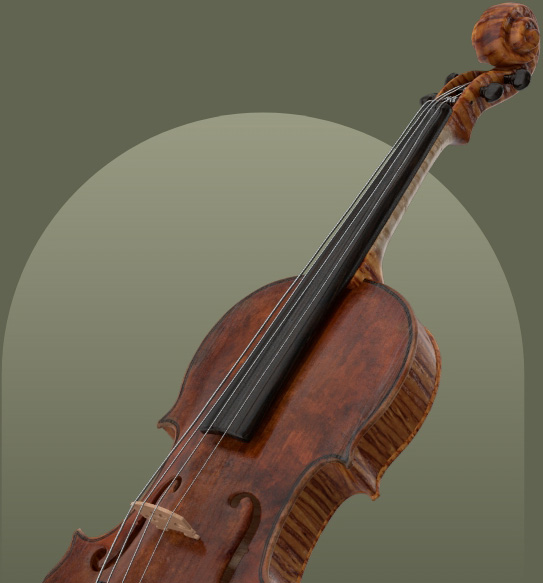
Johann (I) Ohberg
Stockholm, 1723–1779
Johann (I) Ohberg (1723-1779) was a prominent Swedish violin maker active in Stockholm from 1758, recognized as the leading maker of his era. A pupil of S. Beckman, he also mentored E. Sandberg, J. Jerner, and D. Wickström. Ohberg produced a substantial number of instruments, including violins, violas, cellos, and plucked instruments, often individually numbered. His work, though variable in quality, frequently employed a Stainer-derived model and was finished with varnishes ranging from golden-yellow to dark brown. His cellos are particularly noted for their distinctive symmetrical soundholes and cockleshell-carved pegboxes.
Auction Price History
Highest auction price
1 results
| Type | Details | Auction house | Sold | Price |
|---|---|---|---|---|
| Cello | Labelled Gio Battista Gabbrielli, fece in Firenze 1764 Lot 170 | Brompton’s | March 2015 | £15,600est. £ 12,000-18,000 |
No results match those filters.
Maker Overview
Life
Johann (I) Ohberg (1723-1779) was born in 1723 and died in 1779 in Stockholm, Sweden. He was active as a maker from 1758 and became the leading maker in Stockholm during his period in The Brompton's Book of Violin & Bow Makers. Ohberg produced a prolific output of instruments, though their quality was variable. Some of his cheaper work lacked purfling, and his instruments were frequently numbered individually. Dilworth suggests totals of 278 violins, 16 violas, about 40 cellos, and one double bass, in addition to many plucked instruments.
Characteristics
- Model
- Johann (I) Ohberg utilized a good Stainer-derived model, which was slightly undersized and often highly arched.
- Workmanship
- While his output was prolific, the quality of his instruments varied; some cheaper pieces were made without purfling, and Lütgendorff notes that some violins were 'liederlich gemacht' (carelessly made). George Hart describes his workmanship as being of average merit.
- Scroll and Pegbox
- His instruments featured a well-carved and concentric scroll with a broad pegbox.
- Varnish
- Ohberg's best work was finished with a fine golden-yellow varnish. Lesser grades of his instruments had a hard yellow or dull dark brown varnish. Cecie Stainer also notes that he generally used a yellow varnish.
- Distinctive Features
- Violas and cellos are generally considered his most successful instruments. His cellos, in particular, have a very distinctive symmetrical soundhole with the same broad, even sweep in the upper and lower halves, very small finial circles, and a pegbox embellished with a cockleshell carving in the chin. Lütgendorff, however, observes that the F-holes on his cellos are almost consistently unattractive. Some instruments have a Florentine appearance and may have been relabelled as such.
- 1768
I.O.B. Iohann Öhberg
Stockholm 1772
Nr 79John Dilworth
Influence and legacy
- Teacher: Johann (I) Ohberg was a pupil of S. Beckman.
- Pupils: He taught E. Sandberg, J. Jerner, and D. Wickström.
Further Information
- Branding: Ohberg usually branded his instruments on the upper back with marks such as 'I.Ö.B.', 'Johann Öhberg Stockholm. 1768', 'I.O.B. Iohann Öhberg / Stockholm 1772', or 'Nr 79 [Nilsson]'.
- Other Instruments: A Swedish zither made by Ohberg is located at Claudius in Malmö.
Biographies
The overview above is drawn from the following published accounts. Read them in the original:
John Dilworth+
ÖHBERG, Johann (I) Born 1723, died 1779 Stockholm Sweden. Pupil of S. Beckman, active from 1758. Leading maker in Stockholm in his period. Teacher of E. Sandberg, J. Jerner and D. Wickström. Prolific output but of variable quality; some cheaper work without purfling. Instruments frequently numbered individually. Suggested totals are 278 violins, 16 violas, about 40 cellos, and one double bass (also many plucked instruments). Good Stainer-derived model, slightly undersized. Well carved and concentric scroll with broad pegbox. Violas and cellos generally most successful. Best work with fine golden-yellow varnish; lesser grades with hard yellow or dull dark brown varnish. Some instruments have a Florentine appearance and may have been relabelled as such. Cellos have a very distinctive symmetrical soundhole with the same broad even sweep in upper and lower halves, very small finial circles, and pegbox embellished with a cockleshell carving in the chin. Usually branded on upper back: ‘I.Ö.B.’ Johann Öhberg Stockholm. 1768 / I.O.B. Iohann Öhberg / Stockholm 1772 / Nr 79 [Nilsson]
George Hart+
Workmanship of average merit. Varnish mostly of yellow colour.
Cecie Stainer+
A maker in Stockholm in 1773. His instruments were fairly good; he generally used a yellow varnish.
Willibald Leo Lütgendorff+
Er ist entschieden der beste schwedische Geigenmacher. Man trifft häufig sehr
schöne Instrumente, zumeist Violoncelli von ihm, und man muss sich unwillkürlich
fragen, woher hat er die Form und woher hat er das herrliche Holz,
denn es muss damals in Schweden nicht leicht gewesen sein, sich solches aus
dem Auslande zu verschaffen. Hie und da kommen freilich auch sehr liederlich
gemachte Geigen von ihm vor, denen meist die Einlage fehlt. Die F-Löcher an
seinen Violoncelli sind fast durchwegs unschön. Im Übrigen hat er ein hochgewölbtes
Modell bevorzugt, das auf das Stainer’sche zurückgeht. Gelber oder
dunkelbrauner Lack. Eine schwedische Zither von ihm findet sich bei Claudius in Malmö.
Sell your instrument with Amati
Get started by uploading photos of your instrument for our experts to review.
Sell your instrument with Amati
Get started by uploading photos of your instrument for our experts to review.