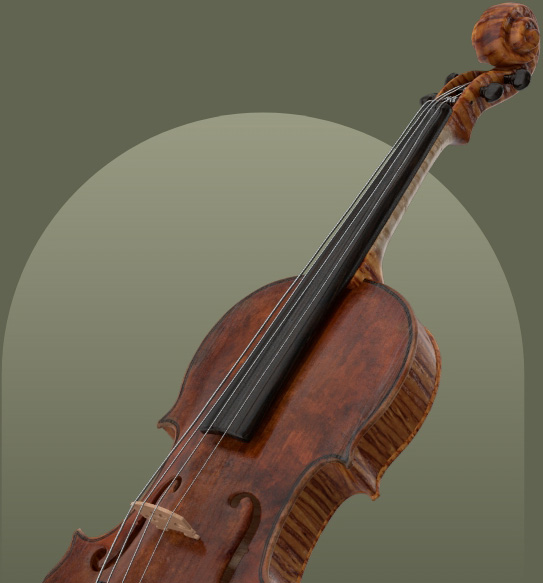
Georg Piegendorfer
Augsburg, 1849–1906
Georg Piegendorfer (1849-1906) was a highly regarded Bavarian violin maker whose career transitioned from music and cabinetmaking to lutherie. After military service and a career as a musician, he discovered a talent for violin repair in 1874, leading him to study extensively and train with F. Chr. Edler. He established a successful repair shop and instrument business in Augsburg, producing carefully crafted violins, cellos, and plucked instruments on Stradivari and Guarneri models, noted for their good tone and use of old wood. Piegendorfer received first prize at the Augsburg Exhibition in 1886 and authored a book on Swabian violin makers. His business was continued by O. Ebner after his death in 1906.
Maker Overview
Life
Georg Piegendorfer (1849-1906) was born in 1849 and died in Augsburg, Germany, in 1906. From a young age, he was involved with music and initially apprenticed as a cabinetmaker. He worked as an assistant in various cities before the outbreak of war in 1866, during which he voluntarily joined the Bavarian Infantry Life Regiment and served as a reserve signalman with the 8th Rifle Company. After the peace treaty, he was assigned to the regimental band, where he received formal musical training. Discharged to the reserve in July 1869, he was recalled in 1870 and served as an oboist throughout the 1870-1871 campaign. Following this, he briefly returned to cabinetmaking before joining a theater orchestra as a French horn player. He remained a musician, undertaking concert tours extensively throughout Germany and Switzerland.
In 1874, Piegendorfer had the opportunity to repair a damaged violin for a colleague. Accustomed to executing fine work, his repair was so unexpectedly successful that he was encouraged from all sides to dedicate himself more to violin making. His colleague provided him with Wettengel's well-known textbook. Finding great joy in the work, he diligently studied the book and acquired other theoretical textbooks, providing him with a strong foundation. In 1875, he became a volunteer with F. Chr. Edler, who instructed him for a year to the best of his ability. By 1877, in Winterthur, he crafted his first violin using his own model and rather inadequate tools, achieving an unexpectedly good result. He made rapid progress and, in 1879, moved to Augsburg as a member of the municipal orchestra. In 1880, he married and established a violin repair shop, which garnered so much demand that he was able to resign from his position as a musician. He subsequently took over Ant. Scherlein's well-established string instrument business in Augsburg and, from that point, produced a number of violins each year that quickly found enthusiasts.
Characteristics
- Workmanship
- Georg Piegendorfer is recognized as one of the best Bavarian violin makers, producing instruments that are described as extremely carefully crafted and possessing very good tone.
- Models
- He worked primarily after the models of Stradivari and Guarneri.
- Materials
- Piegendorfer utilized beautiful, old wood in his constructions.
- Varnish
- , he used a good yellow lacquer that, while perhaps not immediately striking when new, was expected to gain beauty with age. John Dilworth describes his varnish as a good golden-brown.
- Output
- He produced a significant number of violins annually and worked with two assistants.
- Other Instruments
- In addition to violins, he is known to have made cellos and various plucked instruments.
- Labeling
- An example of his label includes "Gg. Piegendorfer / fece in Augsburg. 1898".
- Gg. Piegendorfer
fece in Augsburg. 1898John Dilworth
Influence and legacy
- Self-Study: After repairing a violin in 1874, Georg Piegendorfer diligently studied Wettengel's well-known textbook and other theoretical works on violin making.
- Mentorship: In 1875, he trained as a volunteer for a year under F. Chr. Edler, who provided him with comprehensive instruction.
- Awards: Georg Piegendorfer was awarded first prize at the Augsburg Exhibition in 1886.
- Publications: He authored the book Die Schwäbischen Geigenbauer vom Jahre 1600 bis auf unsere Zeit, published in Leipzig in 1895.
- Succession: His business was succeeded by O. Ebner in 1906.
Further Information
- Active Period: Georg Piegendorfer was active as a violin maker from 1880.
- Workshop Locations: He made his first violin in Winterthur in 1877. In 1880, he established a violin repair shop in Augsburg and later took over Ant. Scherlein's string instrument business in the same city.
Biographies
The overview above is drawn from the following published accounts. Read them in the original:
John Dilworth+
PIEGENDORFER, Georg Born 1849, died 1906 Augsburg Germany. Active from 1880. Awarded first prize at the Augsburg Exhibition 1886. Succeeded in business by O. Ebner 1906. Fine work on Stradivari and Guarneri models. Good golden-brown varnish. Cellos and various plucked instruments also known. Author of Die Schwäbischen Geigenbauer vom Jahre 1600 bis auf unsere Zeit (Leipzig, 1895). Gg. Piegendorfer / fece in Augsburg. 1898
Willibald Leo Lütgendorff+
Einer der besten bayrischen Geigenmacher. Von Jugend auf beschäftigte
er sich schon mit Musik und kam zunächst zu einem Kunsttischler in die Lehre.
Er arbeitete bereits als Gehilfe in verschiedenen Städten, als 1866 der Krieg
ausbrach. Freiwillig trat er beim bayr. Inf .-Leib-Regiment ein und machte den
Feldzug als Reserve-Signalist bei der 8. Schützen – Comp. mit. Nach dem
Friedensschluss wurde er der Regimentscapelle zugetheilt und hier erst eigentlich
zum Musiker ausgebildet. Im Juli 1869 zur Reserve entlassen, wurde er
schon 1870 wieder einberufen und machte den ganzen Feldzug 1870 1871 als
Hoboist mit. Hierauf kehrte er nochmals für kurze Zeit zur Tischlerei zurück
und trat dann als Waldhornist bei einem Theater-Orchester ein. Er blieb jetzt
Musiker und kam als solcher auf Concertreisen weit in Deutschland und der
Schweiz herum. Im Jahre 1874 hatte er Gelegenheit, für einen Collegen
eine schadhafte Geige auszubessern. Gewohnt, feine Arbeiten auszuführen, gelang
ihm der Versuch so über alles Erwarten, dass man ihm von allen Seiten
zuredete, sich dem Geigenmachen mehr zu widmen, und der College brachte
ihm Wettengel’s bekanntes Lehrbuch. Da ihm die Arbeit selbst viele Freude
gemacht hatte, studirte er das Buch mit grossem Eifer durch und verschaffte
sich dann noch andere theoretische Lehrbücher, so dass er gut vorgeschult war,
als er 1875 als Volontär bei F. Chr. Edler eintrat, der ihn nach bestem Können
ein Jahr lang unterrichtete. Im Jahre 1877 machte er in Winterthur mit ziemlich
unzulänglichen Werkzeugen seine erste Violine und zwar nach einem
eigenen Modell, die ihm über Erwarten gut gelang. Er machte nun rasche
Fortschritte und kam 1879 als Mitglied des städtischen Orchesters nach Augsburg,
wo er sich 1880 verheirathete und eine Geigen-Reparaturanstalt gründete, die so
viel Zuspruch fand, dass er seine Stellung als Musiker aufgeben konnte. Er übernahm
dann die gut eingeführte Saiteninstrumentenhandlung von Ant. Scherlein in Augsburg und hat seither Jahr für Jahr eine Anzahl Geigen gemacht, die
schnell ihre Liebhaber finden, da sie überaus sorgfältig gearbeitet und sehr gut
im Ton sind. Er arbeitet nach Stradivari und Guarneri, verwendet schönes,
altes Holz und einen guten gelben Lack, der neu vielleicht nicht so bestechend
aussieht, gewiss aber im Alter an Schönheit zunehmen wird. Er ist mit Anträgen
überhäuft und arbeitet jahraus jahrein mit zwei Gehilfen. Ich habe ihn
Sell your instrument with Amati
Get started by uploading photos of your instrument for our experts to review.
Sell your instrument with Amati
Get started by uploading photos of your instrument for our experts to review.