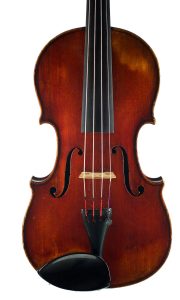
Claude Victor Rambaux
Paris, 1806–1871
Claude Victor Rambaux (1806-1871) was a distinguished French luthier, born in Darney and active primarily in Mirecourt and Paris. He apprenticed with L. Moitessier and worked with Thibout before spending a formative period with François Gand in Paris, where he became a first assistant. In 1838, he opened his own workshop in Faubourg Poissonnière. Renowned for his exceptional skill as a repairer, he specialized in the 'récoupage' or reduction of large old violoncellos and basses to modern dimensions. While he did not produce a vast number of new instruments, those he made exhibited good workmanship and often featured a thick, cloudy varnish. Rambaux was also an experimental maker, exploring various modifications to instrument construction and wood treatment, though not all his experiments were successful. He received several accolades, including a first-class medal at the 1835 Paris Exhibition and silver medals in 1844 and 1849. He retired to Mirecourt in 1857, continuing to work out of passion until his death in 1871.
Request an expert valuation or learn how our global auctions achieve the highest prices for your instruments.
Auction Price History
Highest auction price
11 results
| Type | Details | Auction house | Sold | Price |
|---|---|---|---|---|
| Cello | Labelled Claude Victor Rambaux Breveté à Paris 1849. C.V.R. Lot 111 | — | October 2025 | £20,400est. £ 10,000-15,000 |
| Violin | Labelled Claude Victor ..., two-piece back, varnish of an orange brown colour on a golden ground Lot 23 | — | November 2021 | £5,531est. € 4.000-5.000 |
| Violin | Bearing the maker's label, head not original, some table restorations Lot 358 | — | June 2012 | £3,882est. € 3.000-4.000 |
| Violin | 35.7 cm Paris, 1848 | — | June 2007 | £6,814 |
| Violin | Paris, 1840 | — | June 2005 | £3,956 |
| Cello | 1854 | — | June 2003 | £8,333 |
| Violin | 1846 | — | June 2002 | £1,021 |
| Violin | 1846 | — | March 1996 | £2,760 |
| Violin | 1846 | — | October 1995 | £2,070 |
| Cello | 1861 | — | September 1988 | £2,310 |
| Violin | 1869 | — | April 1987 | £3,080 |
No results match those filters.
Maker Overview
Life
Claude Victor RAMBAUX (1806-1871) was born on February 25, 1806, in Darney, Vosges, and passed away on June 25, 1871, in Mirecourt, France. He hailed from an old family of violin makers. At the age of 14, in 1820, he began his apprenticeship with L. Moitessier in Mirecourt, remaining there until July 12, 1824. Following this, he worked with Thibout in Caen from 1824 to 1827. On August 22, 1827, he moved to Paris and joined the workshop of Gand (father), where he matured into an artist and quickly became the first assistant. He stayed with Gand until 1838, and on June 7, 1838, he established his own workshop at No. 18, Faubourg Poissonnière. His reputation grew rapidly, placing him among esteemed makers like Lupot, Pique, Gand, Bernardel, and Vuillaume, which attested to the excellence of his art. In June 1857, after nineteen years of work in Paris, he retired from his business and returned to Mirecourt, where he continued to work diligently out of passion., the news of his younger son's death near Belfort deeply affected him, and he did not long survive this heavy blow. He was described as a true artist, a fine connoisseur, and possessed an untiring work ethic.
Characteristics
- Workmanship
- Claude Victor Rambaux exhibited good workmanship, particularly in new instrument construction, though he did not produce a large quantity of new violins.
- Specialization
- He was primarily employed as a repairer, demonstrating exceptional skill and excellent judgment in his treatment of old masters' works.
- Récoupage
- He possessed a particular skill in the reduction ('récoupage') of overly large old violoncellos and basses, including early large-model Stradivari cellos, to meet modern requirements.
- Varnish
- His instruments often featured a thick and rather cloudy varnish.
- Experimental Efforts
- Rambaux was an experimental maker, undertaking many efforts in wood treatment and bass bar development. He attempted to modify the central thickness of the belly, but these experiments, like many others before them, were not conclusive. He also made less successful attempts to alter the arching, ribs, and even the external form of violins. Furthermore, he unsuccessfully tried to artificially age wood and enhance tone by inserting a double bottom.
- Model
- He utilized the Stradivari model for his instruments.
- Claude Victor Rambaux
Breveté à Paris 1846John Dilworth
Influence and legacy
- Apprenticeship: Claude Victor Rambaux was apprenticed to L. Moitessier in Mirecourt from 1820 to 1824.
- Early Career: He worked with Thibout in Caen from 1824 to 1827.
- Mentorship: From 1827 to 1838, he worked with François Gand (father) in Paris, under whom he developed into an accomplished artist and became the first assistant.
- Awards: Claude Victor Rambaux received a first-class medal at the 1835 Paris Exhibition and silver medals at the 1844 and 1849 Exhibitions.
- Family: He had two sons, but neither of them became violin makers.
- Reputation: He quickly achieved great renown alongside prominent makers such as Lupot, Pique, Gand, Bernardel, and Vuillaume, which attests to the excellence of his art.
Further Information
- Workshop Location: Claude Victor Rambaux established his own workshop on June 7, 1838, at No. 18, Faubourg Poissonnière, Paris.
- Label: An example of his label reads: 'Claude Victor Rambaux / Breveté à Paris 1846.'
- Initials: He used the initials 'C.V.R.'
Biographies
The overview above is drawn from the following published accounts. Read them in the original:
John Dilworth+
RAMBAUX, Claude Victor Born 1806 Darney, died 1871 Mirecourt France. Apprenticed to Moitessier in Mirecourt 1820-1824. Worked with Thibout in Caen from 1824 and with Francois Gand in Paris from 1827. Established independently 1838 in the Faubourg Poissonnière. Retired to Mirecourt 1857. Experimental maker: many efforts made in wood treatment and bass bar development. Stradivari model. Good workmanship. Thick and rather cloudy varnish. Responsible for the reduction of several old large-model cellos for modern use, including early large model Stradivari cellos. Claude Victor Rambaux / Breveté à Paris 1846. C.V.R.
Cecie Stainer+
b. Feb. 25, 1806, at Darney in the Vosges; d. June 25, 1871, at Mirecourt. In 1820 was apprenticed to L. Moitessier in Mirecourt, and remained with him till July 12, 1824. Then went to Caen and worked under Thibout, 1824-27, and then to Paris, where, from Aug. 22, 1827, till June 7, 1838, he worked with Gand. In 1838 he started his own business at 18, faubourg Poissonniere. The new instruments that he made show great ability, but he chiefly devoted himself, with infinite patience and care, to repairing old instruments ; he was especially skilful in “cutting down” the old Italian violoncellos, which vary much in pattern, and generally have to be reduced in size to that of the Stradivari model, so as to meet modern requirements. After nineteen years’ work in Paris, he retired to Mirecourt in June, 1857, having gained silver medals at the 1844 and 1849 Exhibitions, and the first class medal at the 1835 Paris Exhibition. Label: ” Claude Victor Rambaux Brevete a Paris, 1846, C.V.R.” He had two sons, but neither of them became violin makers.
George Hart+
Worked in early life at Mirecourt, and afterwards in Paris. He was a clever repairer, and gifted with excellent judgment in his treatment of the works of the old masters. He was at one time in the workshop of Gand. He died in 1870.
Willibald Leo Lütgendorff+
Einer alten Geigenmacherfamilie entstammend, kam er mit seinen Eltern bald nach seiner Geburt nach Mirecourt, wo er im Alter von 14 Jahren bei L. Moitessier in die Lehre trat. Von 1824—1827 arbeitete er bei Thibout in Caen, wendete sich dann nach Paris und trat am 22. August 1827 bei Gand (Vater) ein. Bei diesem reifte er zum Künstler heran, so dass er bald erster Gehilfe wurde. Er blieb bei Gand bis 1838 und eröffnete am 7. Juni 1838 im Faubourg Poissonnière No. 18 seine eigene Werkstatt. Dass er neben Lupot, Pique, Gand, Bernardel und Vuillaume schnell zu grossem Ansehen gelangte, beweist am besten die Vorzüge seiner Kunst. Im Jahre 1857 gab er sein Geschäft in Paris auf und zog sich nach Mirecourt zurück, aber immer noch aus Liebhaberei fleissig schaffend. Die Nachricht, dass sein jüngerer Sohn bei Belfort gefallen sei, brach dem sonst noch so rüstigen Manne das Herz, und er überlebte den schweren Schlag nicht lange. Er war eine echte Künstlernatur, ein feiner Kenner und von nimmermüder Arbeitslust. Im Neubau leistete er Hervorragendes, doch hat er nicht allzu viele Geigen gemacht, da er namentlich als Reparateur beschäftigt wurde. Ein besonderes Geschick besass er in der Verkleinerung (»récoupage«) zu grosser alter Violoncelli und Bässe. Weniger glücklich war er mit seinen Versuchen, die Wölbung, die Zargen und selbst die äussere Form der Geigen zu andern. Erfolglos bemühte er sich auch, das Holz künstlich alt zu machen und den Ton durch Einsetzen eines doppelten Bodens zu erhöhen. Sein ihn überlebender Sohn ist nicht Geigenmacher geworden.
Henri Poidras+
Pupil of Francois Gand. Like his master he tried to modify the central thickness of the belly, but these experiments were no more conclusive than the many others preceding them. This maker has left good instruments and appears to.have specialised in the making of ‘cellos.
Sell your instrument with Amati
Get started by uploading photos of your instrument for our experts to review.
Sell your instrument with Amati
Get started by uploading photos of your instrument for our experts to review.