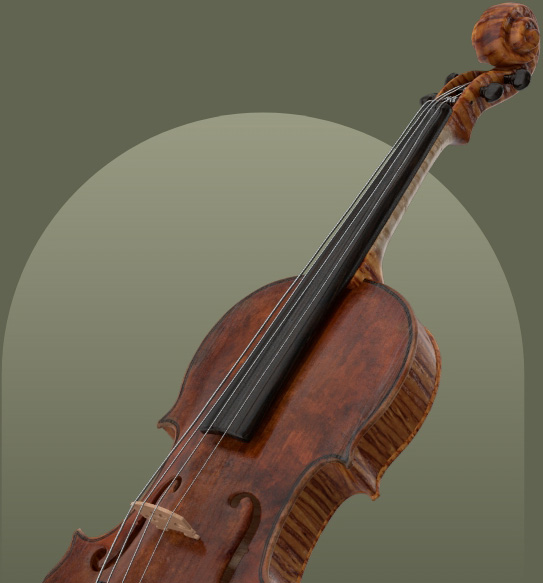
Joseph Alexander Riedel
1810–1866
Joseph Alexander Riedel (1810-1866) was a Polish-born, self-taught violin maker who transitioned from cabinet making to full-time instrument production in 1850. Initially inspired by a repair for Dr. Kessler, who became his patron, Riedel developed a mastery of violin making, studying and copying classical Cremonese and Tyrolean models. Despite conflicting accounts of his prolificacy, his instruments are noted for their meticulous craftsmanship, though his golden-yellow varnish was considered less refined than Italian examples. He worked in Braetz, Meseritz, and Danzig, where he died in 1866, leaving behind instruments that are now highly valued.
Request an expert valuation or learn how our global auctions achieve the highest prices for your instruments.
Auction Price History
Highest auction price
| Type | Details | Auction house | Sold | Price |
|---|---|---|---|---|
| Violin | 1861 | — | October 1993 | £187 |
No results match those filters.
Maker Overview
Life
Joseph Alexander RIEDEL (1810-1866) was born in Brojce, Poland, in 1810. He initially trained as a cabinet maker, learning the joinery trade in Glogau. In 1832, he settled as a master joiner in Braetz (Kr. Meseritz), where he acquired citizenship on December 23, 1834. His passion for violin making, which he harbored since childhood, was rekindled in the 1840s when Dr. Kessler, a district physician in Meseritz, entrusted him with a violin for repair. Riedel not only successfully repaired the instrument but also produced an unexpectedly good copy of it. Dr. Kessler became a supportive patron, providing him with textbooks on violin making and guidance. Riedel diligently studied and copied the best instruments he could acquire, combining scientific seriousness with rare manual dexterity to achieve mastery. Following the death of his wife in 1850, Riedel entirely abandoned his joinery business to focus exclusively on violin making. Early in his career, he experienced the satisfaction of recognizing one of his own violins, which a Polish count had purchased believing it to be a genuine Stradivari. In 1854, he received an award of 100 Thalers from the Royal Prussian Ministry of Commerce. On December 30, 1855, he relocated his residence to Meseritz (also known as Miedzyrzec Podlaski). While there, he continued his diligent studies and also constructed organs between 1859 and 1863. In 1863, he moved to Danzig (Gdansk), where he tragically succumbed to a cholera epidemic just three years later, in 1866.
Characteristics
- Workmanship
- Joseph Alexander Riedel's work is described as decent, with the craftsmanship on all his violins being flawless down to the smallest detail. He never produced factory goods.
- Models
- Early examples of his instruments followed the Tyrolean model. He later adopted classical Cremonese patterns, with a preference for the Guarneri model, though he also worked after Stradivari.
- Materials
- He generally used good materials for his instruments.
- Varnish
- His varnish is noted as being less good, often described as an impoverished or mostly golden-yellow, lacking the 'fire' of Italian violins.
- Production Volume
- Sources contain conflicting information regarding his production volume. John Dilworth states he was "highly prolific" and "said to have made 18 instruments every week". In contrast, Willibald Leo Lütgendorff notes that Riedel initially made about 15 violins annually during winters and later, as he made each instrument from scratch, rarely completed more than 20 instruments (violins, violas, and cellos) per year.
- Labels
- Manuscript labels were used until 1850, after which printed labels were employed, sometimes with handwritten numbers. He also copied the labels of the original instruments he imitated, adding his own inscription, such as "Joseph Riedel in Meseritz / nach Guarnerius, a 1858" or "No. 176 Josephus Riedel in Danzig / imitabat Anno 18.." Another example includes "Repariert von Josef Riedel / in Brätz 1855".
- Joseph Riedel in Meseritz
nach Guarnerius, a 1858John Dilworth - No. 176 Josephus Riedel in Danzig
imitabat Anno 18..John Dilworth - Repariert von Josef Riedel
in Brätz 1855John Dilworth
Influence and legacy
- Training: Riedel was largely self-taught in violin making.
- Mentorship: Dr. Kessler, a district physician in Meseritz, became a warm friend and patron, providing Riedel with textbooks on violin making and offering extensive support.
- Study: He diligently studied the advantages of the best instruments he could obtain, copying them with scientific earnestness.
- Awards: In 1854, he was honored with a monetary prize of 100 Thalers by the Royal Prussian Ministry of Commerce.
- Recognition: His works are now highly valued, with Willibald Leo Lütgendorff noting that his instruments are already highly paid for, and Lütgendorff himself owned a very good violin by Riedel.
Further Information
- Workshop Locations:
- Braetz (Kr. Meseritz): Settled as a master joiner in 1832.
- Miedzyrzec Podlaski (Meseritz): Worked here from 1855.
- Gdansk (Danzig): Moved here in 1863.
Biographies
The overview above is drawn from the following published accounts. Read them in the original:
John Dilworth+
RIEDEL, Joseph Alexander Born 1810, died 1866 Brojce Poland. Cabinet maker. Self-taught violin maker from 1850. Worked at Miedzyrzec Podlaski 1855 and Gdansk 1863. Highly prolific. Said to have made 18 instruments every week. Early examples on Tyrolean model. Later followed classical Cremonese patterns. Decent work but with impoverished yellow varnish. Generally good materials. Manuscript labels up to 1850; thereafter printed. Generally added an imitation label of the instrument being copied beneath his own. Joseph Riedel in Meseritz / nach Guarnerius, a 1858. No. 176 Josephus Riedel in Danzig / imitabat Anno 18.. Repariert von Josef Riedel / in Brätz 1855
Willibald Leo Lütgendorff+
Einer der besseren deutschen Geigenmacher aus der Mitte des 19. Jahrhunderts. Er erlernte ursprünglich in Glogau das Tischlerhandwerk und liess sich als Tischlermeister 1832 in Braetz (Kr. Meseritz) nieder, wo er am 23. Dec. 1834 auch das Bürgerrecht erwarb. Schon als Knabe wollte er immer Geigenmacher werden, und als ihm in den vierziger Jahren der Meseritzer Kreisphysikus Dr. Kessler eine Geige zur Reparatur anvertraute, erwachte seine alte Leidenschaft wieder. Er führte nicht nur die Reparatur zu allseitiger Zufriedenheit durch, sondern fertigte auch eine über Erwarten gelungene Copie der Geige an. Er fand nun an Dr. Kessler einen warmen Freund und Gönner, der ihm alle Lehrbücher des Geigenmachens verschaffte und ihm in jeder Weise an die Hand ging. Er suchte die besten Instrumente, deren er habhaft werden konnte, zu copiren, studirte ihre Vorzüge mit Eifer und wissenschaftlichem Ernste, und unterstützt von einer seltenen Handgeschicklichkeit brachte er es bald zur vollen Meisterschaft. Als 1850 Riedel’s Frau starb, gab er seine Tischlerei ganz auf und verlegte sich von da an ausschliesslich auf das Geigenmachen. Schon in den ersten Jahren seiner Kunstübung hatte er die Genugthuung, dass ihm von einem polnischen Grafen eine Geige gezeigt wurde, die dieser als echte Stradivari gekauft hatte, die Riedel aber sofort als seine eigene Arbeit erkannte. Im Jahre 1854 wurde er vom kgl. preuss. Handelsministerium durch eine Geldprämie von 100 Thalern ausgezeichnet und verlegte am 30. Dec. 1855 seinen Wohnsitz in die Kreishauptstadt Meseritz. Dort arbeitete er, fleissig studirend, weiter und baute von 1859 1863 auch Orgeln. In letztgenanntem Jahre siedelte er nach Danzig über, wo er leider schon nach drei Jahren der Choleraepidemie zum Opfer fiel. Im Anfang betrieb er das Geigenmachen ganz wie die alten Tyroler Meister, indem er im Winter jährlich etwa 15 Geigen machte, mit denen er dann im Sommer auf Reisen ging; aber auch später arbeitete er mit grösster Sorgfalt, so dass er, da er jedes Instrument von Grund aus selbst machte, im Jahre selten über 20 Instrumente (Violinen, Bratschen und Violoncelli) fertigmachte. So ist die Arbeit an allen seinen Geigen bis ins Kleinste tadellos; weniger gut ist sein Lack, der (meist goldgelb) nicht das Feuer der italienischen Geigen besitzt. Er bevorzugte das Guarneri-Modell, arbeitete aber auch nach Stradivari. Im Anfange schrieb er seine Zettel; später verwendete er auch gedruckte Zettel mit handschriftlich hinzugefügter Nummer, oder er copirte den Zettel des Originalinstruments, das ihm als Vorlage diente, und setzte geschrieben oder gedruckt darunter: »Josephus Riedel in Meseritz (Danzig) imitabat Anno 18 . .« Eine Geige, die nicht so gut war, wie er es verlangte, Anerkennung, so dass sein Idealismus um so höher anzAnerkennung, so dass sein Idealismus um so höher anzuschlagen ist, da er sich nie dazu hergab Fabrikwaare herzustellen. Heute werden seine Arbeiten bereits theuer bezahlt. Eine sehr gute Violine von ihm besitze ich selbst.
Sell your instrument with Amati
Get started by uploading photos of your instrument for our experts to review.
Sell your instrument with Amati
Get started by uploading photos of your instrument for our experts to review.