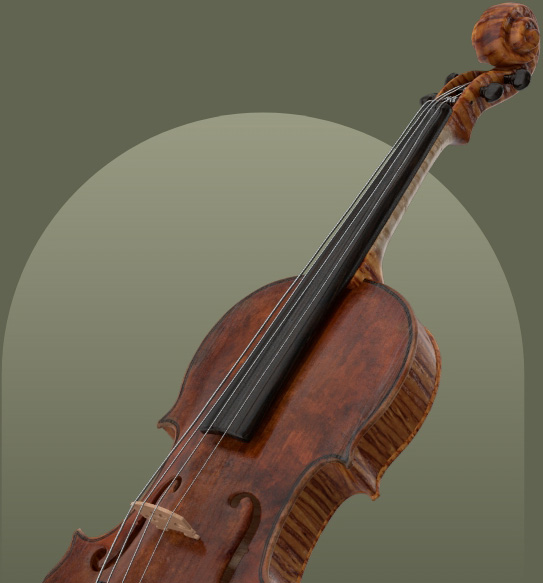
Giuseppe ROCCA
Auction price history
Highest auction price
£210,500
| Type | Details | Sold | Price |
|---|---|---|---|
| Violin | 35.8 cm Turin, 1855 c. [Possibly by] | June 2011 | £24,000 |
| Violin | 35.6 cm [Ascribed to] | May 2011 | £27,313 |
| Violin | 35.8 cm 19th C. [Attributed to] | March 2011 | £31,250 |
| Violin | 35.4 cm Turin, 1850 | October 2010 | £169,250 |
| Violin | 35.4 cm Turin, 1832 c. [Ascribed to & possibly by] | April 2010 | £82,488 |
| Violin | 35.5 cm Turin, 1855 c. | May 2009 | £112,579 |
| Violin | 35.8 cm 19th C. [Attributed to] | March 2009 | £30,000 |
| Violin | 36.1 cm 1860 c. [Attributed to] | November 2008 | £24,000 |
| Violin | 35.4 cm Turin, 1850 c. | October 2008 | £145,000 |
| Violin | 35.7 cm Probably Turin, [Attributed to] | May 2008 | £13,770 |
| Violin | 35.9 cm Italy 19th C. [Ascribed to] | February 2006 | £14,400 |
| Violin | Turin, 1837 [Workshop] | May 2005 | £19,374 |
| Violin | Turin 1850 | November 2004 | £140,000 |
| Violin | [Ascribed to] | March 2004 | £33,600 |
| Violin | 1846 | July 2003 | £100,800 |
| Cello | 1845 | May 2001 | £144,056 |
| Violin | 1845 | November 2000 | £91,500 |
| Violin | 1845 | November 2000 | £80,500 |
| Violin | 1851 | November 2000 | £126,950 |
| Violin | 1849 | March 2000 | £133,500 |
| Violin | 1843 | November 1999 | £128,000 |
| Violin | 1861 | October 1995 | £43,300 |
| Violin | 1854 c. | March 1995 | £104,900 |
| Violin | 1861 | March 1995 | £87,300 |
| Violin | 1857 | November 1994 | £62,000 |
| Cello | 1854 | November 1994 | £210,500 |
| Violin | 1853 | November 1993 | £82,900 |
| Violin | 1854 | April 1993 | £78,500 |
| Violin | 1852 | November 1992 | £99,000 |
| Violin | 1854 | March 1992 | £60,500 |
| Violin | 1859 | November 1991 | £82,500 |
| Violin | 18-- | June 1990 | £66,000 |
| Violin | 1850 | March 1990 | £94,600 |
| Violin | 1854 | November 1989 | £11,550 |
| Violin | 1841 | November 1989 | £99,000 |
| Violin | 1863 | November 1988 | £46,200 |
| Cello | 1838 | November 1987 | £57,200 |
| Violin | 1848 c. | November 1987 | £20,900 |
| Violin | 1856 | April 1987 | £33,000 |
| Violin | 1860 | March 1986 | £25,920 |
| Violin | 1850 | March 1986 | £15,172 |
| Violin | 1845 | November 1985 | £35,200 |
| Violin | 1850 | November 1985 | £28,080 |
| Violin | 1864 | July 1985 | £26,400 |
| Violin | 1847 | April 1985 | £50,600 |
| Violin | 1850 | April 1985 | £33,000 |
| Violin | 1842 | November 1984 | £33,000 |
| Violin | 1840-50 | October 1984 | £7,150 |
| Violin | 1856 | June 1984 | £19,242 |
| Violin | 1860 | June 1984 | £7,244 |
| Violin | 1857 | April 1984 | £13,006 |
| Violin | 1857 | March 1984 | £23,100 |
| Violin | 1859 | June 1983 | £17,280 |
| Violin | 1860 | November 1981 | £10,098 |
| Violin | 1845 | May 1980 | £17,050 |
Maker Overview
History
Giuseppe Rocca (1807-1865) was born in 1807 in Barbaresco, Alba, and died in 1865 in Genoa, Italy. According to John Dilworth in The Brompton’s Book of Violin & Bow Makers, he was a pupil and assistant of Pressenda, whom he may have encountered in Alba between 1814 and 1817. Karel Jalovec, in Italian violin makers, states that Rocca worked with his father as a baker until the age of twenty before becoming Pressenda's apprentice. He worked with Pressenda in Turin between 1820 and approximately 1835. Charles Beare (Grove) is cited by Dilworth as noting two virtually identical violins dated 1839, one bearing Pressenda’s label and the other Rocca’s. In 1844, he was awarded a copper medal at the 4th Turin exhibition, at which time he was living in via Po, Turin, and referred to as a pupil of Pressenda.
Giuseppe Rocca established himself independently by 1850, working in Contrada d’Angennes, Turin. He was a colleague of the dealer and connoisseur Luigi Tarisio. In 1851, he made a copy of the 1716 Stradivari ‘Messie’ violin while it was in Tarisio's possession, possibly being the first luthier to do so. Following Pressenda’s death in 1854, Rocca moved to Genoa where he encountered Gibertini and Bianchi; his work is noted by Dilworth to have begun to decline slightly after this move.
Craft
- Innovation: Giuseppe Rocca possibly became the first luthier to copy the 1716 Stradivari ‘Messie’ violin when he did so in 1851 while the instrument was owned by Luigi Tarisio.
- Materials: Karel Jalovec notes that Rocca used very good wood, and frequently made the back of his instruments from a single piece. Willibald Leo Lütgendorff also notes his use of beautiful wood, often for one-piece backs.
- Methods: Rocca executed extremely fine work on Stradivari and Guarneri models. According to Dilworth, his Guarneri pattern was taken from the ‘Alard’ of 1742, an instrument also in Tarisio's possession. Jalovec adds that he also worked on Maggini patterns and learned a great deal about tone from his master, Pressenda. Rocca followed Cremonese construction closely, utilizing pins set close under the purfling at each end of the back, and willow interior work with the linings morticed to the corner blocks. The only typically Turin characteristic he retained was the sharply marked centre line around the pegbox and scroll. Cécile Stainer describes his work as carefully finished, with a well-cut scroll. Jalovec specifies his scrolls were large like Pressenda's, tasteful, and the shape of his sound-holes beautiful, with suitably located purfling. Dilworth notes that his early work sometimes featured a thin dark red varnish recipe, which was among his least attractive varnishes. Later instruments are described as extremely sophisticated. Regarding varnish, sources present conflicting information: Cécile Stainer states the varnish is of poor quality. Karel Jalovec describes it as yellow, red, brown, or red-brown, of excellent qualities. Willibald Leo Lütgendorff, in Die Geigen- und Lautenmacher vom Mittelalter bis zur Gegenwart, notes that "sein Lack ist weniger gut und oft zu dick, am besten der von rothbrauner Farbe" [his varnish is less good and often too thick, best of the reddish-brown color]. Henri Poidras mentions a "fine red varnish a little thick." Lütgendorff further notes his adeptness at making very good copies of old masters like Stradivari, Maggini, and Guarneri. His instruments are said to have a very rich tone with great carrying power by Jalovec, and a large, noble tone by Lütgendorff. Poidras observes that the outlines of his instruments are harmonious, but the edges are a little heavy and curved up.
Influence
- Training and Mentorship: Giuseppe Rocca was a pupil and assistant of Pressenda, working in his style and approaching him very closely, as noted by Lütgendorff. Jalovec specifically mentions that Rocca learned a great deal from Pressenda, especially regarding tone. His son, Enrico, and A. Montovani were his pupils.
- Schools/Tradition: Rocca's work is considered to be in the style of Pressenda. He closely followed Cremonese construction methods, departing from most typical Turin characteristics, except for retaining the sharply marked centre line around the pegbox and scroll.
- Notable Associations: He was a colleague of the well-known dealer and connoisseur Luigi Tarisio. In Genoa, he encountered other makers, Gibertini and Bianchi.
Legacy
- Modern Recognition: Dilworth notes that Rocca's later instruments are extremely sophisticated and are considered among the very best Italian instruments of the 19th century. His authentic work is generally of a level that is difficult to reproduce, and many workshops continued to make copies of Rocca’s work, often falsely labelled, well into the 20th century.
Further Information
- Technical Characteristics: Giuseppe Rocca branded his instruments internally with ‘G.R.’ Known labels include: "Joseph Antonius Rocca / Taurini 1830," "Joseph Rocca fecit / Taurini anno Domini 1843," and "Joseph Rocca fecit / Premiato di Medaglie alle Esposizione / di Torino, Genova, Londra e Parigi. / Taurini, Anno Domini 1858." Cécile Stainer records a label from 1841: "Joseph Antonio Rocca fecit Taurini, anno Domini 1841," and mentions other known violins dated 1839, 1851, and 1855.
- Historical Uncertainties: Dilworth indicates that Rocca "may have encountered Pressenda in Alba" during 1814-1817, highlighting a degree of uncertainty regarding their initial meeting. Furthermore, he is noted as "possibly the first luthier to" copy the 1716 Stradivari ‘Messie’. Karel Jalovec cautions that "Many instruments dated 1831 are fakes." There is also conflicting information regarding the quality and specific characteristics of his varnish across different sources. Willibald Leo Lütgendorff clarifies a common misreading, stating: "Den Namen Rotta zu lesen und dann Rota daraus zu machen, ist falsch." [To read the name Rotta and then make Rota out of it is wrong.]
Summary
Giuseppe Rocca, born in 1807 in Barbaresco, Alba, and deceased in 1865 in Genoa, was a significant Italian violin maker of the 19th century. Initially a pupil and assistant of Pressenda in Turin, he eventually established his own workshop, receiving a copper medal at the Turin exhibition in 1844. Known for his extremely fine craftsmanship on Stradivari, Guarneri, and Maggini models, Rocca was innovative, possibly being the first to copy the 1716 Stradivari ‘Messie’. He employed high-quality wood, often for one-piece backs, and adhered closely to Cremonese construction methods, though he retained the sharply marked centre line around the pegbox and scroll as a characteristic of Turin work. While there are differing accounts of his varnish quality, his later instruments are celebrated for their sophistication, placing them among the very best Italian instruments of their era. His pupils included his son, Enrico, and A. Montovani, and his authentic work is highly regarded and difficult to reproduce.
Biographies
John Dilworth
ROCCA, Giuseppe b. 1807 Barbaresco, Alba, died 1865 Genoa Italy. Pupil and assistant of Pressenda, whom he may have encountered in Alba when Pressenda was there 1814-1817. Established with Pressenda in Turin between 1820 and c.1835. Charles Beare (Grove) cites two virtually identical violins dated 1839, one bearing Pressenda’s label, the other with that of Rocca. Awarded copper medal at 4th Turin exhibition 1844. At that time living in via Po, Turin and referred to as a pupil of Pressenda. Established independently by 1850, working in Contrada d’Angennes. A colleague of the dealer and connoisseur Luigi Tarisio, in 1851 made a copy of the 1716 Stradivari ‘Messie’ violin while it was in his possession, possibly the first luthier to do so. Following the death of Pressenda in 1854, moved to Genoa where he encountered Gibertini and Bianchi, and his work began to decline slightly. Pupils were his son, Enrico, and A. Montovani. Extrememly fine work on Stradivari and Guarneri models, the Guarneri pattern taken from the ‘Alard’ of 1742, an instrument also in the possession of Tarisio. Early work is very Rocca like, sometimes with the least attractive of his varnishes; a thin dark red recipe. Later instruments are extremely sophisticated, and are amongst the very best Italian instruments of the 19th century. He followed Cremonese construction closely, using pins set close under the purfling at each end of the back, and willow interior work with the linings morticed to the corner blocks. The only typically Turin characteristic he retained was the sharply marked centre line around the pegbox and scroll. Many workshops continued to make copies of Rocca’s work well into the 20th century, and these are often falsely labelled. However, authentic work is generally of a level that is difficult to reproduce. Branded internally: ‘G.R.’ Joseph Antonius Rocca / Taurini 1830 Joseph Rocca fecit / Taurini anno Domini 1843 Joseph Rocca fecit / Premiato di Medaglie alle Esposizione / di Torino, Genova, Londra e Parigi. / Taurini, Anno Domini 1858
Sell your instrument with Amati
Get started by uploading photos of your instrument for our experts to review.
Sell your instrument with Amati
Get started by uploading photos of your instrument for our experts to review.