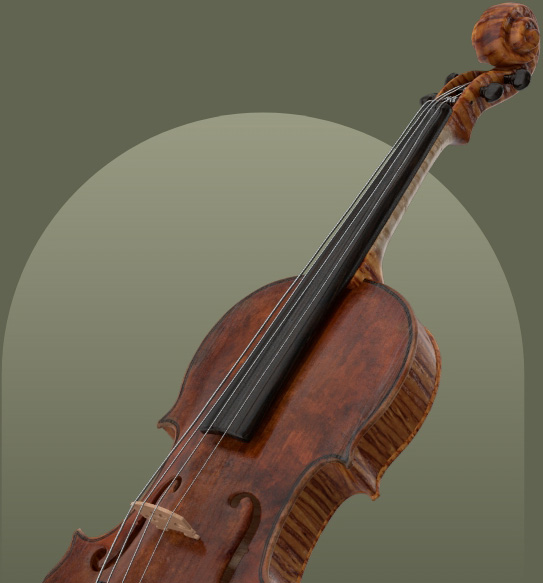
Lucien Schmitt
Grenoble, b. 1892
Lucien Schmitt (1892-after 1949) was a distinguished luthier who initially trained as a violinist before dedicating himself to instrument making. He studied with Mougenot in Mirecourt and Bazin for bow making, gaining further experience with prominent workshops in Geneva, Lyons, Nice, and Paris. After serving in World War I, he established his own workshop in Grenoble in 1922, later moving to Meylan. Schmitt developed three distinct models, including personal designs and those inspired by Amati and Guarneri, and was known for his fine workmanship, one-piece backs, and gold-red oil varnish. His son, Jean Frédéric Schmitt, assisted him in later years.
Request an expert valuation or learn how our global auctions achieve the highest prices for your instruments.
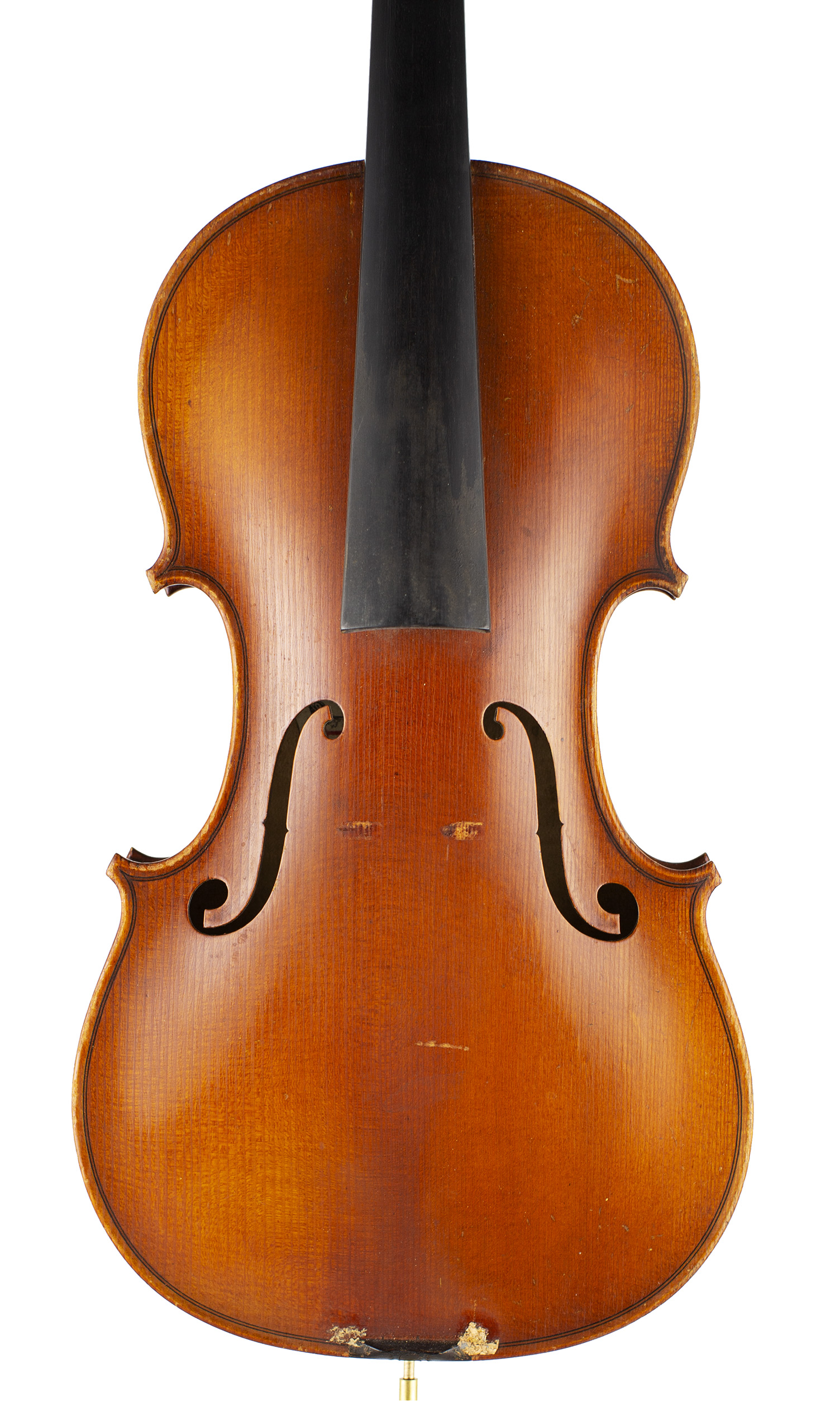
Instruments
Auction Price History
Highest auction price
56 results
| Type | Details | Auction house | Sold | Price |
|---|---|---|---|---|
| Violin | Bearing the maker's label and brands Lot 11 | Vichy | December 2025 | £3,609est. € 2.500-3.000 |
| Violin | Labelled Instrument dessiné et entièrement exécuté par Lucien Schmitt Violinier d'Art à Grenoble Lot 67 | Ingles & Hayday | October 2025 | £6,000est. £ 5,000-7,000 |
| Violin | Bearing the maker's label n. 4 and signature to the back Lot 74 | Vichy | June 2025 | £2,598est. € 2.000-3.000 |
| Violin | Labelled Lucien Schmitt, violonier d'art, à Grenoble, instrument dessiné, et entièrement executé par ... Lot 122 | Tarisio | October 2024 | £4,514est. € 4.000-6.000 |
| Violin | Bearing the maker's label n. 209 and brand, good condition Lot 4 | Laurent | June 2024 | £4,893est. € 2.000-3.000 |
| Violin | Labelled Lucien SCHMIT, Luthier à ..., one-piece back, ribs and head similar, table of regular grain Lot 29 | Millon & A. | May 2024 | £2,655est. € 1.500-2.000 |
| Violin | Labelled Troisième violon de ce modèle dessiné et, entièrement exécuté par, Lucien Scmitt, luthier à ... Lot 89 | Tarisio | February 2024 | £5,635est. € 4.000-6.000 |
| Violin | Bearing the maker's label Lot 803 | Vichy | November 2023 | £4,334est. € 1.500-2.000 |
| Violin | Bearing the maker's label n. 49 an brand Lot 19 | Vichy | November 2023 | £4,541est. € 3.000-3.500 |
| Violin | A violin by Lucien Schmidt, Grenoble, 1934 Lot 78 | Amati | June 2023 | £3,792est. £ 2,000-4,000 |
| Violin | Labelled Lvcien Schmitt Luthier à Grenoble 1925, Tables accordées: tierce mineure Z NoIV, LSG ... Lot 90 | Tarisio | March 2023 | £8,454est. $ 4,000-6,000 |
| Violin | Labelled Lucien Schmitt n. 221 Lot 72 | Vichy | December 2022 | £3,213est. € 3.000-4.000 |
| Violin | Bearing the maker's label and signature Lot 505 | Vichy | November 2022 | £3,526est. € 1.500-2.000 |
| Viola | Bearing the maker's label and brand Lot 58 | Vichy | December 2021 | £6,860est. € 4.000-5.000 |
| Violin | Bearing the maker's label n. 181 and signatures Lot 352 | Vichy | December 2021 | £2,850est. € 1.500-2.000 |
| Viola Bow | Silver mounted, octagonal stick stamped Nicolas Delaune a Lyon Lot 160 | Brompton’s | January 2021 | £960est. £ 800-1,200 |
| Violin | Bearing the maker's label n. 124 and brands to the lower rib and internally, one-piece back Lot 55 | De Baecque | November 2020 | £3,409est. € 2.500-3.000 |
| Violin | Labelled Lucien Schmitt, Luthier à Grenoble - 1935 - No 135, branded to the lower rib L. S. G. Lot 167 | Tarisio | November 2018 | £5,937est. $ 2,500-4,000 |
| Violin | Labelled Lucien Schmitt, Grenoble, L'an 1935, no. 394 Lot 1449 | Gardiner Houlgate | June 2018 | £816est. £ 300-500 |
| Violin | Bearing the maker's label n. 225 and signature Lot 168 | Vichy | June 2017 | £1,357est. € 1.500-2.000 |
| Violin | Maker's label, one-piece back, varnish of a red brown colour on a golden ground Lot 90 | Apollium | June 2017 | £1,816est. € 2.000-3.000 |
| Violin | Labelled Lucien Schmidt, Violonier d'Art Grenoble, 1959, no. 62 Lot 29 | Brompton’s | December 2016 | £1,680est. £ 1,000-1,500 |
| Violin | Labelled Lucien Schmitt, elève de L. Mougenot, ex ouvrier des 1res maisons de, Genève Paris & Lyon ... Lot 110 | Tarisio | October 2016 | £4,800est. £ 2,500-4,000 |
| Violin | N. 78, Mieulx ne scay model Lot 91 | Crédit Municipal | September 2016 | £2,366est. € 2.500-3.500 |
| Violin | Bearing the maker's label n. 210 and signature Lot 367 | Vichy | June 2016 | £1,037est. € 1.500-2.000 |
| Violin | Bearing the maker's label and brand Lot 372 | Vichy | June 2016 | £2,357est. € 3.000-4.000 |
| Violin | Bearing the maker's label n. 99 and brand Lot 122 | Vichy | December 2015 | £3,578est. € 3.000-3.500 |
| Violin | Bearing the maker's label and brands Lot 23 | Vichy | December 2014 | £1,978est. € 2.000-3.000 |
| Violin | Bearing the maker's label n° 88 and brand Lot 406 | Vichy | December 2014 | £2,260est. € 2.000-3.000 |
| Viola | Mieux ne scay model, no. 45 Lot 3 | Crédit Municipal | October 2014 | £4,678est. € 10.000-12.000 |
| Violin | Bearing the maker's label and brand Lot 114 | Vichy | June 2014 | £3,870est. € 3.000-4.000 |
| Violin Bow | Silver mounted, stick stamped LUCIEN SCMITT, Hill style ebony frog Lot 21 | Crédit Municipal | October 2013 | £1,059est. € 700-900 |
| Violin | Labelled Modele Amati - Vernis formule personnelle, Lucien Schmidt, Luthier a Grenoble, 1926, No. 63 Lot 234 | Tarisio | October 2013 | £3,763est. $ 5,000-8,000 |
| Violin | Bearing the maker's label n° 195 and brand Lot 119 | Vichy | June 2012 | £2,717est. € 1.800-2.000 |
| Violin | Bearing the maker's label and brand Lot 154 | Vichy | June 2012 | £3,397est. € 2.600-3.000 |
| Violin | 36.1 cm Grenoble, 1940 c. Workshop of | — | July 2011 | £955 |
| Violin | 30.8 cm Grenoble, 1955 1/2 size Workshop of | — | December 2010 | £380 |
| Violin | 35.8 cm 1963 | — | November 2008 | £5,040 |
| Violin | 35.4 cm Grenoble, 1929 Workshop | — | December 2007 | £1,361 |
| Violin | 35.4 cm Grenoble, 1924 | — | July 2007 | £1,682 |
| Violin Bow | S/E 60.0 g. | — | May 2007 | £1,589 |
| Violin | 35.9 cm Grenoble, 1963 | — | March 2007 | £1,725 |
| Violin Bow | S/E 61.0 g. | — | March 2007 | £1,495 |
| Violin | 35.3 cm Grenoble, 1924 | — | November 2006 | £844 |
| Violin | 35.4 cm Grenoble, 1924 | — | July 2006 | £1,873 |
| Violin | Grenoble, 1935 | — | November 2005 | £1,263 |
| Violin | Grenoble, 1966 | — | May 2005 | £2,400 |
| Violin | 1964 | — | June 2001 | £3,000 |
| Violin | 1977 | — | June 2001 | £2,160 |
| Violin | 1926 | — | March 2001 | £1,175 |
| Violin | 1924 | — | November 2000 | £1,840 |
| Violin | 1936 | — | November 1999 | £2,875 |
| Violin Bow | S/E 62 g. | — | June 1998 | £920 |
| Viola | 41.1 cm 1960 | — | March 1998 | £3,450 |
| Violin | 1924 | — | June 1990 | £1,980 |
| Violin | 1936 | — | June 1988 | £1,540 |
No results match those filters.
Maker Overview
Life
Lucien SCHMITT (1892-after 1949). Sources contain conflicting information regarding his birthplace; he was born in 1892 either in Geneva, Switzerland's The Brompton's Book of Violin & Bow Makers, or at Saint-Julien-en-Genevois in Critical & Documentary Dictionary Of Violin Makers Old & Modern. He died after 1949 in Maylan, France. Schmitt initially pursued a career as a violinist, studying at the Geneva Conservatoire or the Ecole Artistique de Musique at Geneva, where he earned a first prize with commendations from examiners. He subsequently trained as a luthier for two years in Mirecourt with Mougenot, or Mougenot-Jacquet-Gand, and received instruction in bow making from Bazin. His professional experience included working for Vidoudez in Geneva, Lorange in Lyons, Madame Bovis in Nice, and for Caressa and Français in Paris. During World War I, he served as a soldier, was wounded, and received several decorations. Schmitt established his independent workshop in Grenoble from 1922, later relocating to Meylan in 1941. In his later years, he was assisted by his son, Jean Frédéric Schmitt, who was born in 1937.
Characteristics
- Models
- Lucien Schmitt developed three distinct models: two were derived from the patterns of Amati and Guarneri respectively, while the third was entirely his personal creation. These models were titled 'Modèle Normal', 'Modèle de Soloiste', and 'Mieulx ne Sçay'.
- Design Preference
- After initially copying Amati, he later favored the Guarnerius model, noting its more powerful tone.
- Construction
- He crafted instrument backs entirely in one-piece.
- Varnish
- Schmitt utilized a gold-red oil varnish, which he applied either equably or in graded thicknesses.
- Workmanship
- His instruments are noted for their fine workmanship.
- Branding
- Instruments were branded internally and in the pegbox with 'L.S.' and inscribed with 'Lucien Schmitt / Luthier à Grenoble 19.. 1949 Instrument dessiné et entièrement exécuté par / Lucien Schmitt / no.120 / Violonier d'Art à Grenoble'.
- Branded internally and in the pegbox: ‘L.S.’ Lucien Schmitt
Luthier à Grenoble 19.. 1949John Dilworth - Instrument dessiné et entièrement exécuté par
Lucien Schmitt
no.120
Violonier d’Art à GrenobleJohn Dilworth
Influence and legacy
- Luthier Training: He trained for two years in Mirecourt with Mougenot, also referred to as Mougenot-Jacquet-Gand.
- Bow Making: His bow making skills were developed under the tutelage of Bazin.
- Restoration: He was admitted into the workshops of Vidoudez in Geneva to learn the art of instrument restoration.
- Family Involvement: In his later career, Lucien Schmitt was assisted by his son, Jean Frédéric Schmitt, who was born in 1937.
Further Information
- Workshop Locations: Lucien Schmitt established his independent workshop in Grenoble from 1922, subsequently moving to Meylan in 1941.
- Professional Engagements: Prior to establishing his own workshop, he worked for Vidoudez in Geneva, Lorange in Lyons, Madame Bovis in Nice, and for Caressa and Français in Paris.
Biographies
The overview above is drawn from the following published accounts. Read them in the original:
John Dilworth+
SCHMITT, Lucien Born 1892 Geneva Switzerland, d. after 1949 Maylan France. Studied the violin at Geneva conservatoire. Trained for two years as a luthier in Mirecourt with Mougenot. Studied bow making with Bazin. Worked for Vidoudez in Geneva, Lorange in Lyons, Madame Bovis in Nice, and Caressa and Français in Paris. Wounded during World War I. Established independently in Grenoble from 1922, moving to Meylan 1941. Assisted in later years by his son Jean Frédéric Schmitt (Born 1937). Three models: two derived from Amati and Guarneri respectively and a third entirely personal. These are titled ‘Modèle Normal’, Modèle de Soloiste’ and ‘Mieulx ne Sçay’. Fine workmanship. Branded internally and in the pegbox: ‘L.S.’ Lucien Schmitt / Luthier à Grenoble 19.. 1949 Instrument dessiné et entièrement exécuté par / Lucien Schmitt / no.120 / Violonier d’Art à Grenoble
Henri Poidras+
Born at Saint-Julien-en-Genevois in 1892. Was at first drawn towards the violin, wishing to take it up professionally. To that end, he studied at the Ecole Artistique de Musique at Geneva, where he obtained a first prize, with congratulations from the examiners. Soon becoming enthusiastic about violin-making, he went to Mirecourt and stayed two years with Mougenot-Jacquet-Gand, being initiated into bow making by Bazin. He was then admitted into the workshops of Vidoudez at Geneva to learn restoring, and afterwards joined Lorange in Lyons. Was a soldier in the War and won several decorations. Since then he has worked in Geneva with Vidoudez, in Paris for A. Caressa and in Nice for Mme. Bovis. After having copied Amati, he gave preference to the Guarnerius model, the tone being more powerful. He makes the backs entirely in one-piece and uses a gold-red oil varnish applied equably or in graded thicknesses.
Sell your instrument with Amati
Get started by uploading photos of your instrument for our experts to review.
Sell your instrument with Amati
Get started by uploading photos of your instrument for our experts to review.