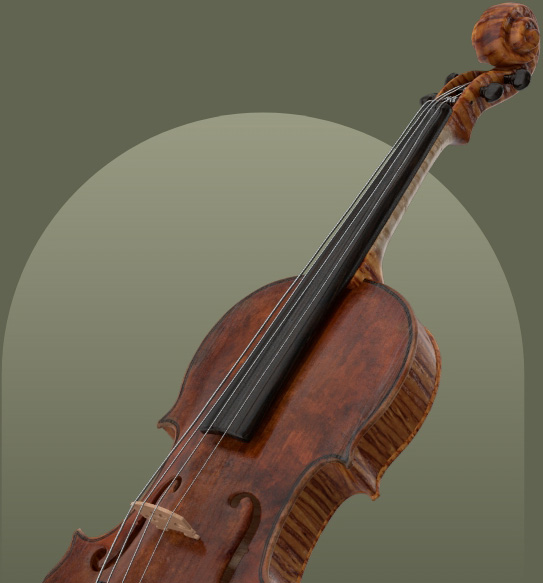
Nicolas Simoutre
1788–1870
Nicolas SIMOUTRE (1788-1870) was a French luthier born in Mirecourt and trained by Nicolas Lupot in Paris. He established his workshop in Mirecourt, with sources differing on whether this was in 1817 or 1820. He later moved to Metz around 1844, where he died in 1870. SIMOUTRE was a prolific maker, credited with approximately 1,000 violins and cellos, known for his good class instruments, often following Stradivari and Guarneri models with a large pattern. His work was accurate, though his spirit varnish was noted for being somewhat dry or thin. Sources provide conflicting accounts of his production focus after 1838, with some stating he made only guitars and others indicating he made only violins. His son, Nicolas Eugene, also became a maker.
Request an expert valuation or learn how our global auctions achieve the highest prices for your instruments.
Maker Overview
Life
Nicolas SIMOUTRE (1788-1870) was born in Mirecourt., he was a pupil of Lupot. John Dilworth specifies that he was born in Mirecourt in 1788 and died in Metz, France, in 1870, having been apprenticed to Lupot in Paris. Willibald Leo Lütgendorff also confirms he was a pupil of Nicolas Lupot in Paris. Sources contain conflicting information regarding the establishment of his workshop in Mirecourt; John Dilworth and Willibald Leo Lütgendorff state he established his workshop in Mirecourt from 1817, while Cecie Stainer indicates he began his business as a violin maker in 1820. He moved to Metz around 1844, or in the early 1840s. Cecie Stainer states he settled in Metz in 1844 and worked there until his death. Willibald Leo Lütgendorff adds that he died in Metz during a siege, while other sources simply state his death year as 1870.
Characteristics
- Production
- Nicolas SIMOUTRE is credited by John Dilworth with making around 1,000 violins and cellos between 1817 and 1838. Willibald Leo Lütgendorff also notes his immense diligence, having made about a thousand violins and cellos.
- Models and Pattern
- Henri Poidras describes his instruments as good class, with a pattern that is a little large, and states he worked after the Stradivarius model. John Dilworth mentions his good Cremonese models and accurate work. Willibald Leo Lütgendorff states he preferred a large pattern and copied all masters, primarily Stradivari and Guarneri.
- Materials
- Willibald Leo Lütgendorff notes that his wood was good but rarely beautiful.
- Varnish
- Henri Poidras observed a little dryness in his varnish. John Dilworth describes it as a thin spirit varnish. Willibald Leo Lütgendorff also states his spirit varnish was not particularly praiseworthy.
- Specialization
- Sources contain conflicting information regarding his production after 1838., he ceased working on bowed instruments and made only guitars from 1838. However, Willibald Leo Lütgendorff states that in the first years of his independence, he mostly made guitars for Parisian and foreign houses, but since 1838, he made only violins.
- Nicolaüs Simoutre
Lupot Nicolaï discipulus
Divoduri fecit 18..John Dilworth - Réparé par Simoutre à Metz
en 1862John Dilworth
Influence and legacy
- Training: Nicolas SIMOUTRE was a pupil of Lupot, and apprenticed to Nicolas Lupot in Paris.
- Assistants: Willibald Leo Lütgendorff highlights that as a capable master, he soon attracted the most talented assistants, including the Vuillaume brothers and Mougenot.
- Family: Cecie Stainer notes that his son, Nicolas Eugene, was also a maker.
Further Information
- Labels: John Dilworth provides examples of his labels, including "Nicolaüs Simoutre / Lupot Nicolaï discipulus / Divoduri fecit 18.." and "Réparé par Simoutre à Metz / en 1862".
Biographies
The overview above is drawn from the following published accounts. Read them in the original:
John Dilworth+
SIMOUTRE, Nicolas Born 1788, Worked Mirecourt, died 1870 Metz France. Apprenticed to Lupot in Paris. Established in Mirecourt from 1817. Prolific maker up until 1838 when he ceased working on bowed instruments and made only guitars. Moved to Metz c.1844. Credited with around 1,000 violins and cellos made between 1817 and 1838. Good Cremonese models. Accurate work but thin spirit varnish. Nicolaüs Simoutre / Lupot Nicolaï discipulus / Divoduri fecit 18.. Réparé par Simoutre à Metz / en 1862
Cecie Stainer+
b. 1788, at Mirecourt ; d. 1870, at Metz. He began his business as a violin maker in 1820, in 1844 settled in Metz and worked there till his death. His son, Nicolas Eugene, was also a mak
Willibald Leo Lütgendorff+
Schüler von Nicolas Lupot in Paris. Im Jahre 1817 begründete er seine Werkstatt in Mirecourt. Da er ein tüchtiger Meister war, hatte er bald einen Zulauf der talentvollsten Gehilfen, von denen die Brüder Vuillaume und Mougenot hervorgehoben werden müssen. In den ersten Jahren seiner Selbstständigkeit machte er meist Guitarren für Pariser und ausländische Häuser, seit 1838 aber nur mehr Violinen. Anfangs der vierziger Jahre des 19. Jahrhunderts siedelte er nach Metz über, wo er während der Belagerung starb. Er war ungemein fleissig und hat an tausend Violinen und Violoncelli gemacht. Er bevorzugte ein grosses Patron und copirte alle Meister, hauptsächlich aber Stradivari und Guarneri. Sein Holz ist gut, aber selten schön; auch sein Spirituslack ist nicht besonders zu loben.
Henri Poidras+
Born at Mirecourt. Pupil of Lupot. This maker has left good class instruments. His pattern is a little large and he worked after the ?Stradivarius model. Objection may be made to a little dryness in his varnish, but on the whole, his make is good.
Sell your instrument with Amati
Get started by uploading photos of your instrument for our experts to review.
Sell your instrument with Amati
Get started by uploading photos of your instrument for our experts to review.