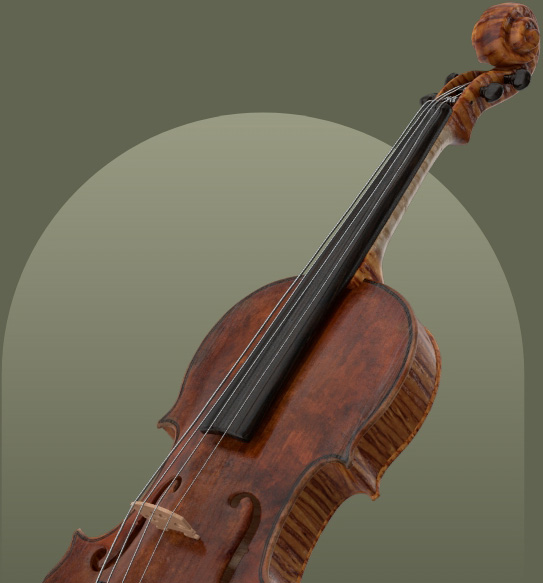
Johann Joseph Stadlmann
Vienna, 1720–1781
A prominent Viennese luthier, Johann Joseph STADLMANN (1720-1781) was the son, pupil, and successor of Daniel Stadlmann. He was appointed luthier to the Viennese court and was known for carefully copying the Stainer model, often with high arching. While sources offer varying assessments of his overall merit, his instruments are noted for their good tone, though his dark red-brown varnish is often criticized. His work sometimes showed Stradivari influence in later years, and examples of his violas, cellos, Viola di Bordone, and Viola d'amore are known.
Auction Price History
Highest auction price
15 results
| Type | Details | Auction house | Sold | Price |
|---|---|---|---|---|
| Violin | Bearing the maker's label, not original head, some table and ribs restauration Lot 703 | — | November 2023 | £3,033est. € 1.500-2.000 |
| Viola | Labelled Joann Joseph Stadlmann kayserl. königl. Hof Lauten und Geigenmacher in Wienn 1753 Lot 131 | — | November 2022 | £7,800est. £ 6,000-8,000 |
| Cello | Labelled Joann Joseph Stadlmann Kaiserl. Königl. Hof Lauten und Geigenmacher in Wien 1767 Lot 49 | — | June 2021 | £33,600est. £ 10,000-15,000 |
| Violin | Labelled Joann Joseph, Stadlmann, Kayferk Könink, Hoflauten und Geigen, macher in Wienn 17... Lot 146 | — | March 2019 | £1,920est. £ 1,500-2,200 |
| Violin | Labelled Joann Joseph Stadtmann, Wienn, 1780, varnish modified Lot 349 | Tarisio | February 2012 | £3,035est. $ 1,800-2,500 |
| Viola | 40 cm 1775 | — | December 2011 | £5,289 |
| Violin | 35.8 cm Vienna, 1750 | — | March 2008 | £1,872 |
| Violin | 35.8 cm Vienna, 1758 | — | June 2007 | £3,206 |
| Violin | 1774 | — | March 1999 | £2,300 |
| Violin | 17-- 3/4 Size | — | December 1995 | £687 |
| Violin | 1777 | — | June 1995 | £4,025 |
| Cello | 1767 | — | November 1989 | £6,050 |
| Viola | 41.0 cm 1765 | — | June 1988 | £4,180 |
| Viola | 39.7 cm 1775 | — | June 1987 | £2,200 |
| Viola | 38.9 cm 1770 | — | November 1980 | £1,540 |
No results match those filters.
Maker Overview
Life
Johann Joseph STADLMANN (1720-1781) was born in 1720 and died in Vienna, Austria, in 1781. He was the son, pupil, and successor of Daniel Stadlmann. On December 15, 1745, he took the citizen's oath and resided in the so-called "Wübmer-Viertel," appearing in tax lists until his death. He was appointed luthier to the Viennese court. From 1781 to 1786, his widow continued the business, though a note in the tax book indicates she was "very poor, supported by her sister."
Characteristics
- Workmanship
- Johann Joseph Stadlmann worked very carefully, similar to his father, following the form. He copied the Stainer model, often taking the arching even higher., he was a "very clever maker" who copied the Stainer model "to great perfection." However, George Hart describes his work as of "average merit," and John Dilworth states it was "generally considered inferior" to his father's.
- Tone and Varnish
- The tone of his instruments is considered quite good. His brown varnish, however, is less favorably regarded, with John Dilworth describing it as "very thin dark and opaque red-brown varnish: one of the least attractive characteristics of the Viennese school."
- Models
- Some evidence suggests Stradivari influence in his later work.
- Known Instruments
- Violas and cellos are known. A Viola di Bordone from 1750 is owned by Fürst Eszterházy in Eisenstadt, Hungary. A Viola d'amore from 1756, featuring a small female head on the pegbox, is part of the royal collection in Berlin (No. 869).
- Label
- His label reads: "Joann Joseph / Stadlmann Kayserl: Konigl: / HofLauten und Geigen / macher in Wien. 1772".
- Joann Joseph
Stadlmann Kayserl: Konigl:
HofLauten und Geigen
macher in Wien. 1772John Dilworth
Influence and legacy
- Training: Johann Joseph Stadlmann was the son and pupil of Daniel Stadlmann.
- Family Continuity: After his death in 1781, his widow continued the business from 1781 to 1786.
- Collections: A Viola di Bordone from 1750 is held by Fürst Eszterházy in Eisenstadt, Hungary. A Viola d'amore from 1756 is part of the royal collection in Berlin.
Further Information
- Residence: He resided in the "Wübmer-Viertel" in Vienna.
- Appointment: He was appointed luthier to the Viennese court.
Biographies
The overview above is drawn from the following published accounts. Read them in the original:
John Dilworth+
STADLMANN, Johann Joseph Born 1720, died 1781 Vienna Austria. Son, pupil, and successor of Daniel Stadlmann, above. Appointed luthier to the Viennese court. Similar work to that of his father, but generally considered inferior. Very thin dark and opaque red-brown varnish: one of the least attractive characteristics of the Viennese school. Some evidence of Stradivari influence in later work. Violas and cellos known. Joann Joseph / Stadlmann Kayserl: Konigl: / HofLauten und Geigen / macher in Wien. 1772
Cecie Stainer+
Son of Daniel A. Stadelmann. He was a very clever maker, who copied the Stainer model to great perfection; he worked till 1764, possibly later.
George Hart+
Copied Stainer ; average merit.
Willibald Leo Lütgendorff+
Er gilt als der Sohn von Dan. Ach. St. und war wohl dessen Nachfolger. Am 15. Dec. 1745 legte er den Bürgereid ab, wohnte im sogen. »Wübmer-Viertel« und kommt bis zu seinem Tode in den Steuerlisten vor. Von 1781—1786 führte seine Witwe das Geschäft fort; ihr Mann scheint ihr nichts hinterlassen zu haben, denn ein Vermerk im Steuerbuch sagt von ihr: »ist sehr arm, wird von ihrer Schwester erhalten.« — Und doch war Joh. Jos. St. ein Künstler; er arbeitete wie sein Vater sehr sorgfältig nach der Form, ahmte das Stainer-Modell nach, nur dass er die Wölbung oft noch höher nahm. Der Ton ist recht gut; weniger ist dies bei seinem braunen Lacke der Fall. Eine Viola di Bordone von 1750 besitzt Fürst Eszterházy in Eisenstadt (Ungarn), eine Viola d’ amore von 1756 mit einem Frauenköpfchen am Wirbelkasten die kgl. Sammlung in Berlin (No. 869).
Sell your instrument with Amati
Get started by uploading photos of your instrument for our experts to review.
Sell your instrument with Amati
Get started by uploading photos of your instrument for our experts to review.