Marcus Stainer
c.1633–1693
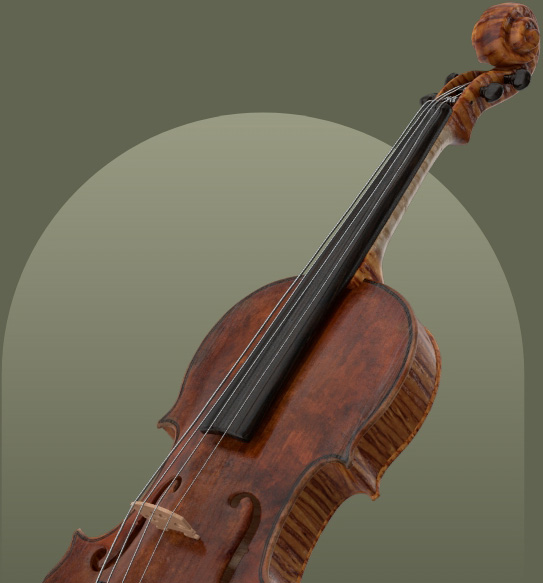
Marcus Stainer, often described as the brother and pupil of the renowned Jacob Stainer, is a figure whose historical existence is debated among scholars, with some suggesting his name was used by dealers. Despite this controversy, other sources detail his life as a violin maker working in Laufen and Kufstein, Austria. He styled himself "Citizen and Violin maker" on his labels. His craftsmanship is generally described as moderate, though some sources praise his skill in imitating Jacob's work, noting his use of fine wood, dark varnish, and a large pattern, often featuring carved heads on the scrolls. His instruments, like the violins reportedly owned by Veracini, were known for a sweet, albeit not powerful, tone.
Request an expert valuation or learn how our global auctions achieve the highest prices for your instruments.
Maker Overview
Life
Marcus Stainer (Born circa. 1633, d.c.1693) is usually described as the brother and pupil of Jacob Stainer, working in Laufen, Austria, and later in Kufstein. However in The Brompton's Book of Violin & Bow Makers, there is no supporting evidence for his existence, with Senn and Vannes suggesting the name is imaginary and used by dealers and fraudsters. Despite this, other sources detail his life and work. George Hart notes that Marcus Stainer styled himself "Citizen and Violin maker" on his labels, recognizing the honor of citizenship by including "Burger" after his name. Cecie Stainer, in A Dictionary of Violin Makers, states that he was a maker of moderate ability who, after his brother's death, made poor imitations of Jacob's work, sometimes with carefully copied labels, leading to the impression that Jacob was careless. The famous Florentine violin player, Veracini, reportedly owned two violins by Marcus Stainer, christened "St. Peter" and "St. Paul," which were unluckily lost in a shipwreck while sailing from London to Leghorn in 1746.
Characteristics
- Workmanship
- Instruments produced by Marcus Stainer are rarely met with, but are described as being of moderate ability, sometimes poor imitations of his brother's work. However, Willibald Leo Lütgendorff notes that while he did not equal his brother in talent, he was quite skilled and successfully imitated Jacob's work. Henri Poidras also describes his make as excellent, though not equal to his brother's.
- Materials and Varnish
- Cecie Stainer notes that his instruments are made of fine wood with dark varnish. Lütgendorff describes them as having reddish-yellow or reddish-brown lacquer. John Dilworth mentions finely worked instruments with dull red-brown varnish.
- Pattern and Tone
- Cecie Stainer indicates a pattern of large size, with a tone described as sweet but not powerful. Lütgendorff also notes a beautiful, large model.
- Distinctive Features
- Marcus Stainer often added carved heads to the scrolls of his instruments, a detail also mentioned by Lütgendorff.
- Specific Instruments
- A violin dated 1683 is known, and a viola from 1659 is said to have a beautiful tone. Lütgendorff specifically praises his gambas and violas.
- Marcus Stainer
bügerl: Lautten und
Geigenmacher in Küfstein
in Tyroll, 1647John Dilworth
Influence and legacy
- Mentorship: Marcus Stainer is described as a pupil of his brother, Jacob Stainer. Willibald Leo Lütgendorff suggests he might have been a pupil of the same master as Jacob.
Further Information
- Working Locations: Marcus Stainer worked in Laufen, Austria, and later in Küfstein, Tyrol.
- Labels: A viola from 1659 bears the written label: "Marcus Stainer, Burger und Geigenmacher in Küfstein, anno 1659." Another label from 1647 is cited as "Marcus Stainer / bügerl: Lautten und / Geigenmacher in Küfstein / in Tyroll," according to Senn and Vannes via John Dilworth.
- Title: He styled himself "Citizen and Violin maker," using the term "Burger" after his name to acknowledge the special privileges associated with citizenship, as noted by George Hart.
Biographies
The overview above is drawn from the following published accounts. Read them in the original:
John Dilworth+
STAINER, Marcus Born circa. 1633, d.c.1693 Küfstein Austria. Usually described as the brother of Jacob Stainer, above, but there is no supporting evidence for his existence. Senn and Vannes suggest that the name is imaginary and used by dealers and fraudsters. Instruments with this label are very much in the style of Jacob Stainer: finely worked with dull red-brown varnish. The 18th century Florentine virtuoso F. M. Veracini is said to have owned a pair of violins by Marcus Stainer which he named ‘Saint Peter’ and ‘Saint Paul’, unfortunately lost in a shipwreck in the English channel in 1746. Marcus Stainer / bügerl: Lautten und / Geigenmacher in Küfstein / in Tyroll, 1647 [Senn, Vannes]
Cecie Stainer+
Brother and pupil of Jacob Stainer; he worked in Laufen, Austria. He was a maker of moderate ability, who, after his brother’s death, made poor imitations of his work, with labels carefully copied from those of Jacob, thus giving rise to the impression that Jacob was sometimes very careless in his work. The famous Florentine violin player, Veracini, had two violins that he much valued, they were christened ” St. Peter” and ” St. Paul”, unluckily Veracini was shipwrecked sailing from London to Leghorn in 1746, and both the violins were lost. His instruments are rarely met with ; they are made of fine wood, the pattern of large size, with dark varnish, the tone sweet but not powerful; a violin is known dated 1683, and a viola, which is said to have a beautiful tone, has the written label : ” Marcus Stainer, Burger und Geigenmacher in Küfstein, anno 1659.”
George Hart+
Described as a brother of Jacob. He styled himself on his label ” Citizen and Violin maker.” Citizenship carried with it special privileges, and this maker apparently recognised the honour by having ” Burger” after his name.
Willibald Leo Lütgendorff+
Jakob Stainer hatte zwei Brüder, Paul und Markus. Paul wurde Tischler, Markus war vielleicht ein Schüler desselben Meisters, bei dem Jakob gelernt hatte. Er liess sich in Laufen und später in Kufstein als Instrumentenmacher nieder. Dass er Klosterbruder geworden sei, wie behauptet wurde, lässt sich nicht beweisen. Kam er auch seinem Bruder an Talent und Können nicht gleich, so war er doch recht geschickt und soll Jakob’s Arbeiten mit Erfolg nachgeahmt haben. Dass er seinen Namen missbraucht hat, ist nicht anzunehmen, wohl aber, dass Andere seine Arbeiten mit gefälschten Zetteln versehen haben. Die ihm zugeschriebenen Geigen haben schönes, grosses Modell, röthlichgelben oder rothbraunen Lack und sind in allen Einzelheiten tadellos ausgeführt. Am Wirbelkasten brachte auch er gerne geschnitzte Köpfchen an; namentlich seine Gamben und Violen sollen gut sein. App.-Ger.-Rath v. Renner besitzt eine Geige von ihm mit dem Zettel:
Henri Poidras+
This maker is supposed to have been a brother of Jacob Stainer. Excellent make, but not equal to that of his brother. Large model. Yellow- red or Brown-red varnish. Often added fancy carving to the scrolls of his instruments.
Sell your instrument with Amati
Get started by uploading photos of your instrument for our experts to review.
Sell your instrument with Amati
Get started by uploading photos of your instrument for our experts to review.