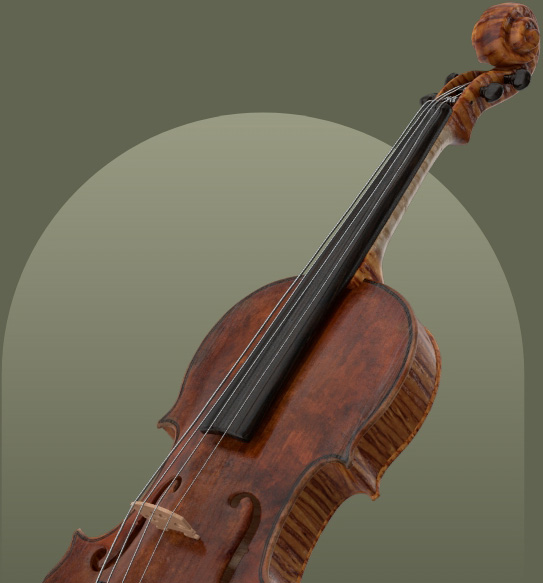
Johann Georg Stauffer
1778–1853
Johann Georg Stauffer (1778-1853) was a prominent Viennese guitar and violin maker, trained by F. Geissenhof. He operated several workshops across Vienna and was active in Kosice, Slovakia, later in his career. Stauffer was celebrated for his craftsmanship, producing instruments on Cremonese, Brescian, Stainer, Bergonzi, and Maggini models, and was considered the best Viennese guitar maker of his era by Lütgendorff. He was also an innovator, designing the arpeggione in 1833, famously associated with Schubert's sonata, and the ‘Guitarre d'amour’ in 1822. His work included experimental instruments influenced by Chanot, such as a cornerless violin and a guitar-shaped violin, some of which are preserved in museum collections.
Auction Price History
Highest auction price
| Type | Details | Auction house | Sold | Price |
|---|---|---|---|---|
| Violin | 1826 | — | April 1991 | £1,430 |
No results match those filters.
Maker Overview
Life
Johann Georg Stauffer (1778-1853)
Johann Georg Stauffer, a distinguished guitar and violin maker, was born in 1778 and passed away in 1853 in Vienna, Austria., he took the citizen's oath on June 20, 1800, and initially established his workshop at Stadt No. 150. was a pupil of F. Geissenhof and succeeded to the business of I. Bartl. His workshop locations in Vienna varied over his career, including 448 Schulhof, later 460 Setzerhof, and then 1064 Plankengasse from 1822-1824. He subsequently relocated to 1111 Neubergergasse, returning to Schulhof at no. 415 in 1825. By 1828, he had moved to 480 Rotenturm and, after 1833, established himself in Schuldenarrest. Around 1841, Stauffer was active in Kosice, Slovakia, with some instruments bearing labels from ‘Casehaii’, its Latinised form.
Characteristics
- General Craftsmanship
- John Dilworth describes his violin family instruments as very craftsmanlike, though sometimes criticized as mechanical and inconsistent.
- Models
- Stauffer produced very neat work on Cremonese and occasional Brescian models. Dilworth notes that Stainer and Bergonzi copies were reportedly among his production, while Lütgendorff adds that he successfully took the English maker William Forster as a model, in addition to Stainer and Italian masters. Maggini models are also noted for intricate purfling decoration and some carved lion’s heads.
- Experimental Instruments
- He created experimental instruments of unorthodox construction and pattern, including a ‘patent’ cornerless violin derived from Chanot. Lütgendorff mentions a guitar-shaped violin influenced by Chanot, which is preserved in the royal collection in Berlin (No. 906).
- Varnish
- Dilworth states his varnish was very variable, often appearing as a hard, glossy, and lifeless spirit recipe, though some pieces featured softer and more attractive coatings, often with shaded and aged finishes. In contrast, Lütgendorff describes his varnish as excellent.
- Scrolls
- His scrolls were typically accurately cut and well finished.
- Innovations
- Stauffer designed the arpeggione in 1833, a fretted small six-stringed cello for which Franz Schubert composed the celebrated Arpeggione Sonata. Lütgendorff also credits him with inventing the ‘Guitarre d'amour’ in 1822, an instrument played with a bow, similar to a violoncello.
- Guitar Making
- Lütgendorff considered him the best Viennese guitar maker of his time. He also crafted guitars based on other makers' models, one of which is held in the musikhistorisches Museum in Stockholm (No. 29).
- Joannes Giorgius Staufer
fecit Viennae anno 18..John Dilworth - Georg Stauffer Wien
im Schulhof No. 448
fecit Viennae, anno 1828John Dilworth - Nach dem modell
Carlo Bergonzi 1726
Johann Georg Staufer
Anno 1836John Dilworth
Influence and legacy
- Training: Johann Georg Stauffer was a pupil of F. Geissenhof.
- Design Influences: His work on experimental violins, including a cornerless model, was derived from and influenced by Chanot. He also successfully adopted the English maker William Forster as a model for his instruments, alongside Italian masters and Stainer.
- Notable Instruments: Stauffer is renowned for designing the arpeggione in 1833, an instrument immortalized by Franz Schubert's Arpeggione Sonata. He also invented the ‘Guitarre d'amour’ in 1822.
- Museum Holdings: A guitar-shaped violin crafted by Stauffer is part of the royal collection in Berlin (No. 906). Additionally, a guitar made after other models is preserved in the musikhistorisches Museum in Stockholm (No. 29).
Further Information
- Labels: Examples of his labels include:
- “Joannes Giorgius Staufer / fecit Viennae anno 18..”
- “Georg Stauffer Wien / im Schulhof No. 448 / fecit Viennae, anno 1828”
- “Nach dem modell / Carlo Bergonzi 1726 / Johann Georg Staufer / Anno 1836”
Biographies
The overview above is drawn from the following published accounts. Read them in the original:
John Dilworth+
STAUFFER, Johann Georg Born 1778, died 1853 Vienna Austria Guitar and violin maker. Pupil of F. Geissenhof. Succeeded to the businesss of I. Bartl. Established at 448 Schulhof. Later moved to 460 Setzerhof and established at 1064 Plankengasse from 1822-1824. Relocated again to 1111 Neubergergasse and in 1825 returned to Schulhof at no. 415. In 1828 moved to 480 Rotenturm and established himself in Schuldenarrest after 1833. Around 1841 he was active in Kosice, Slovakia and some instruments are labelled from ‘Casehaii’, its Latinised form. Violin family of instruments very craftsmanlike but criticised as mechanical and inconsistent. Very neat work on Cremonese and occasional Brescian models, although Stainer and Bergonzi copies reportedly amongst his production. Some experimental instruments of unorthodox construction and pattern. Varnish very variable. The most common impression is of a very hard glossy and lifeless spirit recipe but some with softer and more attractive coatings. Many productions with shaded and aged finishes. Maggini models with intricate purfling decoration, some carved lion’s heads. Scrolls usually accurately cut and well finished. A ‘patent’ cornerless violin derived from Chanot also recorded. Also designed the arpeggione in 1833: a fretted small six-stringed cello for which Schubert wrote the celebrated Arpeggione Sonata. Joannes Giorgius Staufer / fecit Viennae anno 18.. Georg Stauffer Wien / im Schulhof No. 448 / fecit Viennae, anno 1828 Nach dem modell / Carlo Bergonzi 1726 / Johann Georg Staufer / Anno 1836
Willibald Leo Lütgendorff+
Er legte am 20. Juni 1800 den Bürgereid ab und hatte seine Werkstatt Stadt No. 150. Ein sehr tüchtiger Meister, der nicht nur Stainer und die Italiener gut copirte, sondern auch den Engländer William Forster mit Erfolg zum Vorbild nahm. Auch er versuchte der Geige eine neue Form zu geben und war hierin von Chanot beeinflusst. Eine solche Geige in Guitarrenform ist in Berlin, in der kgl. Sammlung (No. 906). Sein Lack ist vorzüglich. Er galt als der beste Wiener Guitarrenmacher seiner Zeit und erfand u. A. 1822 die »Guitarre d’amour«, die, ähnlich wie ein Violoncello, mit dem Bogen gespielt wurde. Auch nach den Modellen Anderer fertigte er Guitarren; eine solche besitzt das musikhistorische Museum in Stockholm Wo. 29).
Sell your instrument with Amati
Get started by uploading photos of your instrument for our experts to review.
Sell your instrument with Amati
Get started by uploading photos of your instrument for our experts to review.