
Jacob Steininger
Aschaffenburg, 1751–1823
Jacob Steininger (1751-1823) was a German violin maker born in Lechbruck bei Füssen. He was a pupil and son-in-law of N. Dopfer, whom he succeeded as court luthier in Mainz in 1788. Due to revolutionary wars, he moved his workshop, eventually settling in Aschaffenburg around 1800, where his sons Franz, Johannes, and Nicolaus joined him. Steininger's work is characterized by a variable quality, with a distinctive Mainz model featuring broad arching and Stradivarian outlines, and specific soundhole designs. He also taught violin-making to Nicholas Diehl. Sources contain conflicting information regarding his death date and specific periods of residence in Frankfurt.
Request an expert valuation or learn how our global auctions achieve the highest prices for your instruments.
Auction Price History
Highest auction price
2 results
| Type | Details | Auction house | Sold | Price |
|---|---|---|---|---|
| Cello | Aschaffen, 1800 | — | November 2005 | £6,316 |
| Violin | Aschaffenburg, 1805 1/2 Size | — | July 2004 | £4,541 |
No results match those filters.
Maker Overview
Life
Jacob Steininger (1751-1823) was born in 1751 in Lechbruck bei Füssen, Germany. Willibald Leo Lütgendorff suggests he appears to originate from the region of Füssen and may have been the son of a father with the same name. Sources contain conflicting information regarding his death date; John Dilworth states he died in 1823 in Aschaffenburg, while Lütgendorff notes he was still living in Aschaffenburg in 1818. He was the son-in-law and pupil of N. Dopfer. After 1775, he was active in Mainz, presumably arriving from Passau, where Dopfer served as court luthier from 1756 to 1788. Steininger succeeded to this appointment in 1788. Around 1790, he was resident in Frankfurt am Main, though Cecie Stainer places him in Frankfurt about 1775. The family left Mainz in 1792 due to the revolutionary wars, staying briefly in Frankfurt before settling in Aschaffenburg around 1800, following an honorable call, with the court of Frederick, Elector of Saxony. In Aschaffenburg, his sons Franz, Johannes, and Nicolaus, along with Nicolaus Diehl, joined his family workshop. His wife, Katharine, is said to have outlived him.
Characteristics
- Work Variability
- Jacob Steininger's work is noted by John Dilworth as being very variable.
- Mainz Model Characteristics
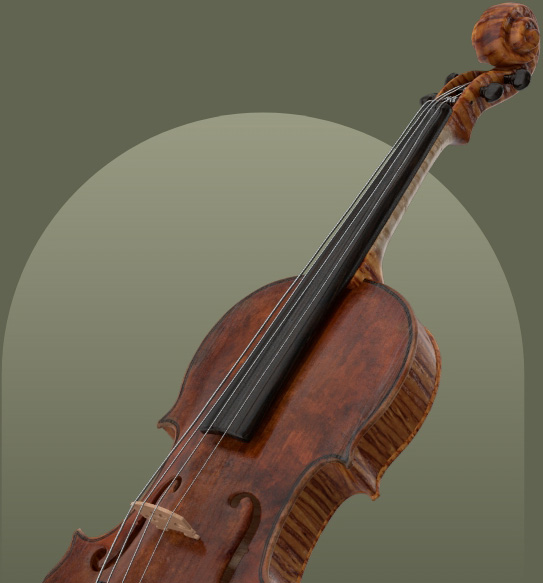
- The characteristic Mainz model features full broad arching, a good strong Stradivarian outline, and small outward pointing corners.
- Soundholes
- Soundholes tend to be upright and widely-spaced, with a cramped upper half, a small upper circle, and a short narrow wing, but with a large and prominent lower circle. On later work, these characteristic soundholes are cut more open and develop an inward slope at the upper end.
- Nicks
- The nicks are cut broad, straight, and deep.
- Scrolls
- Scrolls are neatly concentric but described as a little unrefined.
- Internal Work
- Internal work is quite coarse, featuring small linings spliced (rather than morticed) into the corner blocks in typical German style.
- Poorest Work
- The poorest work exhibits a very Germanic appearance of commercial production of the period, with exaggerated Staineresque scrolls and rather careless layout.
- Materials
- Materials used are not often exceptional.
- Varnish
- Varnish is typically a soft golden-orange or pale golden-brown.
- Known Instruments
- Edward Speyer in England possesses a 7/4-violin by Steininger. A Viola d'amore from 1777, formerly in the Snoeck collection, is located in Berlin.
- Labels
- Examples of his labels include "Jacobus Steininger / Churfurstl: Mayntzischer / Hof Lauten und Geigen- / macher, 1777", "Jakob Steininger, hofgeigen / macher in Aschaffenburg 1806", and "Jacobus Staininger / Chürfürtl / Snaimkilcher / Hoflautern und Geigen / macher 1780 no 127 [Michels]".
- Jacobus Steininger
Churfurstl: Mayntzischer
Hof Lauten und Geigen-
macher, 1777John Dilworth - Jakob Steininger, hofgeigen
macher in Aschaffenburg 1806John Dilworth - Jacobus Staininger
Chürfürtl
Snaimkilcher
Hoflautern und Geigen
macher 1780 no 127John Dilworth
Influence and legacy
- Mentorship: Jacob Steininger was a pupil of N. Dopfer.
- Teaching: He gave instructions in violin-making to Nicholas Diehl, who was his nephew.
- Family Continuity: His sons Franz, Johannes, and Nicolaus were also violin makers and joined his workshop in Aschaffenburg.
- Family Life: His wife, Katharine, is said to have outlived him.
Further Information
- Workshop Locations: Jacob Steininger worked in Mainz from approximately 1775, briefly in Frankfurt, and settled in Aschaffenburg around 1800.
- Titles: He held the title of Churfurstl: Mayntzischer Hof Lauten und Geigen-macher (Electoral Mainz Court Lute and Violin Maker) and later hofgeigenmacher in Aschaffenburg (Court Violin Maker in Aschaffenburg).
Biographies
The overview above is drawn from the following published accounts. Read them in the original:
John Dilworth+
STEININGER, Jacob Born 1751 Lechbruck bei Füssen, died 1823 Aschaffenburg Germany. Son-in-law and pupil of N. Dopfer. Active in Mainz from c.1775 where Dopfer was court luthier from 1756 to 1788 in which year Steininger succeeded to the appointment. The family left Mainz in 1792 as a result of the revolutionary wars, staying briefly in Frankfurt and then settling in Aschaffenburg with the court of the Frederick, Elector of Saxony. Joined in the family workshop there by his sons Franz, above, Johannes and Nicolaus, below, and Nicolaus Diehl. Jacob’s work is very variable. The characteristic Mainz model is rather Gagliano-like: full broad arching, good strong Stradivarian outline, and small outward pointing corners. The soundholes tend to be upright and widely-spaced, with a cramped upper half, small upper circle and short narrow wing, but with a large and prominent lower circle. The nicks are cut broad straight and deep. On later work these characteristic soundholes are cut more open and develop an inward slope at the upper end. The scrolls are neatly concentric, but a little unrefined. Internal work quite coarse, with small linings spliced (rather than morticed) into the corner blocks in typical German style. The poorest work has the very Germanic appearance of commercial production of the period, with exaggerated Staineresque scrolls and rather careless layout. Materials are not often exceptional and varnish is typically a soft golden-orange or pale golden-brown. Jacobus Steininger / Churfurstl: Mayntzischer / Hof Lauten und Geigen- / macher, 1777 Jakob Steininger, hofgeigen / macher in Aschaffenburg 1806 Jacobus Staininger / Chürfürtl / Snaimkilcher / Hoflautern und Geigen / macher 1780 no 127 [Michels]
Cecie Stainer+
A maker in Frankfort about 1775. Nicholas Diehl was a pupil of his. He married the daughter of the violin maker Dopfer.
George Hart+
Son in-law of the Violin-maker Dopfer, and uncle of Nicholas Diel, to whom he gave instructions in Violin-making.
Willibald Leo Lütgendorff+
Er scheint aus der Gegend von Füssen zu stammen und war möglicher Weise der Sohn eines gleichnamigen Vaters. Nach 1775 kam er vermuthlich aus Passau nach Mainz, wo er der Schwiegersohn des Geigenmachers Nikolaus Döpfer wurde und den Titel eines kurfürstl. mainzischen Hof- Geigenmachers erhielt. Um 1790 war er in Frankfurt a./M. ansässig und siedelte gegen 1800, einem ehrenvollen Rufe Folge leistend, nach Aschaffenburg über, wo er noch 1818 lebte. Seine Frau Katharine soll ihn überlebt haben. Er hinterliess zwei Söhne, die gleichfalls Geigenmacher waren. Eine 7/4-Geige von ihm besitzt Edward Speyer in England. — Wenn Valdrighi 1705 liest, so scheint er eine Geige von 1795 gesehen zu haben. Eine Viola d’ amore aus dem Jahre 1777 befindet sich aus der Sammlung Snoeck in Berlin.
Henri Poidras+
Passau, Mainz and Frankfort circa 1810. Father of Franz. Good work.
Sell your instrument with Amati
Get started by uploading photos of your instrument for our experts to review.
Sell your instrument with Amati
Get started by uploading photos of your instrument for our experts to review.
Pupils
Johann Martin Steininger Pupil