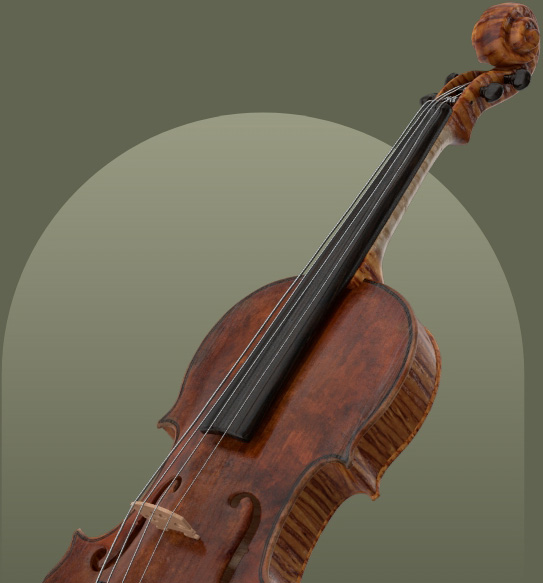
Joachim Tielke
1641–1719
Joachim Tielke (1641-1719) was a preeminent German lute and violin maker based in Hamburg, renowned for his exceptionally ornate instruments. Born in Königsberg, he established his workshop in Hamburg after moving there with his father, Johann Tielke. A "Freimeister," Tielke was celebrated for his prolific output, crafting lutes, viols, violins, cellos, archlutes, guitars, and citherns. His work is distinguished by intensely detailed carving and inlay, often featuring ivory, ebony, gold, silver, mother-of-pearl, and precious stones, achieving what Willibald Leo Lütgendorff described as the highest level of artistic ornamentation. While noted for their "delicate and pleasant" tone, his instruments are primarily prized for their visual artistry. Many of his creations are preserved in major European museums, and he commanded high prices for his work during his lifetime. Despite his significant contemporary reputation, Tielke experienced a period of "undeserved oblivion" in Hamburg during the 19th century.
Request an expert valuation or learn how our global auctions achieve the highest prices for your instruments.
Auction Price History
Highest auction price
| Type | Details | Auction house | Sold | Price |
|---|---|---|---|---|
| Violin | 1684 c. | — | November 1989 | £33,000 |
No results match those filters.
Maker Overview
Life
Joachim Tielke (1641-1719) was a celebrated German lute and violin maker, born in Königsberg in 1641 and dying in Hamburg in 1719., he was the son of Johann Tielke, with whom he moved to Hamburg at a young age. Lütgendorff suggests he hailed from an old lute-making family, likely originating from Königsberg, though John Dilworth identifies his father as Gottfried Tielke. Tielke acquired Hamburg citizenship on July 9, 1669, paying the fee for those not born to citizens. Later that year, on September 7, he married Katharina Fleischer (born April 10, 1646; died December 7, 1724), who also appears to have come from a family of lute makers. Operating as a "Freimeister" due to the absence of a guild for lute makers in Hamburg, Tielke achieved considerable renown. He received numerous commissions from princely courts and was sought out by prominent artists. Lütgendorff notes that Tielke may have traveled to Italy, evidenced by a richly inlaid lute in the Hammer collection in Stockholm bearing the inscription "Joachim Tielke in Fiorenza fecit." He celebrated his golden wedding anniversary on September 7, 1717. Tielke had seven children - three daughters and four sons - none of whom became lute makers, though they may have assisted in decorating his instruments with carvings and inlays.
Characteristics
- Instrument Types
- Joachim Tielke was a prolific maker of lutes, viols of all kinds, violins, and cellos. Henri Poidras and Cecie Stainer further mention archlutes, guitars, and citherns.
- Ornamentation
- He was renowned for his intensely detailed carving and inlay work, with Willibald Leo Lütgendorff stating he achieved the highest level of artistic ornamentation ever. Baron, a contemporary, described Tielke's lutes with bodies crafted from ivory and ebony, and necks intricately inlaid with gold, silver, and mother-of-pearl.
- Specific Examples of Decoration
- Cecie Stainer describes a chiterna in the South Kensington Museum, London, inlaid with tortoiseshell designs encircling mythological deities in ivory, richly ornamented with precious stones. A viola da gamba from 1701 is noted for being entirely inlaid with ivory, including its edges, head, and pegs, with a charmingly designed ivory tail-piece.
- Violin Characteristics
- Dilworth identified several violins, including examples from 1684 and 1687, as rare for their discretion and elegance. These instruments featured carved heads, small corners, flowing soundholes with small wings, a medium arch, and a deep, narrow edge flute.
- Tonal Qualities
- Baron observed that while Tielke's instruments might not possess particularly strong sound, they were "delicate and pleasant."
- Joachim Tielke
in Hamburg, An. 1703John Dilworth - Ren. pre G Handel
Joachim Tielke, Hamburg, 1704John Dilworth
Influence and legacy
- Stylistic Parallels: John Dilworth notes that Joachim Tielke's work exhibits remarkable similarities in many aspects to that of Christopher Wise, a London maker active around the same period.
- Museum Collections: Many of Tielke's instruments are preserved in museums across Europe, with Willibald Leo Lütgendorff noting their presence as valuable showpieces in almost all important museums. Specific examples include a lute in the Lübeck Museum, a pocket violin in the Budweis city museum, and other works in the Braunschweig city museum, Stockholm, and with Claudius in Malmö.
- Documented Instruments: Cecie Stainer and George Hart list numerous instruments, including a lute in the Paris Conservatoire Collection, a chiterna (1665) owned by Mr. George Donaldson, a bass-viol (1669) exhibited in Paris in 1878, a violin (1670) mentioned by Fetis, a guitar (1676), a viola di bordone (1686) belonging to the Gesellschaft der Musikfreunde, Vienna, and a viola da gamba (1701).
- Valuation: von Uffenbach, Tielke received "one hundred Marks or fifty Gulden heavy money" for a lute, a price that was still willingly paid by lutenists as late as 1790.
- Historical Recognition: A commemorative publication was issued for his golden wedding anniversary, containing valuable biographical contributions. Despite his significant contemporary reputation, Lütgendorff notes that Tielke fell into "undeserved oblivion" in Hamburg during the 19th century.
Further Information
- Workshop Location: Joachim Tielke maintained his workshop in Hamburg.
- Labeling Practices: His instruments bear labels such as "Joachim Tielke / in Hamburg, An. 1703 Ren. pre G Handel" and "Joachim Tielke, Hamburg, 1704," as cited by John Dilworth. Lütgendorff also notes that his name was sometimes engraved on ivory inlay, for example, "Tielke in Hamburg fecit (1700)."
- Archival Research: Lütgendorff's inquiries to the Hamburg Archive led to Dr. H. Nirnheim's essay "Zur Geschichte des Musikinstrumentenbaus in Hamburg" (1900), which compiled available archival information on Tielke. Earlier articles include those by Julius Thias (1897) and Dr. J. Heckscher (1897) in the Hamburger Fremdenblatt.
- Instrument Catalogues: A comprehensive list of Tielke's instruments was published by De Wit in his journal (1899/1900).
Biographies
The overview above is drawn from the following published accounts. Read them in the original:
John Dilworth+
TIELKE, Joachim Born 1641 Königsberg, died 1719 Hamburg Germany. Son of Gottfried Tielke, above. Celebrated and prolific maker of lutes, viols of all kinds, violins, and cellos. His Hamburg workshop produced over 150 instruments, many preserved in museums throughout Europe. Most are decorated with intensely detailed carving and inlay work. Several violins have been identified which are rare examples of discretion and elegance, two dated 1687 and one from 1684. Carved heads, small corners, flowing soundholes with small wings, and medium arch with deep narrow edge flute. Remarkably similar in many aspects to the work of Christopher Wise in London at much the same time. Joachim Tielke / in Hamburg, An. 1703 Ren. pre G Handel / Joachim Tielke, Hamburg, 1704 [Hellwig]
Cecie Stainer+
One of a family of makers who lived in Hamburg from about 1539 to 1701. He was celebrated for the lutes, theorbos, guitars, and especially the viols of all kinds which he made, of very fine tone, ornamented with the richest and most varied inlaid work; one violin of his is also mentioned. The following instruments, given in their chronological order, are known : a lute in the Paris Conservatoire Collection; a lute known as a chiterna, with the label: “Joachim Tielke in Hamburg, 1539,” in the South Kensington Museum, London, which is inlaid with designs in tortoiseshell, encircling mythological deities in ivory, richly ornamented with precious stones. A guitar dated 1592, a marvel of richness of design and beautiful workmanship, is in wonderful preservation a bass-viol, dated 1669, was exhibited in Paris in 1878; a violin, dated 1670. mentioned by Fetis ; a guitar inscribed on the back “Joachim Tielke, Hamburg, 1676”; a very beautiful viola di bordone belonging to the Gesellschaft der Musikfreunde, Vienna, was labelled, “Joachim Tielke in Hamburg fecit, anno 1686” ; and a viola da gamba, dated 1701, entirely inlaid with ivory, with the edges, head, and pegs all in ivory, the tail-piece also charmingly designed in ivory.
George Hart+
Viol and Violin-maker. The dates met with on the instruments signed Tielke cover a period of upwards of a century and a half, and thus evidence the existence of the house in connexion with the manufacture of musical instruments through two or more generations. There is of this maker a Viola di Bordone in the collection at Kensington, dated 1686. Mention is made by Fetis of a Violin dated 1670, which was in the possession of Andre of Offenbach ; and a Chiterna dated 1665, similar to that in the Kensington collection, is owned by Mr. George Donaldson. M. Choquet, in his catalogue of the collection of instruments at the Conservatoire, Paris, refers to a Lute (No. 136) by Tielke.
Willibald Leo Lütgendorff+
Einer der berühmtesten deutschen Lauten- und Geigenmacher seiner Zeit der namentlich in der künstlerischen Ausschmückung das Höchste leistete, was überhaupt je geleistet worden ist. Er war der Sohn von Johann T., mit dem er schon in jungen Jahren nach Hamburg eingewandert war. Er entstammte zweifellos einer alten Lautenmacherfamilie, deren Heimath sich noch nicht feststellen liess. Der Name ist von ausgesprochen norddeutschem Klang, also dürfte der Stammsitz der Familie Tielke viel eher in Königsberg als in München zu suchen sein. Auf seinen Wanderfahrten scheint Joachim T. auch nach Italien gekommen zu sein, wofür sowohl seine Arbeit als auch der Umstand spricht, dass sich in der Sammlung Hammer in Stockholm eine reich eingelegte Laute von glockenförmigem Umriss mit der Inschrift: »Joachim Tielke in Fiorenza fecit« befand. Im Jahre 1669, am 9. Juli, erwarb er das Bürgerrecht, wobei er die Gebühr für Solche, die keine Bürgerssöhne waren, bezahlte. Im selben Jahre, am 7. September, heirathete er Katharina Fleischer (geb. 10. April 1646, † 7. Dec. 1724), die wohl auch einer Lautenmacherfamilie entstammte. Joachim Tielke kam zu grossem Ansehen und übte seine Kunst als Freimeister aus, da die Lautenmacher in Hamburg keiner Zunft zugetheilt waren. Er wurde von Nah und Fern mit Auftragen überhäuft, arbeitete für Fürstenhöfe und wurde von den bedeutendsten Künstlern aufgesucht. Baron, der ihn noch selbst gekannt haben könnte, schreibt in seiner »Untersuchung des Instruments der Lauten«: »Unter denen neuen Meistern, welche in Teutschland viel Renommée erworben, ist besonders Herr Joachim Tielke, welcher im Hamburg gelebet, zu remarquiren. Man hat Lauten von ihm gesehen, da das Corpus von lauter Elfenbein und Ebenholtz verfertiget, der Hals aber sehr künstlich mit allerley Gold, Silber und Perlen-Mutter ausgelegt gewesen. In der Holtz- Arbeit ist er auch glücklich gewesen, und klingen seine Instrumente nicht gar besonders stark, doch ganz delicat und angenehm.« Die reiche Einlage mag den Ton manchmal abgeschwächt haben, aber noch heute sind seine Arbeiten in fast allen bedeutenden Museen als kostbare Prunkstücke zu finden. Ein Verzeichniss einer grösseren Anzahl Tielke’scher Instrumente giebt De Wit in seiner Zeitschrift (Jahrg. 1899/1900). Nach dem Zeugniss Conrad’s von Uffenbach erhielt Tielke für eine Laute »hundert Mark oder fünfzig Gulden schweren Geldes« ein Preis, der auch 1790 von Lautenisten noch gerne bezahlt wurde. Er hatte sieben Kinder, drei Töchter und vier Söhne, von denen keiner Lautenmacher wurde; wohl aber scheinen sie ihm behilflich gewesen zu sein, seine Lauten mit Schnitzereien und Einlagen zu verzieren. Joachim T. feierte am 7. Sept. 1717 noch in voller Rüstigkeit das Fest der goldenen Hochzeit, und einen Beleg für das Ansehen, dessen er sich erfreute, giebt eine Festschrift, die damals erschien und manche werthvolle Beiträge zur Biographie des Meisters enthält, die um so willkommener sind, als Tielke gerade in Hamburg im 19. Jahrhundert einer unverdienten Vergessenheit anheimfiel. Eine Anfrage, die ich im Interesse des vorliegenden Werkes an das Hamburger Archiv richtete, gab den Anlass zu Dr. H. Nirnheim’s Aufsatz in den Mittheilungen des Vereins für Hamburgische Geschichte (Bd. VII, Heft 1, No. 7): »Zur Geschichte des Musikinstrumentenbaus in Hamburg«, welcher Alles enthält, was sich im Archiv über Tielke ausfindig machen liess. Im Jahre 1897 (14. Dec.) war bereits ein Aufsatz über Tielke von Julius Thias im Hamburger Fremdenblatt erschienen; im selben Jahre (20. Dec.) ein gleicher, der schon früher geschrieben war, von Dr. J. Heckscher im Hamburger VII, Heft 1, No. 7): »Zur Geschichte des Musikinstrumentenbaus in Hamburg«, welcher Alles enthält, was sich im Archiv über Tielke ausfindig machen liess. Im Jahre 1897 (14. Dec.) war bereits ein Aufsatz über Tielke von Julius Thias im Hamburger Fremdenblatt erschienen; im selben Jahre (20. Dec.) ein gleicher, der schon früher geschrieben war, von Dr. J. Heckscher im Hamburger iten Tielke’s; eine gute Laute besitzt das Lübecker Museum, eine Taschengeige das städt. Museum in Budweis; andere Arbeiten sind im städtischen Museum in Braunschweig, in Stockholm, bei Claudius in Malmö etc. Im Übrigen sei auf das schon genannte Verzeichniss in P. de Wit’s Zeitschrift hingewiesen, das die schönsten erhaltenen Arbeiten nennt. Ausser seinen Zetteln findet man auch manchmal in den Elfenbeinbelag gravirt: Tielke in Hamburg fecit (1700).
Henri Poidras+
Archlutes, guitars, lutes, citherns, all richly ornamented.
Sell your instrument with Amati
Get started by uploading photos of your instrument for our experts to review.
Sell your instrument with Amati
Get started by uploading photos of your instrument for our experts to review.