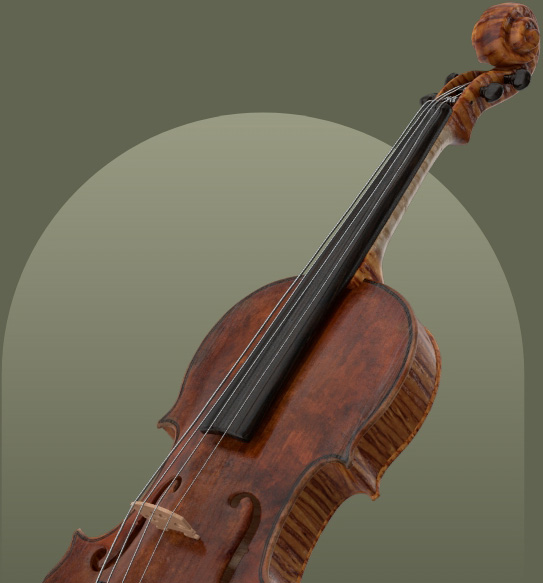
Francois Xavier Tourte
Paris, 1748–1835
François Xavier Tourte, known as 'Tourte le jeune', was a pivotal French archetier (bow maker) born in 1748 in Paris. Initially trained as a watchmaker, he joined his family's bow-making workshop, eventually becoming known as 'the Stradivari of the bow'. He revolutionized bow making by standardizing the use of pernambuco wood, developing the modern 'incurved' camber, and perfecting the frog design, often in collaboration with virtuoso violinists like J. B. Viotti and Rudolph Kreutzer. By 1785, he had established the formal pattern for the modern classical bow, and his 'golden period' around 1800 saw him define ideal lengths and weights for violin, viola, and cello bows. His meticulous craftsmanship, including his unique bending technique and refusal to lacquer sticks, resulted in bows of unparalleled quality that remain highly sought after and admired today. He worked until at least 1833, leaving an enduring legacy that set the standard for all subsequent bow makers.
Request an expert valuation or learn how our global auctions achieve the highest prices for your instruments.
Auction Price History
Highest auction price
95 results
| Type | Details | Auction house | Sold | Price |
|---|---|---|---|---|
| Cello Bow | Silver mounted, signed UBER and KAB Lot 200 | Vichy | December 2025 | £328,864est. € 300.000-350.000 |
| Violin Bow | Gold mounted, octagonal stick unstamped, frog and button later Lot 123 | Tarisio | May 2025 | £53,442est. $ 40,000-60,000 |
| Violin Bow | Silver mounted, octagonal stick unstamped, frog and button made by Nicolas Maire, frog chevalled Lot 78 | Tarisio | March 2024 | £178,183est. $ 100,000-150,000 |
| Violin Bow | Silver mounted, round stick unstamped, frog and button later Lot 128 | Tarisio | November 2023 | £114,230est. $ 120,000-180,000 |
| Violin Bow | Silver mounted Lot 150 | Vichy | June 2021 | £97,269est. € 100.000-120.000 |
| Violin Bow | Silver mounted, round stick unstamped, frog and button later Lot 61 | Tarisio | March 2021 | £41,575est. $ 30,000-50,000 |
| Violin Bow | Violin Bow, 1815 c. Lot 290 | Vichy | December 2020 | £119,837est. € 40.000-50.000 |
| Violin Bow | Silver mounted, silver face Lot 300 | Vichy | December 2020 | £39,199est. € 30.000-40.000 |
| Cello Bow | Silver mounted, minus hair, thin lapping Lot 200 | Vichy | December 2020 | £150,076est. € 50.000-60.000 |
| Cello Bow | Silver mounted, minus hair, thin lapping Lot 100 | Vichy | December 2020 | £66,078est. € 60.000-70.000 |
| Violin Bow | Gold mounted, octagonal stick unstamped, frog and button later Lot 112 | Tarisio | November 2020 | £35,640est. $ 40,000-60,000 |
| Violin Bow | Silver mounted, round stick, later plain ebony frog, silver and ebony button Lot 109 | Ingles & Hayday | March 2020 | £57,600est. £ 40,000-60,000 |
| Violin Bow | Roger & Max Millant collection, illustrated in L'Archet tome I p. 158, n. 4, gold mounted, ivory frog Lot 261 | Vichy | November 2019 | £97,551est. € 100.000-120.000 |
| Violin Bow | Bernard Millant collection, illustrated in L'Archet tome I p. 177 n. 36 Lot 287 | Vichy | November 2019 | £302,921est. € 120.000-150.000 |
| Violin Bow | Bernard Millant collection, illustrated in L'Archet tome I and in Les archets français by E. Vatelot tome 2 Lot 326 | Vichy | November 2019 | £82,148est. € 50.000-60.000 |
| Violin Bow | Silver mounted, thin lapping Lot 200 | Vichy | November 2019 | £73,850est. € 60.000-70.000 |
| Violin Bow | Silver mounted, thin lapping Lot 300 | Vichy | November 2019 | £94,364est. € 80.000-100.000 |
| Violin Bow | Gold mounted, octagonal stick, ebony frog with pearl eye, later gold and ebony button, tinsel lapping Lot 55 | Ingles & Hayday | October 2019 | £114,000est. £ 70,000-100,000 |
| Violin Bow | Silver mounted, frog by J.A. Lamy, button in the Tourte style Lot 100 | Vichy | June 2019 | £95,655est. € 50.000-60.000 |
| Violin Bow | Gold mounted, octagonal stick unstamped, frog and button later Lot 126 | Tarisio | May 2019 | £128,244est. $ 100,000-150,000 |
| Violin Bow | Silver mounted, round stick, later ebony frog with pearl eye, later silver and ebony button Lot 69 | Ingles & Hayday | March 2019 | £108,000est. £ 40,000-80,000 |
| Violin Bow | Millant collection, illustrated in L'Archet, gold mounted, thin lapping, later gold mounts to the frog Lot 140 | Vichy | December 2018 | £129,384est. € 100.000-120.000 |
| Violin Bow | Millant collection, illustrated in L'Archet, vol. I, p. 161, n. 10, thin lapping Lot 175 | Vichy | December 2018 | £289,731est. € 130.000-150.000 |
| Violin Bow | Silver mounted, round stick unstamped, frog a later replica probably by Pierre Simon, button original Lot 152 | Tarisio | November 2018 | £73,076est. $ 55,000-70,000 |
| Violin Bow | Gold mounted, round stick of handsomely figured pernambuco, tortoiseshell frog Lot 245 | Brompton’s | October 2018 | £190,800est. £ 100,000-150,000 |
| Violin Bow | Silver mounted, octagonal stick unstamped, ferrule and heels remade Lot 99 | Tarisio | March 2018 | £100,300est. £ 70,000-100,000 |
| Violin Bow | Silver mounted, original lapping Lot 100 | Vichy | November 2017 | £491,040est. € 130.000-150.000 |
| Violin Bow | Gold mounted, octagonal stick, later ebony frog with Paris eye, later gold and ebony button Lot 53 | Ingles & Hayday | October 2016 | £60,000est. £ 30,000-50,000 |
| Cello Bow | Silver mounted, round stick, later ebony frog with pearl eye, button with two silver bands Lot 169 | Ingles & Hayday | October 2016 | £78,000est. £ 65,000-85,000 |
| Violin Bow | Silver mounted, round stick, ebony frog with pearl eye Lot 46 | Ingles & Hayday | March 2016 | £66,000est. £ 40,000-60,000 |
| Cello Bow | Silver mounted, minus hair Lot 100 | Vichy | June 2015 | £100,726est. € 80.000-100.000 |
| Violin Bow | Silver mounted, octagonal stick unstamped, light lapping Lot 73 | Tarisio | June 2015 | £78,000est. £ 50,000-80,000 |
| Violin Bow | Silver mounted, round stick, head splined Lot 153 | Tarisio | May 2015 | £12,198est. $ 10,000-15,000 |
| Violin Bow | Silver mounted, round stick stamped T., frog and button later, handle grafted Lot 179 | Tarisio | October 2014 | £22,512est. $ 10,000-15,000 |
| Violin Bow | additional fittings in the style of Tubbs Lot 148 | Tarisio | May 2014 | £16,985est. $ 12,000-18,000 |
| Violin Bow | Chevalled frog also by Tourte but from another stick of an earlier period, button original to the stick Lot 95 | Tarisio | March 2014 | £53,100est. £ 50,000-80,000 |
| Violin Bow | Silver mounted, minus hair Lot 400 | Vichy | December 2013 | £67,687est. € 5.000-6.000 |
| Cello Bow | Silver mounted, octagonal stick unstamped, splined head Lot 55 | Tarisio | October 2013 | £16,282est. $ 20,000-30,000 |
| Violin Bow | Silver mounted, faintly stamped Tourte, light lapping Lot 115 | Tarisio | June 2013 | £60,000est. £ 50,000-80,000 |
| Violin Bow | Literature: Etienne Vatelot, Les Archets Français, 1977, Volume II; gold and tortoiseshell mounted Lot 27 | Christie's | April 2012 | £112,785est. $ 150,000-250,000 |
| Violin Bow | S/E 59.0 g. (frog & button later) | — | November 2011 | £31,952 |
| Cello Bow | S/E 77 g. Paris, early 19th C. Probably by | — | October 2011 | £27,500 |
| Violin Bow | G/T 60 g. | — | October 2011 | £102,000 |
| Violin Bow | S/E 49.5 g. no winding (frog & button not original) | — | June 2011 | £42,984 |
| Violin Bow | S/E 55 g. Paris, 1790 c. Ascribed to | — | April 2011 | £62,707 |
| Cello Bow | S/E 77.5 g. Attributed to | — | March 2011 | £6,000 |
| Violin Bow | S/E 57 g. France, 19th C. Ascribed to | — | March 2011 | £9,375 |
| Violin Bow | S/E 50.5 g. no winding (frog & button not original) | — | December 2010 | £40,388 |
| Cello Bow | S/E 79.0 g. (frog & button probably later) Attributed to & possibly by | — | October 2010 | £5,257 |
| Violin Bow | S/E 52.5 g. without hair Attributed to | — | April 2010 | £8,642 |
| Violin Bow | S/E 61 g. 1810 c. (frog later) Probably by | — | March 2010 | £15,600 |
| Violin Bow | S/E 54.0 g. frog made by "D. Peccatte" in the style of "Tourte" | — | October 2009 | £37,074 |
| Violin Bow | S/E 57.0 g. Attributed to | — | May 2009 | £13,199 |
| Violin Bow | Ivory 39 g. without hair nor winding | — | December 2008 | £13,822 |
| Violin Bow | S/E 57.5 g. (frog & button not original) | — | October 2008 | £19,884 |
| Violin Bow | G/E 56 g. certified by J. Tubbs, 1909 (adjustor later) Ascribed to | — | October 2008 | £4,869 |
| Cello Bow | S/E 82.7 g. with replica frog | — | March 2007 | £103,500 |
| Violin Bow | S/E 53.5 g. frog by "Jacob Eury" (head and mortice altered) | — | December 2006 | £27,563 |
| Cello Bow | S/E 81.5 g. Also sold with a silver and ebony replica frog | — | November 2006 | £105,256 |
| Violin Bow | S/E 53 g. without winding | — | June 2006 | £44,518 |
| Violin Bow | G/E 57 g. Without wrap (later frog and button) | — | May 2006 | £22,129 |
| Violin Bow | S/E 52.5 g. (frog not original) Probably by | — | November 2005 | £12,000 |
| Cello Bow | G/I 80 g. (frog & button by "E. Pajeot") | — | June 2005 | £24,150 |
| Violin Bow | S/E 56 g. | — | April 2005 | £15,038 |
| Cello Bow | S/E 74.5 g. without wrapping,with frog copy | — | December 2004 | £45,581 |
| Violin Bow | G/T 60 g. | — | May 2003 | £65,600 |
| Violin Bow | Ivory 43 g. 'Cramer' model, also by "Louis" | — | June 2002 | £10,991 |
| Cello Bow | S/E 90 g. | — | December 2000 | £24,779 |
| Bass Bow | S/E 165 g. | — | June 2000 | £47,823 |
| Violin Bow | S/E 58 g. | — | December 1999 | £27,150 |
| Violin Bow | S/E 56 g. | — | March 1997 | £43,300 |
| Violin Bow | S/E 58 g. | — | March 1995 | £24,150 |
| Violin Bow | S/E 64 g. | — | March 1995 | £6,900 |
| Violin Bow | Ebony 60 g. Open frog | — | March 1995 | £2,645 |
| Violin Bow | G/T 58 g. | — | November 1993 | £52,100 |
| Violin Bow | G/T 58 g. | — | November 1993 | £49,900 |
| Violin Bow | S/E 54 g. | — | June 1992 | £5,500 |
| Violin Bow | S/E 58 g. | — | March 1992 | £11,632 |
| Violin Bow | S/I 59 g. | — | November 1991 | £8,800 |
| Violin Bow | S/E 58 g. (later frog) | — | June 1990 | £9,900 |
| Violin Bow | S/E 61 g. (later frog) | — | November 1989 | £10,450 |
| Cello Bow | S/E 81 g. | — | November 1989 | £22,000 |
| Violin Bow | G/E 61 g. | — | March 1989 | £15,400 |
| Violin Bow | G/T 58 g. | — | November 1988 | £79,200 |
| Violin Bow | S/E 58 g. | — | November 1988 | £24,200 |
| Violin Bow | S/E 58 g. | — | November 1988 | £22,000 |
| Violin Bow | S/E 60 g. | — | November 1988 | £22,000 |
| Violin Bow | S/T 62 g. (later frog) | — | November 1988 | £18,700 |
| Violin Bow | S/E 56 g. | — | November 1988 | £16,500 |
| Violin Bow | G/E 56 g. (later frog) | — | November 1988 | £15,426 |
| Cello Bow | S/E 79 g. | — | November 1987 | £15,400 |
| Violin Bow | S/E 57 g. | — | April 1987 | £8,800 |
| Violin Bow | S/E 60 g. (later frog) | — | April 1987 | £9,900 |
| Violin Bow | G/T 60 g. | — | November 1986 | £28,600 |
| Violin Bow | S/E 50 g. | — | January 1981 | £7,822 |
No results match those filters.
Maker Overview
Life
Francois Xavier Tourte (1748-1835) was born in 1748 and died in 1835 in Paris, France. He was known as 'Tourte le jeune' and was the younger brother of Nicolas Leonard Tourte and son of Nicolas Pierre Tourte. He is widely acknowledged as the most important archetier in the history of the craft, commonly referred to as 'the Stradivari of the bow'.
Tourte initially trained as a watchmaker from approximately 1760., he worked as a watchmaker for eight years before entering his father's and brother's workshop. After his father's death in 1764, he came under the protection of his elder brother, Nicolas Leonard, and was drawn into bow making as his assistant. He is credited with making pernambuco the standard material for bow sticks, introducing it to his brother's workshop and rendering the earlier use of ironwood or snakewood obsolete.
In 1782, the virtuoso J. B. Viotti arrived in Paris and made contact with the Tourte brothers. Francois Xavier was quicker to respond to Viotti's requirements for a more even and flexible stick, leading him to develop the familiar 'incurved' camber of the standard modern bow. Another notable violinist, Rudolph Kreutzer, was instrumental in Tourte's development of the form and function of the frog to maintain a more controlled flat ribbon of hair through the metal 'D' ring or ferrule. By about 1785, he had established the formal pattern for the modern classical bow. From this point, he used his elder brother's brand, with the 'L' removed, signifying that Nicolas Léonard was no longer active.
The next phase of his career, suggested by his production of octagonal rather than round sticks after approximately 1800, saw him move to 10 Quai de l'École. In this 'golden period,' he established the ideal standard lengths and weights for violin, viola, and cello bows, which had previously been highly variable, and perfected the fully mounted, functionally modern frog. He worked until at least 1833, and retired to 38 rue Dauphine, beside the Seine, continuing to produce excellent work even in his 77th year. He worked until he was eighty-five, when failing eyesight necessitated a rest.
Characteristics
- Material Innovation
- He made pernambuco the standard material for bow sticks, replacing ironwood or snakewood. He initially used staves from old sugar hogsheads from Brazil for experiments, but later always selected fine pernambuco wood with perfectly straight grain, strong and elastic, without excessive weight.
- Camber Development
- He developed the familiar 'incurved' camber of the standard modern bow.
- Frog Design
- He developed the form and function of the frog to keep a more controlled flat ribbon of hair, utilizing a metal 'D' ring or ferrule. He also invented a method of spreading the hairs of the bow and fixing them on the face of the nut by means of a movable band of metal, fitting on a slide of mother-of-pearl.
- Standardization
- He laid down the formal pattern for the modern classical bow by about 1785 and established the ideal standard lengths and weights for violin, viola, and cello bows.
- Stick Shape
- After approximately 1800, he produced octagonal rather than round sticks.
- Bending Technique
- He did not cut the stick in a curved shape but cut it straight from the wood and bent it over his knee after heating it over a gentle coal fire. He achieved a permanent and regular bend by subjecting the wood in a state of flexion to a moderate amount of heat for some time.
- Finishing
- He never lacquered his sticks, but only polished them with oil and pumice.
- Quality Control
- He was a conscientious worker who delivered only irreproachable bows, destroying any that he deemed not fully successful.
- Other Skills
- He was also known to be able to carve bridges wonderfully.
- Rarity
- Only one authenticated double bass bow made by him is known.
- Business card (1774): Tourte le Jeune
fait et vend toutes sortes d’archets
Demeure quai de l’école, maison
de marchand de musique, ci
devant Caffé du Parnasse No. 10
au 4me A ParisJohn Dilworth
Influence and legacy
- Family Workshop: After his father's death, he was drawn into bow making as an assistant in his elder brother Nicolas Leonard Tourte's workshop.
- Collaborations with Virtuosos: His work was significantly influenced by the requirements of virtuoso violinists. J. B. Viotti, who arrived in Paris in 1782, suggested many improvements from a violinist's perspective. Rudolph Kreutzer was instrumental in the development of the frog's form and function.
- Historical Accounts: More about him is reported in Fétis's book on Stradivari (pages 118-128), based on Vuillaume's account.
- Renown: He is acknowledged as the most important archetier in the history of the craft, commonly referred to as 'the Stradivari of the bow'. His skill has never been equaled.
- Market Value: He charged 12 louis d'or (about £10) for gold-mounted bows and 3 1/2 louis d'or (nearly £3) for silver-mounted ones. His bows now fetch significantly higher prices, with a violoncello bow selling for £44 at a Paris sale in 1887.
- Enduring Quality: His work remains the most admired and desirable of all the numerous and gifted French bow makers that followed his inspiration. His bows are always preferred by violinists and show no signs of wear.
- Museum Collections: Several of his bows are preserved in the Paris Conservatoire Collection.
- Markings: His bows were rarely marked; only two are known with small engraved labels stating: "Cet archet a ete fait par Tourte en 1824, age de soixante-dix-sept ans."
- Imitation: His bows were so closely imitated by other makers, such as Peccatte and Lafleur, that it is sometimes difficult to distinguish between originals and copies.
Further Information
- Addresses: He settled at 10 Quai de l'École and later retired to 38 rue Dauphine.
- Brand: His brand was TOURTE. He used his elder brother's brand, with the 'L' removed, after about 1785.
- Business Card (1774): His business card read: "Tourte le Jeune / fait et vend toutes sortes d'archets / Demeure quai de l'école, maison / de marchand de musique, ci / devant Caffé du Parnasse No. 10 / au 4me A Paris".
- Nickname: He was known as 'Tourte le jeune' to distinguish him from his brother.
Biographies
The overview above is drawn from the following published accounts. Read them in the original:
John Dilworth+
TOURTE, François Xavier Born 1748, died 1835 Paris France. Bow maker, known as ‘Tourte le jeune‘. Younger brother of Nicolas Leonard Tourte and son of Nicolas Pierre, below. Acknowledged as the most important archetier in the history of the craft, commonly referred to as ‘the Stradivari of the bow’. Trained as a watchmaker from c.1760. After his father’s death in 1764, he came under the protection of his elder brother, and appears to have been drawn into bow making as his assistant. He is credited with making pernambuco the standard material for the sticks, introducing it to his brother’s workshop and making the earlier use of ironwood or snakewood obsolete. In 1782 the virtuoso J. B. Viotti came to Paris and made contact with the Tourte brothers. The younger François Xavier seems to have been quicker to respond to his requirements for a more even and flexible stick, and developed the familiar ‘incurved’ camber of the standard modern bow. Another notable violinist, Rudolph Kreutzer, was instrumental in François Xavier developing the form and function of the frog to keep a more controlled flat ribbon of hair, through the metal ‘D’ ring or ferrule. By about 1785 he had laid down the formal pattern for the modern classical bow. From this point he used his elder brother’s brand, with the ‘L’ removed, signifying that Nicolas Léonard was no longer active. The next phase of his career is suggested by his production of octagonal, rather than round sticks after c.1800, and his move to 10 Quai de l’École. In this his ‘golden period’ he arrived at the ideal standard lengths and weights of the violin, viola, and cello bow (previously were highly variable) and the fully mounted functionally modern frog. One authenticated double bass bow is known. He worked until at least 1833, and retired to 38 rue Dauphine, beside the Seine. His work remains the most admired and desirable of all the numerous and gifted French bow makers that followed his inspiration. Brand: TOURTE. Business card (1774): Tourte le Jeune / fait et vend toutes sortes d’archets / Demeure quai de l’école, maison / de marchand de musique, ci / devant Caffé du Parnasse No. 10 / au 4me A Paris
Cecie Stainer+
He settled at 10, Quai de l’Ecole, and began to make bows; for his first experiments he used the staves of old sugar hogsheads from Brazil, but afterwards always selected fine Pernambuco wood of perfectly straight grain, strong and elastic, without excessive weight. By subjecting this in a state of flexion to a moderate amount of heat for some time, he obtained a permanent and regular bend: to do this without making the exterior brittle is always the great difficulty of bow makers. He was able to definitely settle the correct length and curvature of the stick, the gradual tapering towards the point, and also invented a method of spreading the hairs of the bow and fixing them on the face of the nut by means of a moveable band of metal, fitting on a slide of mother-o’-pearl. In fact, he practically invented the modern bow and has well been called the ” Stradivari” of the bow, for his skill has never been equalled. Most of his great work was done after 1775. Viotti, who arrived in Paris in 1782, is said to have suggested many of the improvements that were required from a violinist’s point of view. He worked until he was eighty-five, when failing eyesight necessitated a rest. He himself charged 12 louis d’or (about £10) for the bows mounted in gold, and 3 1/2 louis d’or (nearly £3) for those mounted in silver, but they now fetch from £20 each ; for Tourte’s bows are always preferred to any others by violinists, and as yet show no signs of wear. Violoncello bows are rarer; at a sale in Paris, Feb. 5, 1887, one was sold to Messrs. Hill and Son for £44. Several of his bows are in the Paris Conservatoire Collection, they are never marked ; only two are known with small engraved labels : ” Cet archet a ete fait par Tourte en 1824, age de soixante-dix-sept ans.” His bows were so closely imitated by other makers that it is not easy always to distinguish between the original and the copy.
Willibald Leo Lütgendorff+
Der Stradivari in der Kunst des Bogenmachens. Er war ursprünglich Uhrmacher und trat erst, nachdem er acht Jahre als solcher gearbeitet hatte, in die Werkstatt seines Vaters und Bruders ein. Eine ganz eigenthümliche Begabung und die peinliche Genauigkeit, die er bei der Uhrmacherei erlernte, brachten es dahin, dass er eine vorher nie dagewesene und auch jetzt noch kaum wieder erreichte Meisterschaft erlangte. Anfangs nahm er das Holz von Zuckerfässern zu seinen Bögen, die er dann für 20—30 Sous verkaufte. Bald erkannte er aber, worauf es bei einem guten Bogen hauptsächlich ankam, und nun versuchte er alle verwendbaren Holzsorten, bis er das Fernambucholz fand. Das mag um 1775—1780 gewesen sein. Er war unablässig bemüht, seine Bögen zu verbessern, und schliesslich gab er dem Bogen seine heutige Gestalt und stellte die Maasse fest. Er ward sehr bald berühmt und erhielt gerne für seine Bögen bis zu 15 Louis d’or; aber er zerbrach jeden fertigen Bogen, wenn das Geringste daran auszusetzen war. Die Stange schnitt er nicht bogenförmig, sondern gerade aus dem Holze und bog sie über dem Knie, nachdem er sie über gelindem Kohlenfeuer erhitzt hatte. Er hat auch seine Stangen nie lackirt, sondern nur mit Öl und Bimstein geschliffen. Er war sich seiner Künstlerschaft bewusst, obwohl er nicht einmal lesen und schreiben gekonnt haben soll. Bekannt ist, dass er auch Stege wundervoll zu schnitzen verstand. Er war sehr fleissig und machte noch in seinem 77. Jahre treffliche Arbeiten. Zum Unterschied von seinem Bruder X. wurde er auch »Tourte le jeune« genannt. — Mehr über ihn berichtet nach Vuillaume’s Erzählung Fétis in seinem Buche über Stradivari (S. 118-128).
Henri Poidras+
The most celebrated of all the French bow makers, thanks to whose improvements we have a standard bow model. In his best sticks, the workmanship is incomparable. A conscientious worker, he delivered only irreproachable bows, destroying those he deemed not fully successful. After having used common woods, as was the custom at the time, he gave preference to the « Pernambouc » wood, adopted it, and since then, this particular wood has always been used in the making of good bows. It is said that he effected the curve by heating. Tourte hardly ever signed, and sometimes, but very seldom, a very small label is found on the lining. He died at an advanced age. Copied by the best makers, such as Peccatte and Lafleur, it is sometimes difficult to distinguish his own works.
Sell your instrument with Amati
Get started by uploading photos of your instrument for our experts to review.
Sell your instrument with Amati
Get started by uploading photos of your instrument for our experts to review.