Raffaele Trapani
Naples, 1780–1840
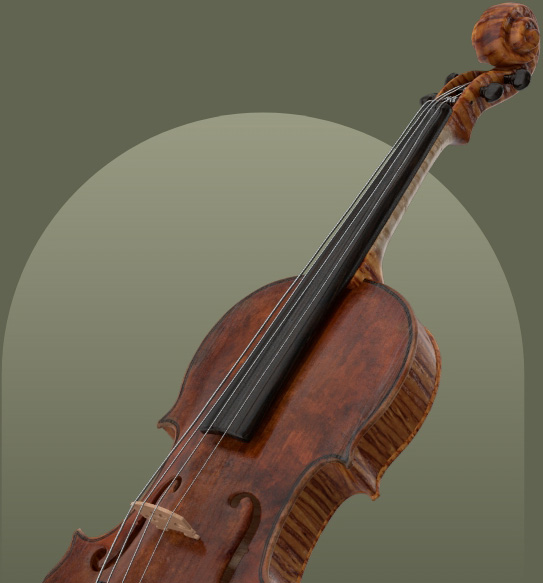
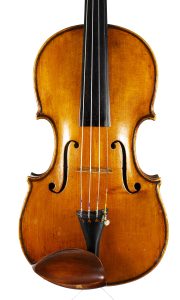
Raffaele TRAPANI was a Neapolitan violin maker active in the early 19th century, known for his distinctive and original approach to instrument making. While some sources describe his workmanship as 'careless', others praise it as 'good' and 'finely finished'. He favored a large pattern with prominent edges, heavy purfling, and a scroll reminiscent of the Brescian school. His varnish was typically thick and red-brown, and his soundholes were often considered lacking in grace. Trapani's work, which included highly regarded 'cellos, consciously departed from the mainstream Neapolitan tradition, incorporating features seemingly designed to strengthen classical violin models.
Request an expert valuation or learn how our global auctions achieve the highest prices for your instruments.
Auction Price History
Highest auction price
4 results
| Type | Details | Auction house | Sold | Price |
|---|---|---|---|---|
| Violin | 36.3 cm Naples, 1820 c. | — | March 2010 | £14,400 |
| Violin | 1815 | — | November 2001 | £8,800 |
| Violin | 1830 | — | March 1999 | £21,850 |
| Violin | 1830 c. | — | March 1993 | £18,700 |
No results match those filters.
Maker Overview
Life
Raffaele TRAPANI (1780-1840) was born in 1780 and died in 1840 in Naples, Italy. He was active as a maker in Naples around 1810, with his working period also cited as 1800 to 1826. His work is noted for its distinctive personal model and stands outside the mainstream Neapolitan school.
Characteristics
- Workmanship
- Sources contain conflicting information regarding the overall quality of his work. Henri Poidras describes his work as 'Careless work', while Cecie Stainer notes it as 'good and original in character'. Willibald Leo Lütgendorff states the 'Arbeit ist im Übrigen gut' (the work is otherwise good), and Karel Jalovec mentions he 'worked skilfully'. John Dilworth describes 'Very finely finished craftsmanship'.
- Model
- His instruments are generally on a large pattern or form, with a flat model, and a full arch of medium height inspired by Maggini.
- Edges and Purfling
- Descriptions consistently mention prominent, strong, or broad edges. Cecie Stainer notes 'prominent edges, and heavy purfling'. George Hart describes 'edges sharp; purfling deeply laid'. John Dilworth details 'Broad edges with deeply sunk channel and neat purfling'. Lütgendorff also mentions 'stark hervortretenden Ecken und guter Einlage' (strongly protruding corners and good purfling).
- Scroll
- The scroll is frequently described as heavy and reminiscent of the Brescian type or school. John Dilworth provides further detail, stating the scroll is 'neatly and concentrically turned, with an extended final curl behind the small eye'. He also notes the absence of a conventional throat, with the pegbox arriving abruptly at the front of the volute, and the flutings of the pegbox cut almost square with a flat-bottomed channel turning sharply up to a flat chamfer at the edges.
- Varnish
- The varnish is generally described as thick and of a red or red-brown colour. Cecie Stainer notes it as 'rather thick and of a red-brown colour'. Henri Poidras mentions 'thick red varnish'. Karel Jalovec states he 'used a red or red-brown varnish'. John Dilworth describes 'Excellently applied clear varnish of golden-brown to orange-red colour'.
- Soundholes
- The soundholes are often criticized for their appearance. Henri Poidras states they are 'entirely lacking grace'. Lütgendorff finds the F-holes, which he makes pointed, 'geradezu hässlich' (downright ugly). Karel Jalovec describes them as 'tapering sound-holes of unseemly cut'. John Dilworth notes them as 'Rather stiff widely-spaced soundholes, sometimes with the wings not separated from the upper and lower edges'.
- Wood
- John Dilworth notes that Trapani 'Often used very finely flamed maple'.
- Unique Features
- John Dilworth highlights that 'The edge of the back turns inward at the top button forming a small raised triangular platform'. Many of his characteristics, such as the pegbox and soundholes, seem to be a conscious effort to strengthen vulnerable areas in classical violin models.
- Best Instruments
- Karel Jalovec states that his 'Best are his 'cellos'.
- Raffaele Trapani
Napoli 1815John Dilworth
Influence and legacy
- School/Tradition: His scroll and overall style are noted to be of the Brescian type or school.
- Inspiration: His full arching was inspired by Maggini.
- Departure: His work is explicitly stated by John Dilworth to stand 'outside of the mainstream Neapolitan school'.
Further Information
- Labels: His labels include 'Raffaele Trapani, Napoli, No. —.' and 'Raffaele Trapani / Napoli 1815 No.8.'
- Description by Vannes: Vannes describes Raffaele Trapani as an engineer.
Biographies
The overview above is drawn from the following published accounts. Read them in the original:
John Dilworth+
TRAPANI, Raffaele Born 1780, died 1840 Naples Italy. Very finely finished craftsmanship on very distinctive personal model. Large form. Full arch of medium height inspired by Maggini. Excellently applied clear varnish of golden-brown to orange-red colour. Broad edges with deeply sunk channel and neat purfling. The edge of the back turns inward at the top button forming a small raised triangular platform. The scroll is neatly and concentrically turned, with an extended final curl behind the small eye. There is no conventional throat; the pegbox arrives abruptly at the front of the volute. The flutings of the pegbox are cut almost square, with a flat-bottomed channel turning sharply up to a flat chamfer at the edges. Often used very finely flamed maple. Rather stiff widely-spaced soundholes, sometimes with the wings not separated from the upper and lower edges. Most of these characteristics seem to be a result of a conscious effort to strengthen weak and vulnerable areas in classical violin models. Vannes describes him as an engineer. His work certainly stands outside of the mainstream Neapolitan school. Raffaele Trapani / Napoli 1815 No.8.
Cecie Stainer+
A maker in Naples about 1810. His workmanship is good and original in character; his violins are on a large pattern, with prominent edges, and heavy purfling ; the scroll is heavy and of the Brescian type ; the varnish is rather thick and of a red-brown colour. Label ; ” Raffaele Trapani, Napoli, No. —.”
George Hart+
Large pattern ; flat model; purfling deeply laid ; edges sharp ; scroll heavy.
Willibald Leo Lütgendorff+
Er suchte nach einem neuen Modell, ohne dass es ihm gelungen wäre, etwas Besseres als seine Vorgänger zu finden. Die F-Löcher, die er spitz verlaufen lässt, sind geradezu hässlich. Die Arbeit ist im Übrigen gut, das Patron gross, mit stark hervortretenden Ecken und guter Einlage. Der Lack ist ziemlich dick und von rothbrauner Farbe. Die Schnecke erinnert an die Brescianer Schule. Eine genauere Beschreibung einer Geige von ihm ist bei Vidal zu finden.
Henri Poidras+
Careless work. The thick red varnish lends an aspect to this individual make ot a large model with sound holes entirely lacking grace.
Karel Jalovec+
Naples, 1800, 1826. He worked skilfully in the fashion of the Brescian school, built instruments of flat arching, strong edges, tapering sound-holes of unseemly cut. He used a red or red-brown varnish. Best are his ‘cellos. Price 12.000 Kc.
Sell your instrument with Amati
Get started by uploading photos of your instrument for our experts to review.
Sell your instrument with Amati
Get started by uploading photos of your instrument for our experts to review.