Thomas Urquhart
London, c.1629–1698
Request an expert valuation or learn how our global auctions achieve the highest prices for your instruments.
Instruments
Auction Price History
Highest auction price
9 results
| Type | Details | Auction house | Sold | Price |
|---|---|---|---|---|
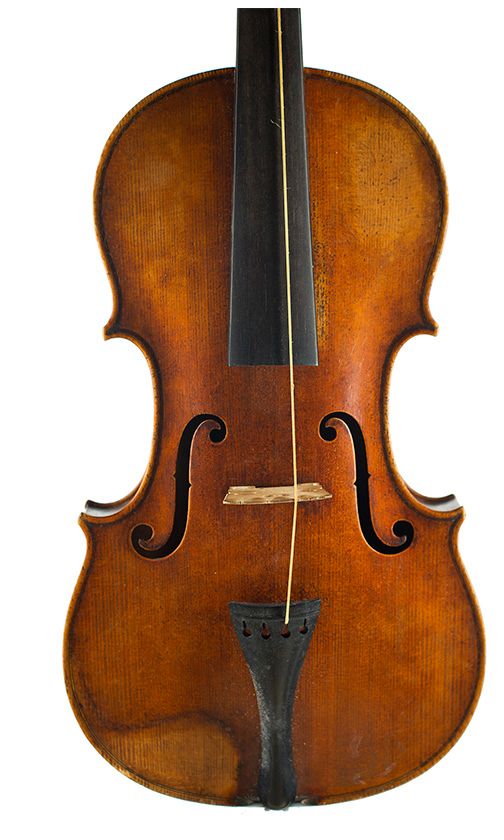
| Violin | A violin by Thomas Urquhart, London, 1680 Lot 78 | Amati | June 2019 | £3,034est. £ 2,500-4,500 |
| Small Violin | Unlabelled, scroll probably later Lot 99 | Ingles & Hayday | March 2018 | £8,400est. £ 7,000-10,000 |
| Small Violin | Unlabelled, scroll probably later Lot 100 | Ingles & Hayday | October 2017 | £9,360est. £ 10,000-15,000 |
| Violin | 34.7 cm London, 1670 c. (the scroll later) Probably by | — | June 2010 | £9,000 |
| Violin | London, 1681 | — | July 2004 | £1,553 |
| Violin | 1670 | — | June 2002 | £7,768 |
| Violin | 168- | — | April 1991 | £2,640 |
| Violin | 1680 c. | — | April 1987 | £2,640 |
| Violin | 1680 c. | — | November 1985 | £3,080 |
No results match those filters.
Maker Overview
Life
Thomas Urquhart (circa. 1629-c.1698) was an important early British maker, active in London about 1650-80. His origins are unclear but probably lie in Inverness, Scotland. Authenticated labels for Urquhart are rare, but most published sources indicate that he worked on London Bridge. Various music shops were located on London Bridge during this period, including that of John and Elizabeth Miller, who may have acted as agents for Urquhart. His work has also been found bearing the labels of John Shaw, the owner of another music shop in The Strand. No records have been found for his own habitation in the city or its environs.
Characteristics
- Workmanship
- Thomas Urquhart's work is quite fastidious, appearing to be on an Amati model, with some instruments featuring slightly pinched arching, while others are slightly more bulbous and Brescian. His style may be considered as resembling that of Jacob Rayman.
- Models
- His violins are of two sizes, some on a small pattern and others on a large pattern, both of which are described as very highly arched. One contralto viola has been recorded, but no cellos are known.
- Construction Details
- The corners are not very prominent or are described as blunt. The purfling is narrow and placed close to the edge, being remarkably neat with an extended mitre in the corners. Corners may be shaped to a flattened arrow-shaped point rather than a simple squared-off terminus. The ribs are set into a slot cut in the inner edge of the back, a characteristic shared with contemporary Flemish makers. Scrolls usually feature a fan-shaped incised carving at the chin and drill points tracing the spiral of the volutes. Soundholes are stylized in various ways with extended pointed or spade-shaped wings.
- Varnish
- The oil varnish is of excellent quality, often yellowish-brown or sometimes red, and is similar to Italian varnish. It is also described as high-quality golden brown, quite Amati-like in appearance, although somewhat harder.
- Materials
- Urquhart generally used quite plain materials, probably of local species.
- Tone
- The tone of his instruments is clear and silvery, and his violins are considered excellent in tone.
- Labels
- Manuscript labels include 'Thos Urquhart 1681'. Printed labels include 'Tho. Urquhart, 166..' and 'Tho. Urquhart Fecit Londini 1646'.
Influence and legacy
- Training: Thomas Urquhart may have worked with Jacob Rayman, and it is possible that he emerged from the same school as Rayman.
- Mentorship: He may have been the teacher of Edw. Pamphilon.
- Rarity: Instruments made by Thomas Urquhart are considered rare.
- Recognition: His violins have often been mistaken by non-experts for genuine Stainer or even Gasparo da Salò instruments.
- Exhibitions: Works by Thomas Urquhart were exhibited at the Vienna Music and Theatre Exhibition (Wiener Musik- und Theater-Ausstellung).
Biographies
The overview above is drawn from the following published accounts. Read them in the original:
John Dilworth+
URQUHART, Thomas Born circa. 1629, d.c.1698 London UK. Important early British maker whose origins are unclear but probably lie in Inverness, Scotland. Authenticated labels are rare but most published sources say that he worked on London bridge. Various music shops were sited on London bridge in this period, including that of John and Elizabeth Miller who may have acted as agents for Urquhart. His work has also been found bearing the labels of John Shaw, the owner of another music shop in The Strand. No records have been found for his own habitation in the city or its environs. His work is quite fastidious, appearing to be on an Amati model, some with slightly pinched arching; others slightly more bulbous and Brescian. Many particular mannerisms characterise his work and those of contemporary English luthiers: the ribs are set into a slot cut in the inner edge of the back, like contemporary Flemish makers; and the scrolls usually have a fan-shaped incised carving at the chin and drill points tracing the spiral of the volutes. Purfling is remarkably neat, with an extended mitre in the corners. Corners may be shaped to a flattened arrow shaped point rather than a simple squared off terminus. Soundholes also are stylized in various ways with extended pointed or spade shaped wings. Varnish is of high quality golden brown, quite Amatis� in appearance, although somewhat harder. Quite plain materials in general, probably of local species. No cellos known. One contralto viola recorded. Manuscript label: Thos Urquhart 1681 Printed labels: Tho. Urquhart, 166.. Tho. Urquhart Fecit Londini 1646 [BVMA]
Cecie Stainer+
A maker in London about 1650-80; he was probably a Scotchman. His work resembles that of Jacob Rayman, with whom he may have worked, and shows great merit for the period at which he lived. His violins are of two sizes, some on a small, others on a large pattern, very arched, the corners not very prominent, the purfling narrow and placed close to the edge; the oil varnish, of a yellowish-brown or sometimes red colour, is of excellent quality, and is similar to Italian varnish; the tone is clear and silvery. His instruments are rare.
William Meredith Morris+
The best part of the work is the varnish, which very closely resembles the Italian varnish. I have seen only one genuine violin of his make, which was much arched, and had a sweet but very small tone.
George Hart+
Nothing is known concerning the history of this excellent maker. The style may be considered as resembling that of Jacob Rayman, and it is possible that he worked with him. His varnish is equal to that on many Italian instruments.
Willibald Leo Lütgendorff+
Dem Namen nach muss er aus Schottland stammen. Er durfte aus derselben Schule wie Jakob Rayman hervorgegangen und der Lehrer Edw. Pamphilon’s gewesen sein. Er hatte ein grosses und ein kleines Modell, beide sehr hochgewölbt, mit ziemlich stumpfen Ecken. Seine Arbeit ist recht gut; der Lack von gelbbrauner oder röthlichbrauner Farbe, ist überraschend schön. Auch im Ton sind seine Geigen vorzüglich, die von Nichtkennern schon oft für echte Stainer oder gar Gasp, da Salò genommen wurden. Arbeiten von ihm waren u. A. auf der Wiener Musik- und Theater-Ausstellung zu sehen. (Vgl. Katalog, England. S. 18.)
Henri Poidras+
Very fine brown- red varnish. Very high model.
Sell your instrument with Amati
Get started by uploading photos of your instrument for our experts to review.
Sell your instrument with Amati
Get started by uploading photos of your instrument for our experts to review.