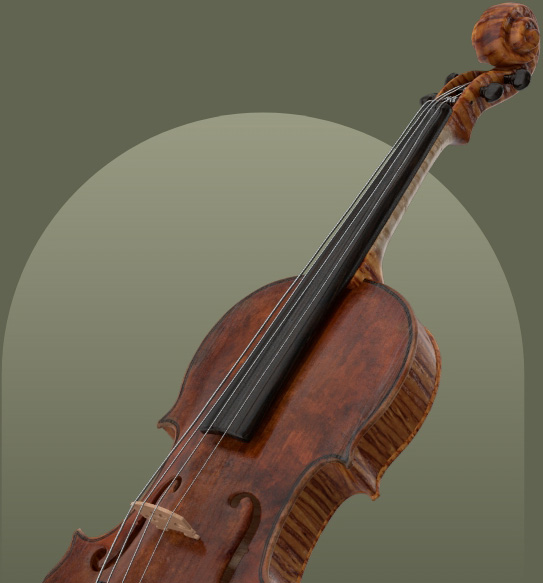
Jean Cornelius Vauchel
1782–1856
Jean Cornelius Vauchel (1782-1856) was a German luthier of French descent, born in Offenbach. He trained in Paris with Tourte, establishing himself in Würzburg around 1809 as luthier to the Grand Duke and the court of Tuscany. Vauchel's mature work, influenced by the classical Cremonese school, is noted for its fine and accurate workmanship, with instruments valued by artists like Niccolò Paganini and Louis Spohr for their Italian quality of tone. Despite his eccentric personal habits, including pigeon breeding, he was considered one of the best violin makers of his time.
Request an expert valuation or learn how our global auctions achieve the highest prices for your instruments.
Maker Overview
Life
Jean Cornelius Vauchel (1782-1856) was born in Offenbach, Germany, in 1782, the son of French refugees., his father, Joseph Maria Vauchel, was an engraver who had come to Germany as a political refugee. After the outbreak of the French Revolution, his father returned to Paris with his family, where Jean Cornelius Vauchel learned violin making and worked for Tourte, with whom he was also friends. He later returned to Germany alone, establishing himself in Würzburg around 1809 as luthier to the Grand Duke. He was also appointed maker to the court of Tuscany. Vauchel worked in various locations, including Damme and Mainz, before retiring to Schweinheim in 1853. Lütgendorff notes that Vauchel was described as an eccentric character, dedicating his free time to pigeon breeding in Schweinheim. After an incident where local youths shot his pigeons, he moved to Damm near Aschaffenburg in 1853, purchasing a small property at lit. A. Haus No. 7, where he set up a workshop with his assistant, J. Reiter. He avoided most social interaction, only occasionally conversing with a Frenchman named Régnier (or Renier). Vauchel died in 1856 in Schweinheim, Germany, and was buried on January 13, 1856, in Aschaffenburg, not in Damm, according to his last wish.
Characteristics
- Subheading
- Early Work:'s early work is characterized by high arches and is considered unremarkable.
- Subheading
- Mature Period: His mature period shows a stronger influence from the classical Cremonese school and is regarded as more successful.
- Subheading
- Workmanship: Dilworth describes his workmanship as fine and accurate. Lütgendorff adds that he worked with impeccable care, possessed fine sensibility, and valuable knowledge of acoustic laws.
- Subheading
- Varnish: The varnish on his instruments was inconsistent, but the best examples are of very fine quality.
- Subheading
- Tone Quality: Henri Poidras states that his instruments are valued by artists for their Italian quality of tone. Lütgendorff further emphasizes that the tone of his violins very closely approaches that of genuine Italian instruments.
- Rep von J Vauchel
Darmstadt
1815John Dilworth - J. Vauchel d’Offenbach
fecit 1850John Dilworth - J. Vauchel d’Offenbach fecit et
von J.Reiter, dessen Eleven aus Mittenwald à Isar
Vollendet in Damm
bei Aschaffenburg
Anno 1857John Dilworth
Influence and legacy
- Subheading: Mentorship: Jean Cornelius Vauchel worked for Tourte in Paris and confirmed by Willibald Leo Lütgendorff, who also notes their friendship.
- Subheading: Assistant/Student: He left his shop in the care of his assistant, J. Reiter of Mittenwald, upon his retirement. Lütgendorff identifies Reiter as his apprentice and notes that Reiter completed all unfinished works and acquired Vauchel's tools from his heirs.
- Subheading: Patronage: Vauchel was enthusiastically supported and highly esteemed by renowned virtuosi of his period, including Niccolò Paganini and Louis Spohr.
- Subheading: Recognition: His instruments were well-paid for, and he was considered one of the best violin makers in the world by figures like Spohr and Paganini.
- Subheading: Tombstone: A violin was engraved on his tombstone in Aschaffenburg, marking his profession and artistic legacy.
Further Information
- Subheading: Workshop Locations: Vauchel worked in Offenbach, Paris, Würzburg (from circa 1809), Damme, and Mainz. He retired to Schweinheim in 1853 and later moved his workshop to Damm, specifically at lit. A. Haus No. 7.
- Subheading: Labels: John Dilworth provides examples of his manuscript labels, including "Rep von J Vauchel / Darmstadt / 1815", "J. Vauchel d'Offenbach / fecit 1850", and "J. Vauchel d'Offenbach fecit et / von J.Reiter, dessen Eleven aus Mittenwald à Isar / Vollendet in Damm / bei Aschaffenburg / Anno 1857".
- Subheading: Personal Habits: Willibald Leo Lütgendorff describes Vauchel as a peculiar individual who dedicated his free time to pigeon breeding. He was also known for his distinctive attire, wearing a brown top hat and a long coat that reached below his knees when he went out.
Biographies
The overview above is drawn from the following published accounts. Read them in the original:
John Dilworth+
VAUCHEL, Jean Cornelius Born 1782 Offenbach, died 1856 Schweinheim Germany. Son of French refugees in Offenbach. Worked for Tourte in Paris. Moved back to Offenbach and established in Würzburg from c.1809 as luthier to the Grand Duke there. Also appointed maker to the court of Tuscany. Worked in Damme and Mainz, finally retiring to Schweinheim 1853 leaving his shop in the care of his assistant J. Reiter of Mittenwald. Early work is high-arched and unremarkable, but his mature period is more influenced by the classical Cremonese school and more successful. Fine and accurate workmanship. Varnish inconsistent, but the best is of very fine quality. Enthusiastically supported by Paganini, Spohr, and other virtuosi of the period. Manuscript labels: Rep von J Vauchel / Darmstadt / 1815 J. Vauchel d’Offenbach / fecit 1850 J. Vauchel d’Offenbach fecit et / von J.Reiter, dessen Eleven aus Mittenwald à Isar / Vollendet in Damm / bei Aschaffenburg / Anno 1857
Willibald Leo Lütgendorff+
Sein eigentlicher Name soll Vauchelle gewesen sein; er war der Sohn eines Franzosen, der als politischer Flüchtling nach Deutschland gekommen war und da sein Brod als Graveur zu verdienen suchte. Nach dem Ausbruch der Revolution kehrte der Vater mit seiner Familie wieder nach Paris zurück, wo Jean V. das Geigenmachen erlernte und auch bei Tourte, mit dem er befreundet war, arbeitete. Er scheint dann allein nach Deutschland gegangen zu sein; wann er nach Würzburg kam, liess sich nicht feststellen, am 4. Juni 1819 aber war er dort schon als Hof-Geigenmacher ansässig. Vorübergehend scheint er auch in Mainz gearbeitet zu haben. Er brachte es zu Ansehen und fand vielseitige Anerkennung. In seinem Tagebuch findet sich die Bemerkung: »Mein Vater Joseph Maria Vauchel entflieht am 27. Dec. 1827.« Er scheint also zu den Feinden des Ministeriums Karls X. gehört zu haben und dürfte seinen Lebensabend bei seinem Sohne beschlossen haben. Vauchel wird stets als ein sonderbarer Kauz geschildert; um 1850 lebte er in dem Dorfe Schweinheim bei Aschaffenburg und verwendete alle seine freie Zeit auf die Taubenzucht. Als aber Schweinheimer Burschen auf seine Tauben schossen, zog er nach Damm bei Aschaffenburg, wo er sich 1853 das kleine Anwesen lit. A. Haus No. 7 kaufte. In einem Nebengebäude richtete er sich eine Werkstatt ein, wo er mit seinem Gesellen Reiter aus Mittenwald fleissig arbeitete. Er vermied selbst mit den nächsten Nachbarn jeden Umgang und verkehrte nur hie und da mit einem Franzosen Namens Régnier (oder Renier), der in der Dammer Porzellanfabrik in Stellung war. Seine Geigen wurden ihm gut bezahlt; Spohr und Paganini schätzten ihn als einen der besten Geigenmacher der Welt, und er konnte behaglich leben. Auch in Damm umgab er sich mit allerlei Geflügel und hatte eine schön eingerichtete Wohnung, in der es mancherlei kostbare Alterthümer und dgl. zu sehen gab. Er war nicht verheirathet, doch brachte er eine Haushälterin nach Damm mit, die einen dreijährigen Sohn besass, als dessen Vater Vauchel bezeichnet wurde. Personen, die sich des Meisters noch erinnern, schildern ihn als einen grossen, hageren Mann, der, wenn er ausging, stets einen braunen Cylinder und einen bis tief unter die Kniee reichenden, langen Rock trug. Er war sich seines Werthes wohlbewusst und liess von dem Preise, den er für seine Geigen forderte, keinen Pfennig ab. Als ein Händler einst eine Geige bei ihm bestellte und nachträglich zu feilschen begann ergriff der leicht zum Zorne gereizte Vauchel seine Arbeit und zerschlug sie in tausend Stücke. Seinem letzten Wunsche entsprechend wurde er nicht in Damm, sondern (am 13. Januar 1856) auf dem Friedhofe in Aschaffenburg begraben. Sechs Männer trugen ihn von Damm zum Kapuziner- oder Karlsthor nach Aschaffenburg, und von dort begleiteten ihn drei Geistliche zu seiner letzten Ruhestätte Auf seinem Grabstein ward eine Geige eingemeisselt. Vauchel war zweifellos eine echte Künstlernatur, der mit tadelloser Sorgfalt arbeitete, feines Empfinden und werthvolle Kenntnisse der akustischen Gesetze besass. Der Ton seiner Geigen kommt in der That dem echter italienischer sehr nahe. Sein Schüler I. B. Reiter vollendete noch alle unfertig hinterlassenen Arbeiten und erwarb von den Erben schliesslich Vauchel’s Werkzeuge.
Henri Poidras+
Mayence 1782-1856. Frenchman established in Germany. His instruments are valued by artists for their Italian quality of tone.
Sell your instrument with Amati
Get started by uploading photos of your instrument for our experts to review.
Sell your instrument with Amati
Get started by uploading photos of your instrument for our experts to review.