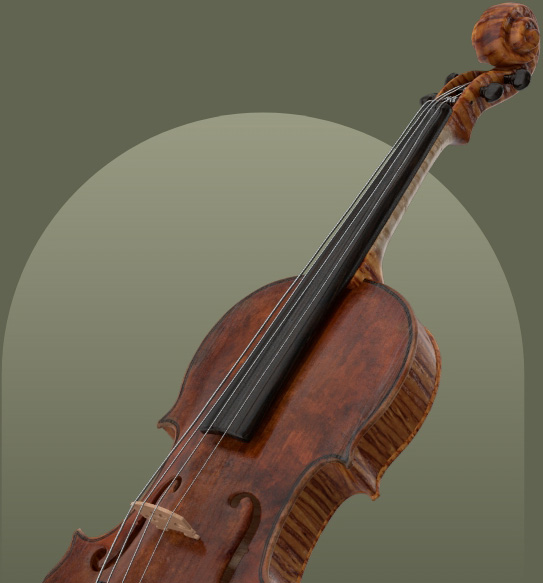
Giacomo Zanoli
Verona, worked 1725–1765
Giacomo Zanoli, active circa 1725-1765, was an Italian luthier and the son of Giovanni Battista Zanoli. He worked in Venice, Padua, and Verona, eventually taking over his father's workshop in Verona. His craftsmanship is characterized by a distinctive scroll, specific arching, and a fine golden-yellow brown varnish. While some sources praise his 'very fine work' and 'excellent cellos' that are 'much sought after', others describe his work as 'without artistic merit'. His instruments, particularly cellos, are noted for their powerful appearance and have commanded significant market value.
Request an expert valuation or learn how our global auctions achieve the highest prices for your instruments.
Auction Price History
Highest auction price
7 results
| Type | Details | Auction house | Sold | Price |
|---|---|---|---|---|
| Violin | Violin, 1750-60 c. Lot 186 | Tarisio | May 2025 | £43,792est. $ 50,000-80,000 |
| Violin | Labelled Fato in Verona di Giacomo Zanoli 175... Lot 115 | Tarisio | March 2024 | £46,109est. $ 50,000-80,000 |
| Violin | Labelled Petrus Guarnerius filius Joseph Cremonensis fecit. Venetiis Lot 155 | Sotheby's | October 2012 | £21,250est. £ 18,000-25,000 |
| Violin | 35.1 cm Verona, 1758 (table possibly by "Giorgio Seraphin") | — | November 2008 | £28,764 |
| Violin | 1745 | — | October 1999 | £17,194 |
| Cello | 1737 | — | November 1996 | £41,100 |
| Cello | 1750 c. | — | June 1988 | £41,800 |
No results match those filters.
Maker Overview
Life
Giacomo Zanoli (circa 1725-1765) was the son of Giovanni Battista Zanoli. Evidence suggests his presence in Venice. An internal inscription of 'Padua 1737' on one of his cellos, as documented by John Dilworth, indicates his activity there. Karel Jalovec states that he worked in Venice and came to Padua in the 1740s, remaining there until his father's death. Lütgendorff suggests he returned to Verona after his father's death to take over the inherited workshop. Jalovec specifies his move from Padua to Verona occurred between 1755 and 1758. Inscriptions such as 'Giacomo Zanoli fece in Verona, 1741' and 'Fato in Verona di Giacomo Zanoli 1752' further confirm his work in Verona.
Characteristics
- Workmanship
- John Dilworth describes his work as very fine, often based on a Stainer-derived model, featuring medium-height arching of a somewhat square cross-section, small corners, upright soundholes, and a distinctive scroll with a large, nicely symmetrical concentric volute. His pegbox is noted as fairly long and slender with a very parallel back face and a narrow chin. Dilworth also highlights his excellent cellos, which possess a powerful, Montagnana-like appearance.
- Materials & Varnish
- Dilworth notes the use of walnut for linings and large pins in the upper and lower back. His varnish is described as a fine, rich, and transparent golden-yellow brown by Dilworth, and a wonderful brown-yellow or brown-red by Karel Jalovec.
- Models & Patterns
- Sources contain conflicting information regarding the primary models used by Zanoli. John Dilworth indicates a Stainer-derived model, while Karel Jalovec states that the arching of his instruments was almost always designed on the model of Guarneri del Gesu, and that he worked on various patterns. Henri Poidras notes that his violins recall those by Landolphus.
- Instrument Types
- Willibald Leo Lütgendorff mentions that his violas and cellos are the most common. Henri Poidras states that he made 'cellos that are much sought after.
- Artistic Merit
- Sources also present conflicting views on the artistic merit of his work. John Dilworth praises his 'very fine work' and 'excellent cellos'. Henri Poidras notes his 'cellos that are much sought after'. Conversely, Willibald Leo Lütgendorff states that his work is 'ohne Kunstwerth' (without artistic merit).
Influence and legacy
- Family Tradition: Giacomo Zanoli was the son of Giovanni Battista Zanoli, indicating a likely training and influence within a family workshop tradition.
- Market Value: Karel Jalovec reports that his instruments were valued at 40,000 Kc, with some works exceeding 100,000 Kc. Henri Poidras notes that his 'cellos are much sought after.
Biographies
The overview above is drawn from the following published accounts. Read them in the original:
John Dilworth+
ZANOLI, Giacomo Worked circa. 1725-1765 Verona Italy. Son of Giovanni Battista Zanoli, below. Evidence exists to show his attendance in Venice in 1742, and one cello has an internal inscription ‘Padua 1737’. Very fine work on Stainer-derived model. Medium height arching of somewhat square cross-section. Small corners, upright soundholes, distinctive scroll with large concentric volute nicely symmetrical, fairly long slender pegbox with very parallel back face, narrow chin. Excellent cellos of powerful Montagnana-like apperance. Fine rich and transparent golden-yellow brown varnish. Walnut used for linings. Large pins in upper and lower back. Giacomo Zanoli fece in Verona, 1741 Fato in Verona di Giacomo Zanoli 1752
Cecie Stainer+
Worked in Padua,
Willibald Leo Lütgendorff+
Sohn des Giov. Batt. Z. Anfangs arbeitete er in Venedig und soll um 1740 in Padua gewesen sein. Er kehrte jedenfalls nach dem Tode seines Vaters nach Verona zurück, wo er die ererbte Werkstatt übernahm. Seine Arbeit ist ohne Kunstwerth. Am häufigsten kommen seine Violen und Violoncelli vor. Seinen Venezianer Zettel scheint er selbst gesetzt und gedruckt zu haben.
Henri Poidras+
Son of one above mentioned. This maker worked at Venice and made ‘cellos that are much sought after. His violins recall those by Landolphus.
Karel Jalovec+
Venice, Padua, Verona 1730 — 63. Son of Giov. Bapt. Zanoli. He worked in Venice and came in the forties of the 18th century to Padua, where he stayed until his father’s death. From Padua he moved, in the years 1755 — 58, to Verona, where he took over his father’s workshop. He worked on various patterns, the arching of his instruments is, however, almost always designed on the model of Guarneri del Gesu. His best instruments are of large pattern, beautiful low arching, broadly rounded-off edges, neatly finished purfling. He applied a wonderful brown-yellow or brown-red varnish. Price 40.000 Kc; some of his works, however, are valued at far above 100.000 Kc.
Sell your instrument with Amati
Get started by uploading photos of your instrument for our experts to review.
Sell your instrument with Amati
Get started by uploading photos of your instrument for our experts to review.