
The Monograph Collection · I
The Monograph Collection · I
Antonio Stradivari
‘La Pucelle’ Violin, 1709
By John Dilworth · Edited by John Milnes
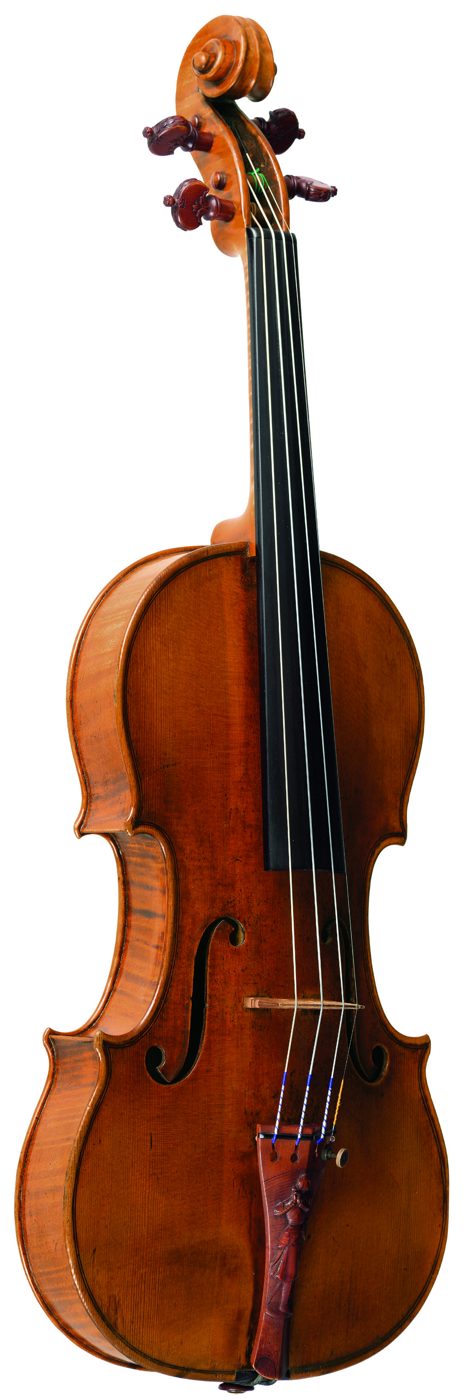
“Almost certainly the finest Stradivari that is not in a museum, and certainly the best preserved.” The first title in the Amati / J & A Beare Monograph Collection examines the Golden Period violin named by Vuillaume for its untouched condition.
First published 2014 by Usk Publishing Limited, London · ISBN 978-0-9573499-1-9 · 48 pages · Text © John Dilworth
| Maker | Antonio Stradivari |
| Instrument | Violin |
| Date | 1709, Cremona |
| Form | ‘P’ form (dated 1705) |
| Back length | 353 mm |
| Present owner | David Fulton |
| Photography | Tucker Densley & John Milnes |
1709: an astonishingly productive year
Provenance: Tarisio, Vuillaume and the Clarks
The history of ‘La Pucelle’ is reasonably clear. It is thought to have been among the many Cremonese masterpieces brought to Paris around 1840 by the eccentric Piedmontese dealer and collector Luigi Tarisio. It was purchased in that year by the Parisian master luthier Jean-Baptiste Vuillaume, who recorded that it still had its original bass bar and neck. Having coined for it the name ‘La Pucelle’ in acknowledgement of its pure condition, he provided a tailpiece depicting Joan of Arc, ‘the maid of Orleans’ (or ‘la Pucelle’ in French). This elegant boxwood tailpiece is still attached to the violin. Vuillaume sold the instrument eleven years later to a banker named Leroy de Chabral, who in turn sold it in about 1870 to a Monsieur Glandaz of Paris. It was recorded by Charles-Eugène Gand in his notebook in that year, already under Glandaz’ ownership. (Gand also mentions a prior owner, ‘Herman’, about whom nothing else is currently known.) Vuillaume obviously kept an eye on the glorious violin, for in 1870 he brought it, along with the ‘Messie’, and the ‘Diable’ by Guarneri del Gesù, to the South Kensington Loan Exhibition in London. Thus the ‘Virgin’, the ‘Messiah’ and the ‘Devil’ were on display side by side. It was a grand coup for Vuillaume, already in semi-retirement but forced in the previous year to protect his instruments from the Communard uprising in Paris. It was possibly one of his last acts as an internationally admired and respected expert and luthier. He died only three years later. ‘La Pucelle’ was photographed as item no. 90 for the Loan Exhibition catalogue compiled by Carl Engel (published 1872), and until the Stradivari exhibition in the Ashmolean Museum, Oxford in 2013, this was the only time it was seen on public display.

Photo © John Milnes
The violin remained in Glandaz’ ownership until his death in 1878. Put up for auction at the Hotel Drouot in Paris with a reserve of 10,000 francs, it was bid up to 22,100 francs but bought in at that price by Glandaz’ son. Such was the excitement during the sale that several people standing on a table to get a better view fell, but fortunately the violin was unharmed. It was subsequently proposed that the violin be presented to the Paris Conservatoire, but negotiations fell through, and in 1904 it was brought to London by Alfred Hill. In that same year the Hills sold it to R. C. Baker, an English city merchant living in Nutfield, Surrey. He owned the ‘Viotti-Bruce’ Stradivari (also dated 1709), which he sold in 1924 through Hills, but he retained ‘La Pucelle’ as his last companion, having no children or other deserving heirs to whom he cared to leave it. In 1924 the Hills valued the violin at more than £5,000, having given a figure of £800 around the time of Baker’s purchase twenty years earlier. It did eventually return to Hills in 1937 and was sold in 1942 to Robert A. Bower, a dedicated collector, and owner of the magnificent 1721 ‘Lady Blunt’ violin amongst many other Stradivaris, as well as the ‘Rode’ and ‘Vieuxtemps’ violins by Guarneri del Gesù.
By 1946 it was in the hands of J. Frank Otwell of Wilmington, Delaware, USA, in which country it has remained ever since. It was purchased in 1956 by Anna E. Clark of New York through Wurlitzers for her daughter Huguette M. Clark. The Clark family were phenomenally rich and influential, their money made from copper mining in the nineteenth century. Anna Clark was a great patron of the arts, and, to assist the violinist Henri Temianka and the cellist Robert Maas to form their own ensemble, she purchased the ‘Paganini quartet’ in 1946. These instruments had all been owned by Paganini, and thus provided the name of the new quartet, which went on to become one of the most admired of the twentieth century. She acquired ‘La Pucelle’ in 1956 as a gift to her daughter Huguette on her fiftieth birthday. In later years Huguette became something of a recluse. In 2001 at the age of 95 she relinquished ‘La Pucelle’, although she lived for a further ten years, dying in 2011. The sale was negotiated by Charles Beare, who offered it to its present owner David Fulton with the words: ‘I have in my hand the very best Strad that will ever be available to you, almost certainly the finest Stradivari that is not in a museum, and certainly the best preserved’. Fulton’s purchase ended a long period of anonymity for this wonderful violin, although restoration carried out earlier by Simone Sacconi at Wurlitzers in New York enabled Sacconi to publish photographs of the interior in his great work I ‘Segreti’ di Stradivari (Cremona, 1972). David Fulton’s generosity enabled the violin to be publicly displayed for only the second time in its life at the Ashmolean Museum, Oxford in 2013, and for the very first time it can now be heard on a recording: ‘Homage’ played by James Ehnes (Onyx Classics, 2008).
The label
‘La Pucelle’ has a beautifully well preserved label, comparable in freshness with that of the ‘Messie’ violin of 1716. It is stylistically and historically a perfect match for the two Viotti instruments, in particular the ‘Viotti-Bruce’ alongside which it was displayed at the Ashmolean in 2013.

Photo © John Milnes
The ‘P’ form
Wood and materials
As always in this period, Stradivari’s selection of materials is superb. He obviously had at his disposal the first choice of imported maple and we may speculate that the timber merchants from the Alps and the Balkans made the Casa Stradivari their first call. Dendrochronology reveals that the same log of spruce often appears in small groups of instruments closely linked chronologically, suggesting that Stradivari acquired his wood in batches probably already split and cut into suitably sized wedges. (The notion that he bought entire trees, to be floated down the Po river from the Alpine forests to his rather limited premises in Cremona, seems a little unrealistic.) In the backs the same imported maple with wonderfully close grain and deep rippling flame can be visually identified in groups of violins from the same few years. In the study of Guarneri del Gesù’s work it is plain to see that the same piece of maple occurring in several instruments of the 1734 – 1736 period, with the flame disposed in exactly the same way, showing that the wedges were from the same log, already cut to length. Similarly, the distinctive marking of the back of ‘La Pucelle’, with a noticeable broadening and dislocation of the flame in the upper bouts, appears in precisely the same position in the ‘Magaziner’ of 1710. It would seem that these two violins were made by Stradivari from four book-matched wedges of maple adjacent to each other in the same maple log.


Photo © Tucker Densley, courtesy of the Ashmolean Museum
The back
The back of ‘La Pucelle’ is notable for the unusually low and slightly convex area of arching in the middle of the upper bout (see the side views below). It has been suggested that Stradivari uncharacteristically made an error with his gouge in carving the back. An alternative view is that the wood settled slightly during seasoning. The extremely deep and broad flame in this area could be the reason for this, and also the idea that the classical Cremonese did not, in contradiction to most traditional theories of violin making, attach much importance to long seasoning for the wood. Dendrochronology of the spruce used for the table indicates that the wood was commonly no more than a dozen years old when used, and often virtually fresh (especially in the case of Guarneri del Gesù). We have as yet no way of measuring the seasoning time of the maple in the rest of the instrument, but the period may well have been similar, since the 20mm thickness required very little time to dry sufficiently for practical purposes. Signs of warping and twisting due to continued seasoning ‘in situ’ are not uncommon on classical instruments. There are certainly signs that the back centre joint of ‘La Pucelle’ has been under stress in this upper area.


Photo © Tucker Densley, courtesy of the Ashmolean Museum
The front
The ribs
The ribs and scroll are made of very similar wood to the back, although it is hard to say if they originate from the same log. The lower ribs are both formed from the same continuous piece, and it looks as if the upper ribs were made in the same way, although the neck makes this difficult to assess reliably. The lower rib has in fact been cut and the joint filled with a purfling strip. This is a common repair made necessary by the strong differential shrinkage of the differently disposed grain in the wood of the back, front, and ribs.


Photo © John Milnes
The middle bout ribs are both turned so that the flame lies in the opposite direction; something that Stradivari generally preferred not to do. As is usual in such well-preserved instruments, it is clear that the rib garland was made to a consistent depth of 32.5mm, apart from a taper starting just beyond the upper corners down to the upper block, where the height is reduced to 30.5mm. The purpose of this taper, which imparts some bending force to the front of the instrument, is not completely clear; perhaps to provide strength or extra resonance, or both.
In the upper corners of the middle bouts are deep creases and even splits in the flame as a result of bending the maple to such a tight radius. This feature seen fairly often in Stradivari’s instruments and reveals a pragmatic approach beneath his apparent perfectionism. Also faintly visible are irregular knife marks on the edges of the ribs, possibly from the tip of the knife used to chamfer and round off the overhanging edges of the front and back after assembly.

Photo © John Milnes
Internal structure
Corners and purfling
The corners are worth studying carefully. The shape and length of Stradivari’s corners varied to quite a degree during his career, and can help pinpoint a very close period in which any instrument was made. Almost from the beginning the corners are heavier, broader, and more substantial than those seen in Amati work. But in the Long Pattern instruments of the 1690 – 1700 period, the upper corners were made longer, with a discernible downward curve; the result of the tight inner curve of the middle bout being extended as the base line for the corner. This slight delicate droop to the upper corners continued into the 1700s, and is still just noticeable in ‘La Pucelle’. By 1716, as we can see from the ‘Messie’, Stradivari’s corners had developed their full strength in both upper and lower bouts. The poplar and dyed pear wood purfling contained within these corners and edge is quite broad by Stradivari’s standards. Like the corner work, the purfling is always a useful indicator of period. It seems logical that Stradivari made up his purfling in batches, which then provided the inlay for all his output in a given period, and it is usually identical in violins, cellos, and violas made within the same years. The breadth of the purfling brings a strength and solidity to the edge and is another testimony to the master’s skill. The inlay is even and unfaltering, the beautifully formed points in each corner finished by eye, and departing from the curve of the upper and lower bout to provide the characteristic deflected ‘bee-sting’. As is always the case with Stradivari, the point of the ‘sting’ is a continuation of the outer black layer of the middle bout purfling. Under close examination these points are delightfully variable and not as mechanically perfect as is sometimes imagined. The initial marking lines for the subtly deflected ‘bee stings’ are visible, and even slight misalignments between the two strands of purfling.

Photo © John Milnes
The upper and lower bands are joined on the centre line of the back with a short sloping scarf cut. This falls on the small pin on the lower bout, the common Cremonese point which was evidently used to locate the back on the rib garland accurately during assembly. It also conveniently shows us that Stradivari purfled the instrument after the soundbox had been closed; the purfling cuts across the pins which lie beneath, having evidently been finally fixed in place at an earlier stage. A similar pin is present in the top bout, but it is almost completely obscured by the purfling. The arching rises from the purfling to a modest height, shaped by Stradivari’s familiar subtle and consistent hand. Although low, it is not hollow or weak.


Photo © John Milnes
Arching
The soundholes
The soundholes are wonderfully elegant and beautifully finished, as one would expect. They sit with great poise and balance on the front, the edges still looking sharp enough to cut paper. Comparing these virtually perfect soundholes with those on other celebrated instruments by Stradivari brings home the great variation observable in position, inclination, widths, and even symmetry in the work as a whole. These particular soundholes on ‘La Pucelle’ are cut with a quite generous width in the arm, a feature going back to the 1680s. Amongst these and later examples there are soundhole pairs that lean inwardly at the upper hole, and later there appear soundholes cut with a slender arm, set sometimes very upright and parallel. Then, in the Golden Period and beyond, there appear mixtures of all these traits in pairs of soundholes on the same instrument. The explanations for all this apparently random treatment lie in the techniques Stradivari used to draw out the soundholes and the obvious fact that there were more than one pair of hands at work in the atelier. It is widely assumed that Stradivari laid out the soundholes on the inner surface of the table. It would be characteristic of him to want to avoid leaving any unsightly traces of the marking-out process on the exterior. The evidence of many, perhaps even most, Cremonese instruments where traces have remained indicates that other makers did lay out the soundholes on the logical place: the outer surface. If the cut is made to a line inscribed on the inside, very slight changes in the vertical angle of the knife blade will produce quite observable difference on the outer surface. This can be seen in Stradivari instruments.

Photo © John Milnes
On ‘La Pucelle’ the outer line of the soundhole is cut at an almost vertical angle. The inner line has a strong inward lean, giving the appearance from the outside of a deep undercut. This obviously affects the finished appearance of the soundhole. Another well-understood Stradivarian technique was to pierce the table with circular cutters specific to the different diameters of the upper and lower holes. These cutters follow the grain of the wood, and also the outward curvature of the arching in the vertical plane, and thus always cut radially to the arch. But the greatest noticeable variation in the soundhole disposition on Stradivari instruments is in the location of the terminal circles. Stradivari placed these holes relative to the ribs, measuring in from the border rather than out from the centre line of the instrument. Thus the spacing and position of the holes is entirely dependent on the distance between ‘C’ bout ribs and the accuracy of their fitting and shaping, rather than as a consistent stepped measurement from a marked centre line. Furthermore, the entry hole for the circular cutter is very easily displaced by the hard winter grain of the spruce, and inevitably there is a degree of accidental variation. Comparing the lateral spacing of both upper and lower holes in various instruments, there is a difference of up to 9mm from the widest to the narrowest examples. The setting of the soundholes on ‘La Pucelle’ in fact fits the lower median in both regards; the spacing of both upper and lower holes are just slightly below the average measurements for the Golden Period. As a very rough generalisation, it may be said that while the widest setting of the upper holes appears in the later years, the widest setting of the lower circles tends to occur in the 1710 – 1716 period.


Photo © John Milnes
A strong asymmetry is noticeable in the upper wings of the soundholes. On the treble side the upper wing is short and the apex of the upper curve closer. On the bass side the upper wing is a little longer, perhaps more elegant, and the upper curve has a higher tighter radius. This gives the treble soundhole a closer stylistic link to those of the ‘Archinto’ viola and the cellos of this period. Whether this is an accident of cutting or a deliberate expression is impossible to say.
Perhaps the height of subtle craftsmanship lies in the fluting of the lower wings. A part of the Cremonese art since the very first known works of Andrea Amati, Stradivari concentrated a great deal of effort on this detail. His soundhole design provides much greater width to the wings, and consequently the way they are incorporated into the flow of the surrounding arching becomes more visually important. Stradivari seems to have established the modelling of the lower wing with an initial deep and tightly radiused gouge cut, which flows from the tip of the wing right up to, and often beyond, the nick at the centre of the arm and gives a very sharply raised edge to the lower part of the soundhole. After this, the whole area between the soundhole and the purfling is blended with scrapers, through the lower hole to a beautifully straight broad channel that throws the arching of the breast into sharp relief. Looking along the length of the arching from a low angle presents this clearly and reveals the slight scuffle of scraper marks that formed it. The artistry in this single minor aspect of violin making is often obscured by the wear and tear in well-used instruments, but is here as sharply defined as when Stradivari worked it.

Photo © John Milnes
The scroll
The scroll of ‘La Pucelle’ is an absolute master class in precision and harmony of line. The eye is quite delicate, and the volutes elegantly spiralled, although the chamfer is very heavy. Accentuated by the black ink applied to the wood beneath the varnish, the chamfer is cut at a flat angle, so that the greatest width appears from the side view. Seen from the front or back, the chamfer seems narrower. But overall the emphatic, precisely laid line of the chamfer balances the equally strong and precise purfling in the corners.


Photo © Tucker Densley, courtesy of the Ashmolean Museum
The thinly worn varnish on parts of the volute throws the small gouge workings into sharp contrast. As with all of Stradivari’s work, the human hand is clearly visible only a very little way below the surface. Vertical gouge cuts form the walls of each turn, and there are traces of abrasive used to smooth the surface down. Clear saw cuts form the throat of the scroll and, within the pegbox, the upper terminus has been chased back deeply under the head, possibly in repeated attempts to cut a neatly presentable surface in this restricted area. This feature is particularly marked on the later ‘Messie’ and ‘Lady Blunt’ violins.


Photo © John Milnes
The wear to the back of the pegbox on the treble side is already evident in the photographs from the 1872 London Loan Exhibition, as is the erosion of the upper treble corner on the front. It is evidence that the violin was well used in its early life, despite Vuillaume’s insistence on its purity. This kind of wear on the scroll is probably due to the action of the left hand in tuning the treble pegs while in the playing position, probably exacerbated by heavy finger rings worn by the player. That aside, it is clear from the violin’s history and ownership that other abrasion, damage, and restoration has been minimal, though at the cost of public performances on this rare and beautiful instrument.


Photo © John Milnes
The varnish
The varnish is spectacular, although it is obviously worn to a degree. Since the time of Cozio di Salabue writing in the early nineteenth century, it has been a common observation that Stradivari’s varnish was always tender, and possibly at its most vulnerable in the very first years. To makers and commentators of that post-classical period this was a strongly held criticism of Stradivari. Cozio di Salabue wrote in 1816 that his varnish did not stick properly to the wood, and would not last as long as that of the Amatis. The Bolognese luthier G. A. Marchi described his search for tougher, more tenacious, varnishes in his manuscript of 1786. These views certainly contributed to the abandonment and loss of the most beautiful, yet soft and vulnerable, recipe common to all the Cremonese masters, and used to the greatest effect by Stradivari himself. The golden-orange coloured coat lies very thinly on the ground or priming coat. There is quite deep penetration of the wood grain with colour, especially in the deep end grain of the maple figure, and in the bending creases of the centre ribs mentioned above the wood is almost stained black or gives a burnt appearance. These areas would probably been more obvious when the violin was in brand new condition, but are now part of the random pattern of wear and contusions that gives the instrument such variety and depth. The ground itself seems to carry a lot of colour, and the refractive interaction of the two layers seems fundamental to the ‘dichroic’ effect of the varnish in which different tones of colour appear with changing viewing angles, and most dramatically, with slight changes in ambient light. This gloriously coloured varnish appears in Stradivari’s work only from about 1695. Earlier work has a fine but paler coating, but a period of experimentation is apparent in the 1680s, from which the celebrated, even mythologised, Stradivari varnish emerged. This subtle red-orange recipe, already perfected on this 1709 violin, is Antonio Stradivari’s own unmistakable signature.

Photo © John Milnes
Table of measurements
Photographs
Studio photographs © Tucker Densley, courtesy of the Ashmolean Museum; detail photographs © John Milnes.
