Leopold (I) Widhalm
Nuremberg, 1722–1776
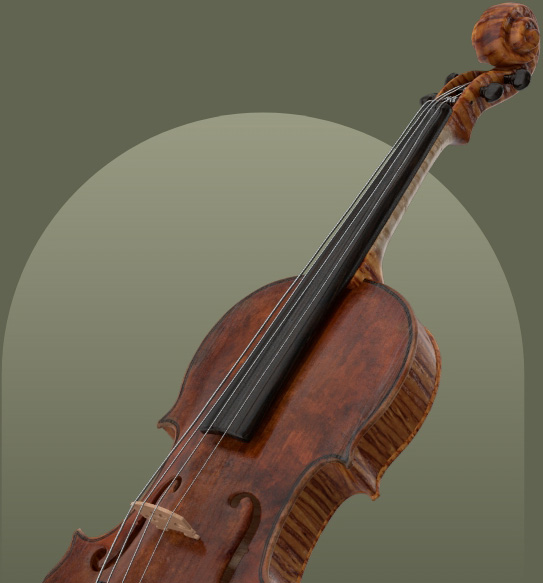
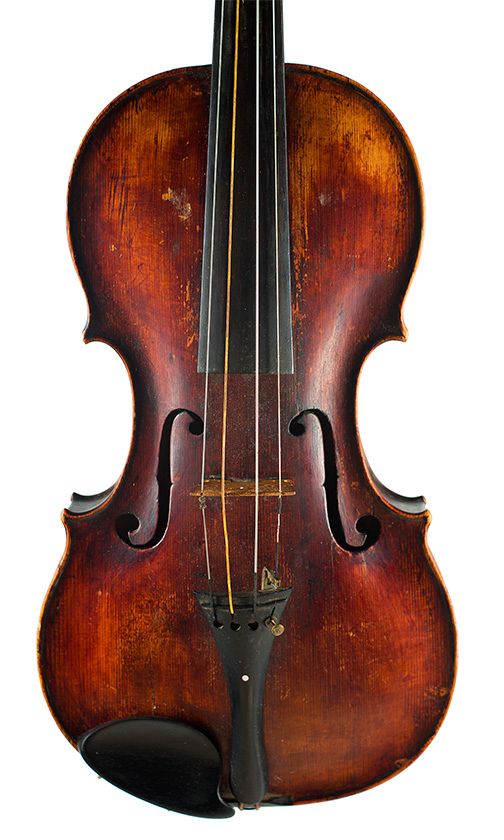
Leopold (I) Widhalm (1722-1776) was a highly regarded German luthier, active in Nuremberg from approximately 1750 to 1780, and is widely recognized as the foremost German maker following Jacob Stainer. His instruments, including violins, violas, cellos, double basses, and harps, are celebrated for their distinctive and graceful model, featuring a medium high arch, deeply fluted edges, and broad, beautifully inlaid purfling. Widhalm"s craftsmanship is further distinguished by Stainer-pattern soundholes, a scroll synthesizing Amati and Stainer designs, and particularly fine varnish ranging from golden-brown to dark orange-brown with a rich, translucent quality. He utilized excellent, carefully chosen materials. His workshop legacy was continued by his son, Martin Leopold Widlhalm, who used the same labels, often branded internally with "L.W." and sometimes a double-headed eagle.
Instruments
Auction Price History
Highest auction price
71 results
| Type | Details | Auction house | Sold | Price |
|---|---|---|---|---|
| Violin | Labelled Leopold Widhalm, Lauten-und Geigenmacher in Nürnberg fecit Anno 1745, head later Lot 69 | Ingles & H. | March 2025 | £4,800est. £ 4,000-6,000 |
| Violin | Bearing rhe maker's label and brand to the back Lot 55 | Vichy | June 2023 | £14,961est. € 9.000-11.000 |
| Violin | Bearing the maker's label and brand Lot 321 | Vichy | June 2023 | £8,549est. € 6.000-8.000 |
| Violin | Labelled Leopold Widhalm Lautten-und Geigenmacher in Nürnberg. fecit A. 1775, branded LW Lot 103 | Tarisio | March 2023 | £12,931est. $ 8,000-12,000 |
| Violin | Labelled Leopold Widhalm Lauten-und Geigenmacher in Nürnberg fecit An. 17... Lot 194 | Ingles & Hayday | November 2022 | £8,400est. £ 7,000-10,000 |
| Violin | Labelled Leopold Widhalm Lautten un Geigenmacher in Nürnberg 17..., branded LW, head later Lot 129 | Tarisio | March 2022 | £9,171est. $ 10,000-15,000 |
| Violin | Handwritten illegible label, internally branded L W Lot 202 | Freeman's | May 2019 | £2,426est. $ 3,000-4,000 |
| Violin | Later German head of 18th C. Lot 324 | Vichy | December 2018 | £4,276est. € 4.000-5.000 |
| Violin | edges doubled, cheek graft to head Lot 152 | Skinners | November 2018 | £3,080est. $ 3,000-4,000 |
| Violin | Labelled Leopold Widhalm Lauten und, geigenmacher in Nürnberg fecit a 1773, branded L W Lot 161 | Tarisio | March 2017 | £10,800est. £ 6,000-9,000 |
| Violin | Labelled Leopold Widhalm Lautten-und Geigenmacher in Nürnberg, fecit A. 1776, branded LW internally Lot 5 | Ingles & Hayday | March 2017 | £8,400est. £ 4,000-6,000 |
| Violin | Labelled Leopold Widhalm Lautten und, Geigenmacher in Nürnberg. fecit A. 1765 Lot 154 | Tarisio | October 2015 | £4,279est. $ 2,500-4,000 |
| Violin | Branded L.W. Lot 415 | Vichy | June 2015 | £3,504est. € 4.000-4.500 |
| Viola | Jointed back of faint broad curl, table of fine grain, varnish of a plum red colour on a golden ground Lot 71 | Gardiner Houlgate | October 2014 | £3,840est. £ 2,000-3,000 |
| Violin | One-piece back of irregular medium curl, table of fine grain, varnish of a reddish orange colour Lot 73 | Dorotheum | December 2013 | £5,737est. € 10.000-12.000 |
| Violin | Lot 239 | Bonhams | May 2013 | £6,500 |
| Violin | Labelled Widhalm Lot 357 | Vichy | December 2012 | £4,293est. € 4.000-5.000 |
| Violin | Bearing the maker's label Lot 455 | Vichy | June 2012 | £10,675est. € 8.000-10.000 |
| Violin | 35.9 cm Nurnberg, late 18th C. (head later) | — | December 2011 | £3,288 |
| Violin | 35.8 cm Nurnburg, 1730 c. | — | December 2011 | £3,957 |
| Violin | 35.5 cm Nurnberg, 1800 c. | — | November 2011 | £6,015 |
| Violin | 35.6 cm Possibly by | — | October 2011 | £1,920 |
| Cello | 73.5 cm Nürnberg, 1766 | — | May 2011 | £13,110 |
| Violin | 35.6 cm Nurnberg, 1750 c. | — | December 2008 | £1,135 |
| Violin | 35.7 cm Nürnberg, 1771 | — | November 2008 | £8,581 |
| Violin | 35.8 cm Nurnberg, 1787 | — | August 2008 | £818 |
| Violin | 35.9 cm Nurmberg | — | June 2008 | £2,208 |
| Violin | 35.9 cm Nuremburg, 1775 Possibly by | — | May 2008 | £1,144 |
| Violin | Nürnberger,1750 - 1755 c. | — | March 2008 | £4,975 |
| Violin | 35.8 cm | — | March 2008 | £4,604 |
| Violin | 35.7 cm Nurnberg, 1780 c. | — | February 2007 | £2,880 |
| Violin | 35.6 cm Nuremberg, 1772 (restored soundpost crack & more) | — | December 2006 | £7,190 |
| Violin | 35.5 cm Nurnberg, 1785 | — | October 2006 | £3,985 |
| Violin | 35.6 cm 1790 c. Attributed to | — | July 2006 | £1,200 |
| Violin | 35.3 cm Nurnberg, 178 | — | May 2006 | £6,132 |
| Violin | 35.6 cm Nurnberg, 1770 (the head later) | — | May 2006 | £3,986 |
| Violin | 35.4 cm Nurnberg, 1768 | — | February 2006 | £3,600 |
| Viola | 38.3 cm Nurnberg, 1815 | — | October 2005 | £3,111 |
| Violin | 2nd half of 18C. | — | May 2005 | £3,068 |
| Violin | Nurnberg | — | October 2004 | £1,336 |
| Viola | 39.4 cm 1816 | — | October 2003 | £6,095 |
| Violin | 1795 c. | — | November 2002 | £3,525 |
| Violin | 1818 | — | November 2002 | £2,232 |
| Violin | 1790 | — | November 2002 | £2,988 |
| Violin | 1808 | — | October 2002 | £3,084 |
| Violin | 1774 | — | October 2002 | £2,294 |
| Violin | 1799 | — | June 2002 | £3,397 |
| Violin | 18th c. | — | May 2002 | £3,533 |
| Violin | 1760 | — | December 2001 | £5,768 |
| Violin | 1775 | — | November 2001 | £3,800 |
| Violin | 1797 | — | October 2001 | £5,319 |
| Violin | 1770 | — | February 2001 | £3,910 |
| Violin | 1775 | — | October 2000 | £3,624 |
| Violin | 1790 | — | October 2000 | £6,040 |
| Violin | 1805 | — | November 1998 | £5,760 |
| Violin | 17-- | — | November 1997 | £3,402 |
| Violin | 1780 c. | — | July 1997 | £4,000 |
| Violin | 1760 c. | — | November 1996 | £4,600 |
| Violin | 1776 | — | November 1995 | £5,175 |
| Violin | 1768 | — | June 1995 | £6,900 |
| Violin | 1790 | — | June 1995 | £5,750 |
| Violin | 1780 c. | — | November 1993 | £6,050 |
| Violin | 1800 c. | — | November 1993 | £4,140 |
| Violin | 1752 | — | June 1993 | £2,070 |
| Violin | 1750-75 | — | April 1993 | £4,600 |
| Violin | 1800 c. | — | April 1993 | £3,105 |
| Violin | 1811 | — | June 1992 | £5,060 |
| Violin | 1785 | — | March 1992 | £4,620 |
| Cello | 1770 c. | — | June 1991 | £5,500 |
| Cello | 1800 | — | September 1987 | £6,050 |
| Cello | 17-- | — | November 1980 | £1,650 |
No results match those filters.
Maker Overview
Life
Leopold (I) Widhalm (1722-1776) is generally recognized as the best German maker following Stainer. He was born in 1722 and died in 1776 in Nuremberg, Germany, where he was active as a maker around 1750-1780. He was succeeded by his son, Martin Leopold Widlhalm, who continued the workshop and used the same label.
Characteristics
- Model Characteristics
- His instruments feature a very distinctive and graceful model with a medium high arch and edges that are deeply fluted.
- Purfling
- He used broad, beautifully inlaid purfling, and some instruments are noted to have double purfling.
- Soundholes
- The soundholes are based on the Stainer pattern, described as refined and neat without any exaggeration.
- Scroll
- The scroll is very well worked, representing a synthesis of Amati and Stainer patterns; some instruments also feature carved pearwood heads.
- Edgework
- Characteristic edgework includes the underside being strongly chamfered with a knife cut.
- Interior Construction
- The interior blocks and linings are made of pine, and the 'c' bouts are morticed.
- Varnish
- His varnish is particularly good, ranging from light golden-brown in early work to a dark orange-brown in his mature period, always possessing a rich, soft translucency and frequently a fine crackled texture. Other descriptions include a transparent red colour, yellow varnish verging on red, brilliant red, or dark brown-red.
- Materials
- He utilized excellent materials, with wood that was carefully chosen, though Cecie Stainer notes it was sometimes worked too thin.
- Tone
- Henri Poidras notes that his own large model has a round and powerful tone.
- Instruments Produced
- He made violins, small violas, cellos, double basses, and harps.
- ‘L.W.’ Leopoldus Widhalm
Norimbergae, A.1768John Dilworth - Leopoldus Widhalm
Norimbergae, 1774John Dilworth - Leopold Widhalm, Lauten-
und Geigenmacher in Nürnberg, fecit A. 1768John Dilworth
Influence and legacy
- Stylistic Influence: Widhalm's work shows a clear influence from Jacob Stainer, with John Dilworth recognizing him as the best German maker following Stainer, and Cecie Stainer and Henri Poidras noting his very skilful imitations or being the best copyist of Stainer.
- Design Synthesis: His scroll design is described as a synthesis of Amati and Stainer patterns.
- Family Continuity: Leopold (I) Widhalm was succeeded by his son, Martin Leopold Widlhalm, who continued the workshop and used the same label.
Further Information
- Workshop Location: He worked in Nuremberg, Germany.
- Branding: Instruments are branded internally with or without a small double-headed eagle, close to the label, and often bear the initials 'L.W.'.
- Labels: Examples of his labels include "Leopoldus Widhalm / Norimbergae, A.1768", "Leopoldus Widhalm / Norimbergae, 1774", and "Leopold Widhalm, Lauten- / und Geigenmacher in Nürnberg, fecit A. 1768". A label in a large alto reads: "Leopold Widhalm, Lauten und Geigenmacher in Nürnberg, fecit 1777."
Biographies
The overview above is drawn from the following published accounts. Read them in the original:
John Dilworth+
WIDHALM, Leopold (I) Born 1722, died 1776 Nuremberg Germany. Generally recognised as the best German maker following Stainer. Very distinctive and graceful model with medium high arch and deeply fluted at the edges. Broad purfling, beautifully inlaid. Soundholes based on the Stainer pattern, but refined and neat without any exaggeration. The scroll is also very well worked, a synthesis of Amati and Stainer patterns. Some instruments have carved pearwood heads. Characteristic edgework having the underside strongly chamfered with a knife cut. Interior blocks and linings of pine with ‘c’ bouts morticed. Varnish particularly good, ranging from light golden-brown in early work, to a dark orange-brown in the mature period, but always of a rich, soft translucency and frequently with a fine crackled texture. Excellent materials. Small violas noted; also cellos and double basses. Succeeded by his son Martin Leopold Widlhalm, below, who continued with the same label. Branded internally with or without small double-headed eagle, close to the label: ‘L.W.’ Leopoldus Widhalm / Norimbergae, A.1768 Leopoldus Widhalm / Norimbergae, 1774 Leopold Widhalm, Lauten- / und Geigenmacher in Nürnberg, fecit A. 1768
Cecie Stainer+
A maker in Nuremberg about 1750-80. He made very skilful imitations of the Stainer instruments, the wood was carefully chosen, though sometimes worked too thin ; the varnish, a transparent red colour, is of good quality. Several of his violins have double purfling and are branded with his initials inside ; the work was carefully finished He also made good harps. Label in a large alto, beautifully made : ” Leopold Widhalm, Lauten und Geigenmacher in Nürnberg, fecit 1777.”
Henri Poidras+
Nuremberg circa 1760. This maker may be looked upon as the best copyist of Stainer. His own large model has a round and powerful tone. Fine woods. Yellow varnish verging on red, brilliant red or dark brown-red. Make of value.
Sell your instrument with Amati
Get started by uploading photos of your instrument for our experts to review.
Sell your instrument with Amati
Get started by uploading photos of your instrument for our experts to review.