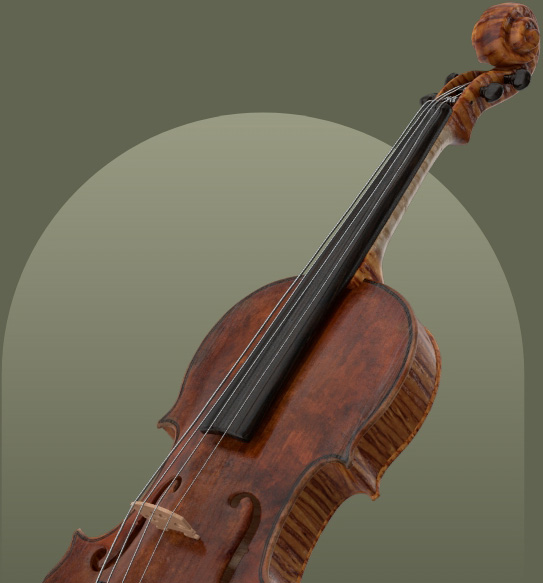
Hendrick (I) Willems
worked 1650–1700
Hendrick (I) Willems was a notable luthier active in Ghent, Belgium, from approximately 1650 to 1700, presumed to be the son of Jooris Willems. He was known for crafting a variety of instruments, including violas, cellos, and pochettes, often characterized by high arching, long squared-off corners, and sometimes a lion's head scroll. His construction method involved setting ribs into grooves without a mould, and he utilized fine woods, frequently employing walnut, lime-tree, or plane-tree for backs and sides. Willems's work, which shows influences from both the Stainer and Brescian schools, is recognized for its clean finish and distinctive aesthetic, with examples preserved in prominent museum collections.
Auction Price History
Highest auction price
3 results
| Type | Details | Auction house | Sold | Price |
|---|---|---|---|---|
| Labelled Cornelis Kleynman fecit Amsterdam 1686 Lot 74 | — | October 2018 | £30,000est. £ 25,000-35,000 | |
| Labelled Hendrick Willems Tot Ghendt 1690 Lot 63 | — | October 2016 | £28,800est. £ 25,000-35,000 | |
| Violin | 1690 | — | March 2001 | £4,320 |
No results match those filters.
Maker Overview
Life
Hendrick (I) Willems (circa. 1650-1700) worked in Ghent, Belgium, and is presumed to be the son of Jooris Willems.
His biographical information includes being employed to repair the bass in St. Bavon's Cathedral, Ghent, in 1670, and again in 1698 for the bass used in the rood-loft of the same cathedral.
Characteristics
- Known Instruments
- Hendrick (I) Willems is known for producing three large violas, a cello, a pochette, a bass viol, an alto of large pattern, and a small pocket violin.
- Construction Method
- Instruments were made with the ribs set into grooves cut into the inner edges of the back, without the use of a mould.
- Aesthetic Characteristics
- His instruments often feature a high arching, very long squared-off corners, and a neck ending in a lion's head, though the lion's head on some instruments, such as a viola from 1651, may be a later addition. The soundholes are described as elegantly following an early Amati pattern, or as rather straight and stiff, similar to the Brescian model or those found in a Stainer instrument. The model is characterized by high arching, sharply prominent corners, and stiff, steep f-holes. A pochette from 1679 features a ribbed back and a carved lion's head.
- Varnish
- The varnish is noted for its rich red-brown colour with a dry Venetian texture, or as a very high-quality golden-yellow colour. Sources also describe the varnish as generally too dry or brittle.
- Wood Selection
- He consistently used remarkably fine wood for the belly of his instruments. For the back and sides, especially in basses, he frequently utilized walnut, lime-tree, or plane-tree wood. For the back, which is often flat in his violas, he used various woods without strict selection, including maple, beech, lime, or walnut.
- Workmanship
- The outline and beautiful finish of his work could almost be mistaken for Italian craftsmanship, and his work is generally described as very clean.
Influence and legacy
- Stylistic Influences: Hendrick (I) Willems's model and soundholes show similarities to both the Stainer school and the Brescian school of violin making.
- Museum Collections: A viola dated 1651, featuring a lion's head, is preserved in the Brussels Musical Instrument Museum. The collection also includes a cello with a lime wood back, walnut ribs, and neck. A pentagonal pochette from 1679, originally from the Snoeck collection, is located in Berlin.
Biographies
The overview above is drawn from the following published accounts. Read them in the original:
John Dilworth+
WILLEMS, Hendrick (I) Worked circa. 1650-1700 Ghent Belgium. Presumed son of Jooris Willems, below. Known or recorded are three large violas, a cello, pochette, and bass viol. The sole biographical information: employed to repair the bass in St. Bavon’s Cathedral, Ghent 1670. Viola in the Brussels Musical Instrument Museum, dated 1651, is high-arched with very long squared-off corners and lion’s head (probably a later addition). Soundholes very elegantly following early Amati pattern. Varnish of rich red-brown colour with dry Venetian texture. The collection also includes a cello with lime wood back, ribs and neck of walnut, and similar varnish of very high quality, golden-yellow in colour. Pochette with ribbed back and carved lion’s head dated 1679. Instruments made with the ribs set into grooves cut into the inner edges of the back, without a mould. Hendrick Willems tot Ghendt, 1651 [Stainer]
Cecie Stainer+
A maker in Ghent, Belgium, about 1650-1700. An alto of large pattern has remarkably fine wood used for the belly; the corners are prominent and squared at the ends; the sound-holes, rather straight and stiff, are similar to the Brescian model, or those in a Stainer instrument; the neck ends in a lion’s head ; the outline and the beautiful finish could almost be mistaken for Italian work, but the varnish is too dry. It is labelled: ” Hendrick Willems tot Ghendt, 1651.” For a bass-viol made for use in Saint Bavon’s Cathedral (Ghent) he was paid, on March 28, 1670, a sum of £5 (Flanders). A small pocket violin, with a pentagonal back, with the neck ending in a lion’s head, was signed: ” Hendrick Willems tot Ghendt, 1679 ‘ In 1698 he is mentioned as the repairer of the bass used in the rood-loft of St. Bavon. Nearly all his instruments have beautiful wood for the belly, but walnut, lime-tree, or plane-tree wood is frequently used for the back and the sides, especially in the case of the basses.
Willibald Leo Lütgendorff+
Vielbeschäftigter Geigen- und Lautenmacher des 17. Jahrhunderts. Sein Modell erinnert ebenso an Stainer wie an die Brescianer Schule: hohe Wölbung, scharf hervortretende Ecken, steife und steile F-Löcher. Die Arbeit ist sehr sauber, das Holz der Decke immer sehr gut; nur zum Boden, der bei den Violen häufig flach ist, nimmt er das Holz ohne Wahl, bald Ahorn, bald Buche, Linde oder Nussbaum. Der Lack ist gewöhnlich zu spröde Am Wirbelkasten bringt er gerne Löwen oder Frauenköpfchen an. Arbeiten von ihm sind in der Kathedrale von Gent. Aus der Sammlung Snoeck ist eine fünfkantige Pochette von 1679 in Berlin.
Sell your instrument with Amati
Get started by uploading photos of your instrument for our experts to review.
Sell your instrument with Amati
Get started by uploading photos of your instrument for our experts to review.