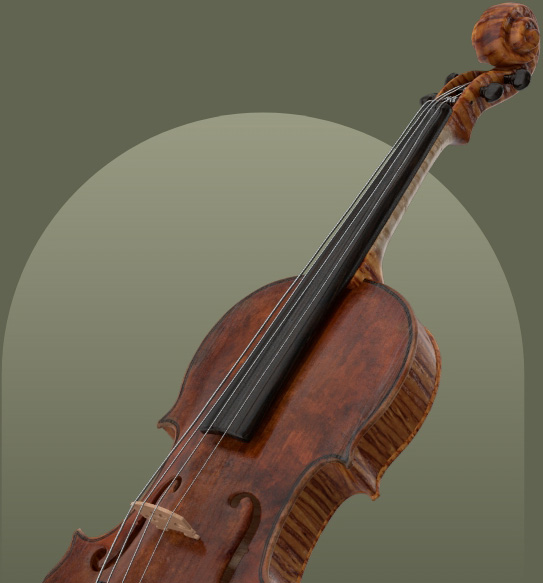
Jooris Willems
worked 1630–1662
Jooris Willems was an influential Flemish instrument maker and musician active in Ghent from approximately 1630 to 1662/1665. He served as a cornettist and violist at Saint Bavon's Cathedral and is considered the founder of a notable dynasty of early Flemish violin makers. His craftsmanship, characterized by finely figured maple-wood, short and thin corners, and graceful, Italian-inspired sound-holes, showed an early awareness of the Amati school. He employed a construction technique without a mould, supporting ribs in a slot around the back's inner edge. His instruments, including viols and violins, are preserved in institutions such as the Musical Instruments Museum in Brussels and a bass viola in Berlin.
Maker Overview
Life
Jooris Willems (circa 1630-1662/1665) was a maker active in Ghent. Sources provide slightly conflicting dates for his activity, with some indicating circa 1630-1665, while others state circa 1630-1662. He is first mentioned in August 1634 as a player of the cornet in Saint Bavon's Cathedral in Ghent. He also served as a violist at the Cathedral from 1630 to 1662. The last mention of Jooris Willems in the Cathedral archives is recorded in 1662. His son, Nicolas Willems, was appointed viol player in the same Cathedral on August 5, 1671, indicating the beginning of a significant dynasty of early Flemish violin makers.
Characteristics
- Materials and Design
- His instruments are generally crafted from finely figured maple-wood. The corners are described as short and thin, and the sound-holes are graceful, resembling the Italian model. A tenor-viol from 1642 had its back made of lime-tree wood.
- Varnish
- Sources contain conflicting information regarding the varnish. Cecie Stainer notes a violin of small pattern from 1659 with yellow varnish. John Dilworth describes a fine clear golden-brown varnish, thinly applied, on instruments of Amati form. In contrast, Willibald Leo Lütgendorff mentions the varnish as brittle and pale (spröde und fahl).
- Construction Technique
- 's workshop adopted the technique of building without a mould, supporting the ribs in a slot cut around the inner edge of the back. This method was common among other early violin makers in England and Turin.
- Labels
- Instruments bear labels such as "Jooris Willems tot Ghendt, 1642" for a tenor-viol and "Jooris Willems tot Ghendt, 1659" for a violin.
- Jooris Willems
tot Ghendt, 1642John Dilworth
Influence and legacy
- Italian Model: His work, particularly the sound-holes, shows a resemblance to the Italian model. Willibald Leo Lütgendorff notes that his model is reminiscent of the Amati-school.
- Amati Awareness: John Dilworth highlights that Jooris Willems and his workshop represent a very early awareness of the contemporary work of the Amati brothers in Cremona, influencing the form of his instruments.
- Dynasty: Jooris Willems is recognized as the founder of a significant dynasty of early Flemish violin makers.
- Family Continuity: His son, Nicolas Willems, continued the family's musical tradition, being appointed as a viol player at Saint Bavon's Cathedral in Ghent.
- Museum Holdings: The Musical Instruments Museum in Brussels possesses a viol dated 1642 and two violins from 1659 by Jooris Willems. Additionally, a viola from 1616 is attributed to him in the same museum. A bass viola from the Snoeck collection is located in Berlin.
Further Information
- Profession: Jooris Willems was a cornettist and violist at Saint Bavon's Cathedral in Ghent.
- Location: He worked in Ghent.
- Known Instruments: Instruments include a tenor-viol (1642), a small pattern violin (1659), and two viols supplied for the choir of Saint Bavon in 1658. The Musical Instruments Museum, Brussels, holds a viol of 1642, two violins of 1659, and a viola of 1616. A bass viola from the Snoeck collection is in Berlin.
Biographies
The overview above is drawn from the following published accounts. Read them in the original:
John Dilworth+
WILLEMS, Jooris Worked circa. 1630-1662 Ghent Brussels Cornettist and violist at Ghent Cathedral 1630-1662. Founder of significant dynasty of early Flemish violin makers. They represent a very early awareness of the contemporary work of the Amati brothers in Cremona, yet adopted the technique (common to other early violin makers in England and Turin) of building without a mould, supporting the ribs in a slot cut around the inner edge of the back. The Musical Instruments Museum, Brussels possesses a viol of 1642, two violins of 1659, and a viola of 1616. Amati form, with fine clear golden-brown varnish, thinly applied. Jooris Willems / tot Ghendt, 1642
Cecie Stainer+
A maker in Ghent about 1630-65. The first mention of him is in August, 1634, as player of the cornet in Saint Bavon’s Cathedral (Ghent). His instruments are generally made of finely figured maple-wood; the corners short and thin; the sound-holes are graceful and more like the Italian model. A tenor-viol had the back made of lime-tree wood and was labelled: “Jooris Willems tot Ghendt, 1642.” In 1658 he supplied two viols for use in the choir of Saint Bavon. A violin of small pattern, with yellow varnish, was labelled: ” Jooris Willems tot Ghendt, 1659.” The last mention of this maker in the Cathedral archives is in 1662. His son, Nicolas, was appointed viol player in the Cathedral, Aug. 5, 1671.
Willibald Leo Lütgendorff+
Wahrscheinlich ein Bruder von Hendrick I. W. Er war Cornetbläser und Geigenmacher. Seine Arbeit ist sehr sorgfältig und erinnert im Modell an die Amati-Schule; nur die Ecken sind wesentlich weniger hervorspringend und der Lack spröde und fahl. Sein Sohn Nicolas war Violist an der Genter Kathedrale. Eine Bassviola aus der Sammlung Snoeck ist in Berlin.
Sell your instrument with Amati
Get started by uploading photos of your instrument for our experts to review.
Sell your instrument with Amati
Get started by uploading photos of your instrument for our experts to review.