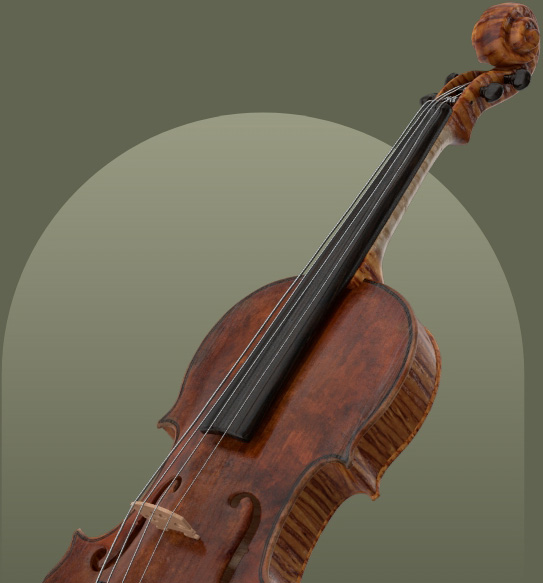
Giovanni Guidanti
Bologna, 1687–1760
Son of Floriano Guidanti, above. Succeeded to the appointment to the Accademia Filarmonica in 1716. Records of the Accademia show that he was highly valued as a maker and repairer, reflected also in the admiration of G. A. Marchi expressed in his Manoscritto Liutario (Bologna, 1786). — John Dilworth
Auction Price History
Highest auction price
19 results
| Type | Details | Auction house | Sold | Price |
|---|---|---|---|---|
| Violin | Labelled Joannes Florenus Guidantus Fecit Bononiae Anno 1749 Lot 44 | Ingles & H. | October 2024 | £33,600est. £ 20,000-30,000 |
| Violin | 35.4 cm Attributed to | — | March 2010 | £4,600 |
| Violin | 35.8 cm 18th C. Attributed to | — | October 2009 | £7,500 |
| Violin | 35.8 cm Bologne, 1730 c. (some restorations) | — | June 2009 | £19,187 |
| Cello | 73.8 cm Bologna, 1720 c. Attributed to | — | November 2008 | £59,280 |
| Violin | Bologna, 1733 c. | — | October 2005 | £50,914 |
| Violin | 1738 | — | March 2002 | £18,900 |
| Violin | 1737 | — | November 2001 | £24,000 |
| Violin | 1741 | — | May 1994 | £17,806 |
| Violin | 1740 | — | April 1991 | £5,500 |
| Violin | 1730 c. | — | June 1990 | £15,400 |
| Cello | 17-- | — | March 1990 | £50,600 |
| Violin | 1738 | — | March 1989 | £29,700 |
| Violin | 1700 c. | — | June 1988 | £17,600 |
| Violin | 1740 c. | — | April 1987 | £10,780 |
| Violin | 1731 | — | February 1985 | £16,500 |
| Viola | 41.4 cm 1737 | — | June 1982 | £21,600 |
| Violin | 1741 | — | June 1981 | £4,180 |
| Violin | 1730 | — | June 1980 | £2,457 |
No results match those filters.
Maker Overview
Life
Giovanni Guidanti. Sources contain conflicting information regarding his life dates: Cecie Stainer indicates he was active from about 1685 to 1728, while John Dilworth states he was born in 1687 and died in 1760 in Bologna, Italy. He was the son of Floriano Guidanti. succeeded to the appointment to the Accademia Filarmonica in 1716. Records of the Accademia show that he was highly valued as a maker and repairer, an admiration also expressed by G. A. Marchi in his Manoscritto Liutario (Bologna, 1786). In 1730, Guidanti moved from the old family home in San Mamolo to apartments belonging to the Friars of San Giacomo, which, implied a change of fortune. Willibald Leo Lütgendorff notes that much confusion surrounds this family, exacerbated by the frequent falsification of labels and the mixing of their wording even in old times. He states that because violins are often well-imitated, it is difficult to distinguish genuine from non-genuine instruments. Lütgendorff also mentions that the best connoisseurs now differentiate between father and son, while others consider the otherwise rare first name Guidante to be the family name, a notion that the labels indeed encourage. A viola d'amore, exhibited at Milan in 1881, was ornamented with a beautifully and artistically carved head representing a blindfolded Cupid. A viola da gamba by Guidanti was dated 1728.
Characteristics
- Workmanship
- Cecie Stainer describes him as an excellent workman, noting that his instruments look well. John Dilworth praises his very fine work, describing it as well proportioned and elegant. However, Cecie Stainer states that the purfling is carelessly done, and George Hart similarly notes the purfling was badly let in. In contrast, John Dilworth describes the purfling as neat, usually made of beechwood. Willibald Leo Lütgendorff notes that the work is sometimes imprecise, but the varnish is always good.
- Model
- His instruments are on a high model. John Dilworth specifies a Gagliano-like model, broad across the middle bouts.
- Sound-holes
- Cecie Stainer and George Hart both describe the sound-holes as long.
- Corners
- John Dilworth notes small corners.
- Head
- John Dilworth describes a finely cut head with small, very concentric volutes. The viola d'amore exhibited in Milan in 1881 featured a beautifully and artistically carved head representing a blindfolded Cupid.
- Varnish
- John Dilworth mentions a rich golden-coloured varnish, but quite thinly applied. Willibald Leo Lütgendorff states that the varnish is always good.
- Tone
- Cecie Stainer notes that the tone is rather poor.
- Form
- George Hart describes the outer form as inelegant, particularly the middle bouts.
- Joannes Guidantus fecit
Bononiae, anno 1715John Dilworth - Joannes Florenus Guidantus
fecit Bononiae 1731John Dilworth
Influence and legacy
- Mentorship: Cecie Stainer suggests that Giovanni Guidanti was possibly a pupil of Nicola Amati. Willibald Leo Lütgendorff notes that the violins attributable to the father (Floriano Guidanti) reveal the school of Amati.
- Appointments: succeeded to the appointment to the Accademia Filarmonica in 1716.
- Reputation: Records of the Accademia Filarmonica show that he was highly valued as a maker and repairer, a sentiment in his Manoscritto Liutario (Bologna, 1786).
Further Information
- Workshop Location: Giovanni Guidanti worked in Bologna.
- Labels: Labels found on his instruments include "Joannes Guidantus fecit Bononiae, anno 1715" (Cecie Stainer, John Dilworth). Another label reads "Joannes Florenus Guidantus fecit Bononiae, 1724" (Cecie Stainer), though John Dilworth cites a similar label as "Joannes Florenus Guidantus / fecit Bononiae 1731".
- Instruments: Instruments attributed to him include violas d'amore, violas da gamba, and violins.
Biographies
The overview above is drawn from the following published accounts. Read them in the original:
John Dilworth+
GUIDANTI, Giovanni Born 1687, died 1760 Bologna Italy. Son of Floriano Guidanti, above. Succeeded to the appointment to the Accademia Filarmonica in 1716. Records of the Accademia show that he was highly valued as a maker and repairer, reflected also in the admiration of G. A. Marchi expressed in his Manoscritto Liutario (Bologna, 1786). In 1730 Guidanti moved from the old family home in San Mamolo to apartments belonging to the Friars of San Giacomo, implying a change of fortune. Very fine work on a Gagliano-like model, broad across the middle bouts, but well proportioned and elegant. Small corners and neat purfling (usually of beechwood). Finely cut head with small, very concentric volutes. Rich golden-coloured varnish, but quite thinly applied. Joannes Guidantus fecit / Bononiae, anno 1715 Joannes Florenus Guidantus / fecit Bononiae 1731 [Pasqual]
George Hart+
High model ; sound-hole long ; purfling badly let in; the outer form inelegant, particularly the middle bouts. At the Exhibition at Milan, 1881, a Viola d’Amore was exhibited, signed “Joanne Guidantus, fecit Bononiae, anno 1715,” ornamented with a beautiful head artistically carved, representing a blindfolded Cupid.
Cecie Stainer+
A maker in Bologna about 1685 to 1728. Was possibly a pupil of Nicola Amati. He was an excellent workman, his instruments look well, are on a high model, with long sound-holes; but the purfling is carelessly done and the tone is rather poor.
A viola d’amore, exhibited at Milan in 1881, ornamented with a beautiful head, artistically carved, representing a blindfolded Cupid, was labelled: “Joannes Guidantus fecit Bononiae, anno 1715.” Another label was: “Joannes Florenus Guidantus fecit Bononiae, 1724.” A viola da gamba was dated 1728. See “Florenus.”
Willibald Leo Lütgendorff+
Über diese Familie herrscht viel Unklarheit, die dadurch noch vermehrt
wird, dass schon in alten Zeiten die Zettel der einzelnen Mitglieder vielfach
gefälscht, ihr Wortlaut miteinander vermengt wurde. Da auch die Geigen
häufig gut nachgeahmt sind, ist es oft schwer, die echten von den unechten zu
unterscheiden. Die besten Kenner unterscheiden jetzt Vater und Sohn, andere
halten den sonst selten vorkommenden Vornamen Guidante für den Familiennamen,
wozu die Zettel in der That auch verführen. Die Entscheidung könnte
nur getroffen werden, wenn man möglichst viele, zweifellos echte Arbeiten
gleichzeitig miteinander zu vergleichen in der Lage wäre. Die Geigen, die
dem Vater zuzuschreiben waren, verrathen die Schule Amati’s, die Arbeit ist
manchmal ungenau, der Lack aber immer gut. Wenn man nicht annehmen
will, dass er ein Alter von etwa 90 Jahren erreicht hat und Geigen mit seinem
Namen und der Jahreszahl 1750 etc. für echt hält, so muss er ausser seinem
Sohne Guidante noch einen mit ihm gleichnamigen Nachkommen gehabt haben,
von diesem würde die Geige im Museum Kraus in Florenz herstammen. Auch
nach rückwärts findet man unmögliche Jahreszahlen angegeben, so wurde 1898
in Köln eine Basslaute mit dem Zettel: Joannes Florenus 1590 in Cremona versteigert. Die Jahreszahl dürfte richtig gelesen 1690 geheissen haben, wie auch Cremona für Bononiæ gelesen wurde.
Sell your instrument with Amati
Get started by uploading photos of your instrument for our experts to review.
Sell your instrument with Amati
Get started by uploading photos of your instrument for our experts to review.