The Most Expensive Violin Ever Sold – and What £18 Million Actually Buys You.

Someone asked me the other day what the most expensive violin in the world is, and I gave them the honest auctioneer’s answer, which is: nobody entirely knows, because the people who buy them at that level would rather you didn’t.
But we do have a couple of numbers to slobber over.
My first reference point is seven years before. The same vendor, David Fulton sold the Lord Wilton, Guarneri Del Gesú, 1742 for $20m. This ended up in Moscow, which is heart-breaking for all the obvious reasons and the least we say the better.
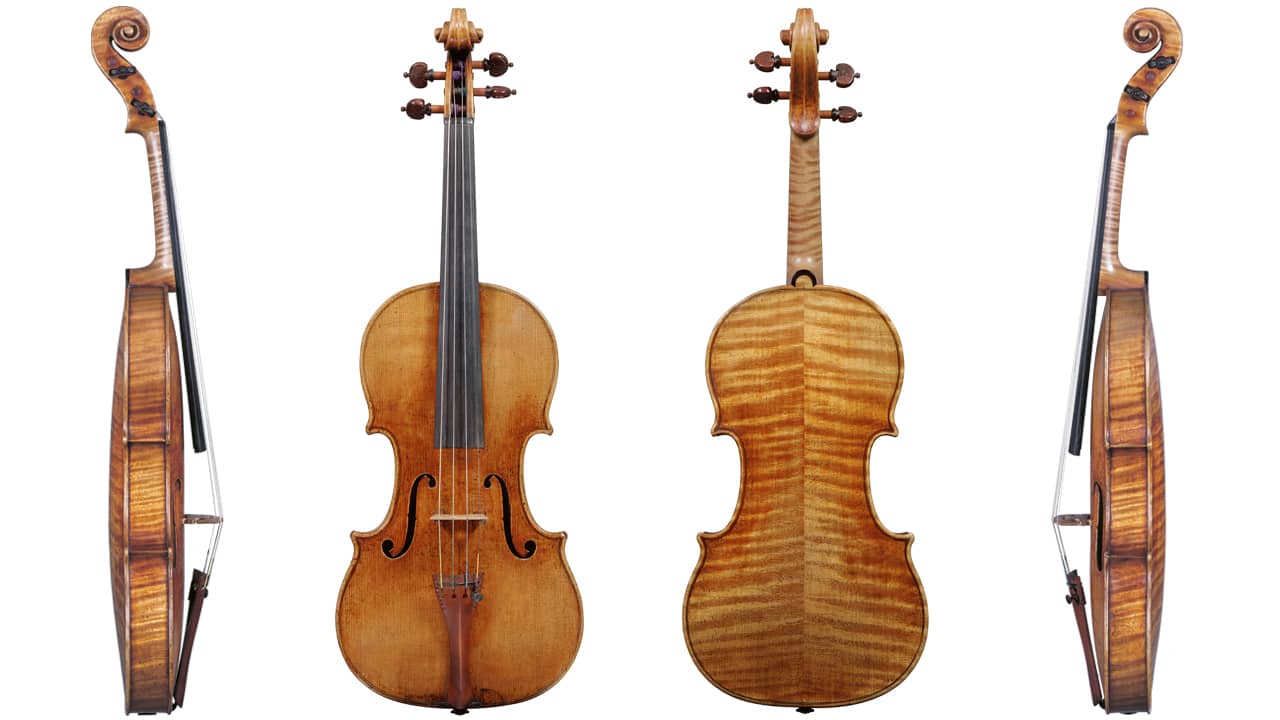
This year the 1715 “Baron Knoop” Stradivari changed hands for a reported $23 million – roughly £18 million – which makes it, as far as anyone can say out loud, the most expensive violin ever sold. Hat tip to my ex-boss Peter Biddulph who was the agent for the deal.
It was a private sale to an anonymous buyer, so there was no saleroom, none of the drama or transparency that we love about auctions. It was, however, a very large amount of money and a pretty decent ROI for the vendor, so I don’t think anyone will be complaining too much.
For scale: the last owner, the collector David Fulton, is said to have bought it back in 1993 for $2.75 million. I have made worse investments. I have made worse investments this week.
So what, people reasonably ask, could possibly be worth tens of millions for a violin?
Here is the unromantic version. It comes down to four things.
1 – The maker. Guarneri Del Gesù or a golden-period Stradivari (roughly 1700 to 1720) is the top of the tree, and the Baron Knoop is squarely in it. There are only so many of these instruments, the number does not go up, and every serious collector on earth wants one.
2 – Condition. What the trade prizes is originality – wood that hasn’t been excessively repaired, a scroll that hasn’t been replaced, varnish that has been left to do what varnish does. A tired old repair, or worse, woodworm, can quietly remove a nought from the price.
3 – Provenance. A violin with a documented life – who owned it, who played it, where it has been – is worth more than an identical one that turns up from nowhere. The paperwork, unglamorously, is part of the instrument. For instance, although the Guarneri I mentioned above once belonged to Lord Wilton, hence the name, it latterly belonged to Lord Menuhin. This definitely adds value. Lots.
4 – Sound. Which I have put last on purpose, because at this level it almost stops mattering to the price. A great Strad should sing, of course. But a $23 million violin is not really being bought to be played on a wet Tuesday in Leeds.
That is the part people find hardest to swallow – that the finest violins have become, on top of everything else, an asset class. They go up. They are portable. They are, unlike a Monet, actually useful.
I have complicated feelings about this, and I will spare you most of them. But I will say that every so often I get to hold one of these instruments, and the money briefly stops being the point. You are holding three hundred years of someone else’s craft, and it still works. That never gets old.
Now – the useful bit, because I know why some of you are really here.
Almost nobody reading this owns a Baron Knoop. But a great many people own an old violin in a case in the loft, with a faded label inside claiming to be something it almost certainly isn’t, and no idea whether it’s worth £30 or £30,000.
That is a much more interesting question, and it’s the one we’re actually good at answering.
If you have an instrument or a bow you’ve always wondered about, bring it to one of our valuation days – no appointment theatre, no obligation, just an expert opinion on what you’ve got. You can get in touch with us here https://amati.com/valuations/.
And if all this talk of records has put you in the mood to bid rather than sell, our next auction is always coming up.
Either way, do check the loft. You’d be amazed what turns up.
JKB
P.S. As an aside I should mention that David Fulton has written an amazing book on collecting ‘The Fulton Collection, A Guided Tour, Peter Biddulph, London’ which is a fascinating insight into both an astonishing collection, but also the thought process that went into creating and owning it.
Share this:


Related posts