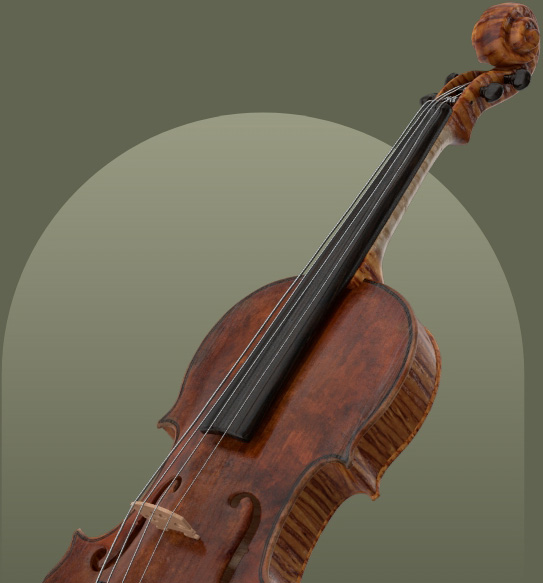
Mathias Petter Kraft
Gavle, Stockholm, 1753–1807
Mathias Petter Kraft (1753-1807) was a prominent Swedish instrument maker, born in Gävle and active in Stockholm. Apprenticed to Pehr Lundborg, he became instrument maker to the court in 1780. Kraft crafted a variety of stringed and keyboard instruments, including violas, cellos, lutes, harps, and theorbes, noted for their good workmanship, Florentine-Tyrolean-Italian influences, and light golden-brown varnish. His legacy includes a school for the poor established by his will and numerous instruments preserved in significant collections and museums across Europe.
Auction Price History
Highest auction price
| Type | Details | Auction house | Sold | Price |
|---|---|---|---|---|
| Viola | 38.0 cm Stockholm, 1783 #3 | — | May 2004 | £3,107 |
No results match those filters.
Maker Overview
Life
Mathias Petter Kraft (1753-1807) was born in Gävle in 1753 and died in Stockholm, Sweden, in 1807. He served an apprenticeship with Pehr Lundborg from 1773 to 1778. By 1780, Kraft was appointed instrument maker to the court, establishing himself as a significant and successful craftsman of his era., his will provided for the establishment of a school for the poor in Stockholm, which continued its operation until 1972.
Characteristics
- Instrument Types
- Mathias Petter Kraft produced a wide variety of instruments, including all sorts of stringed and keyboard instruments. Willibald Leo Lütgendorff notes that he later focused more on harp making and, from 1800 onwards, also made keyboard instruments. Specific examples include violas, a large cello measuring 77.3cm (30 ½"), lutes, harps, 13- and 15-string theorbes, and a Nagelharfe.
- Workmanship
- John Dilworth describes his workmanship as good, showing a slightly Florentine combination of Tyrolean and Italian models, with Staineresque soundholes. His scrolls were well balanced but not scrupulously cut. Lütgendorff, however, states that his violins, which are rare, are not particularly good, while his lutes are better.
- Varnish
- Instruments by Kraft feature a fine light golden-brown varnish.
- Labels
- His labels include inscriptions such as "Matth. Pett. Kraft Köngl Hof / Instrument Makare Stockholm / Ao. 1781. No. 39" and "Pet. Kraft / Köngl hof Instrujn Makare / Stockholm." Lütgendorff mentions that his labels often depicted a lute and a harp alongside allegorical imagery, suggesting these were his specialties.
- Matth. Pett. Kraft Köngl Hof
Instrument Makare Stockholm
Ao. 1781John Dilworth - No. 39 Pet. Kraft
Köngl hof Instrujn Makare
StockholmJohn Dilworth
Influence and legacy
- Apprenticeship: Mathias Petter Kraft was apprenticed to Pehr Lundborg from 1773 to 1778.
- Philanthropy: His will led to the establishment of a school for the poor in Stockholm, which remained active until 1972.
- Collections: Two small violas by Kraft are known, one dated 1787 is housed in the Cathedral school in Skara. Claudius in Malmö possesses a 13- and a 15-string theorbe and a Nagelharfe by him. The Hammer collection once held four of his theorbes. P. de Wit owns one theorbe, the Museum in Copenhagen has another, the Musikhistoriska Museum in Stockholm holds a harp from 1785, and the Museum in Gothenburg has a lute.
Biographies
The overview above is drawn from the following published accounts. Read them in the original:
John Dilworth+
KRAFT, Mathias Petter Born 1753 Gävle, died 1807 Stockholm Sweden. Apprenticed to Pehr Lundborg 1773-1778. Appointed instrument maker to the court 1780. Made all sorts of stringed and keyboard instruments; a significant and successful craftsman in his time. His will provided for the establishment of a school for the poor in Stockholm which survived until 1972. Two violas of small size known, one dated 1787 in the Cathedral school in Skara. Also a large 77.3cm (30 ½”) cello. Good workmanship showing a slightly Florentine combination of Tyrolean and Italian models, Staineresque soundholes, and fine light golden-brown varnish. Scrolls well balanced but not scrupulously cut. Matth. Pett. Kraft Köngl Hof / Instrument Makare Stockholm / Ao. 1781. No. 39 Pet. Kraft / Köngl hof Instrujn Makare / Stockholm [Nilsson]
Willibald Leo Lütgendorff+
Der bedeutendste schwedische Instrumentenmacher seiner Zeit, der auch
den Hoftitel besass. Seine Geigen die nur vereinzelt vorkommen, sind nicht
besonders gut, besser dagegen seine Lauten. Später verlegte er sich mehr auf
den Harfenbau, und von 1800 an machte er auch Klavierinstrumente. Eine
13- und eine 15-saitige Theorbe und eine Nagelharfe besitzt Claudius in Malmö;
in der Sammlung Hammer waren vier Theorben von ihm; eine besitzt P. de Wit,
eine das Museum in Kopenhagen, eine Harfe von 1785 das musikhistorische
Museum in Stockholm, eine Laute das Museum in Gothenburg. Auf seinem
Zettel sieht man neben allegorischem Beiwerk nur eine Laute und eine Harfe —
wohl seine Specialität — abgebildet.
Sell your instrument with Amati
Get started by uploading photos of your instrument for our experts to review.
Sell your instrument with Amati
Get started by uploading photos of your instrument for our experts to review.