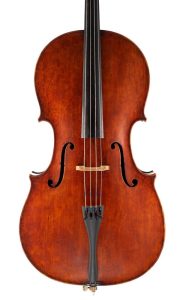
Andrea Amati may have invented the violin, but what would one be worth today?

It is no coincidence that the name on our letterhead is ‘Amati’. It could have been Groblicz or Da Salo, two other makers with an almost equal claim to have invented the violin. And although it helps that Amati is an easier name to spell (or pronounce) than Groblicz*, it is mostly because Andrea Amati is generally considered to be the father of the violin.
Andrea Amati was born in Cremona around 1505 and died there in 1577, and he is about as close as we have to the person who invented the violin. Not the idea of a bowed string, which people had been scraping at for centuries, but the violin as you would recognise it now. Four corners, the elegant waist, the f-holes, the scroll, the purfling running round the edge like a signature. He settled the proportions, and they have barely moved in four hundred and fifty years.
Given the pace of change in almost every other area of life, it is genuinely astonishing that we have kept the violin almost exactly as Andrea Amati left it.
The king’s order
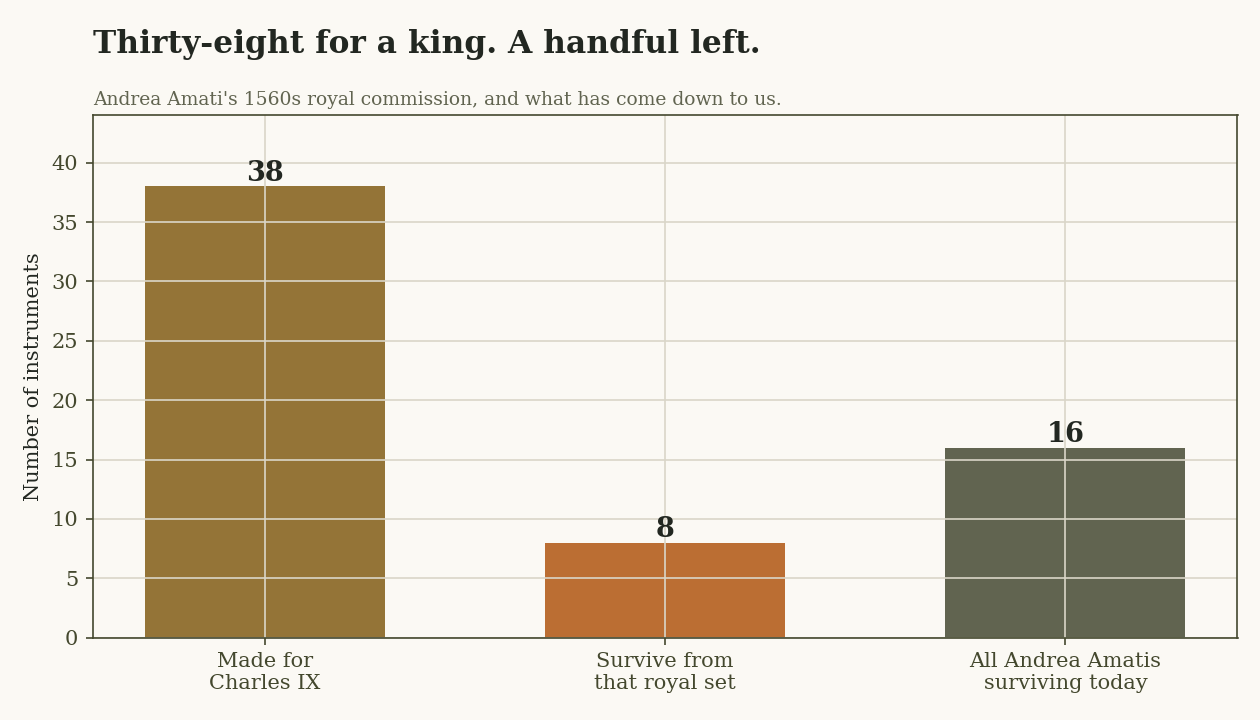
His great commission came from the French court. Around 1560 the young King Charles IX ordered a set of thirty-eight instruments, painted and gilded, hung with the fleur-de-lys and the Latin mottoes of the French crown. Twelve large violins, twelve small ones, six violas and eight basses.
It was, in effect, the first orchestra. It was also the finest advertisement any workshop has ever run, because nearly five hundred years later we are still talking about it.
Most of that royal set is gone. The French Revolution was not kind to gilded symbols of monarchy, and only about eight instruments from the commission are known to survive. Of everything Andrea Amati ever made, we can account for perhaps sixteen instruments in all; eight violins, three violas and five cellos. The exact tally depends rather on who is counting and how forgiving they are feeling about later repairs.
The oldest of the old
One of those survivors, a violin dated 1564, sits in the Ashmolean Museum in Oxford. It is generally reckoned to be the oldest violin in the world still carrying its original date.
The oldest surviving cello is his too. It is called “The King”, it lives at the National Music Museum in South Dakota, and it was cut down to a more manageable size in Paris in 1801. This was not unusual with cellos of this period which were frequently made large.
One family, and everyone who came after
If legacies matter, it is telling that almost every famous name you can think of grows out of this one workshop.
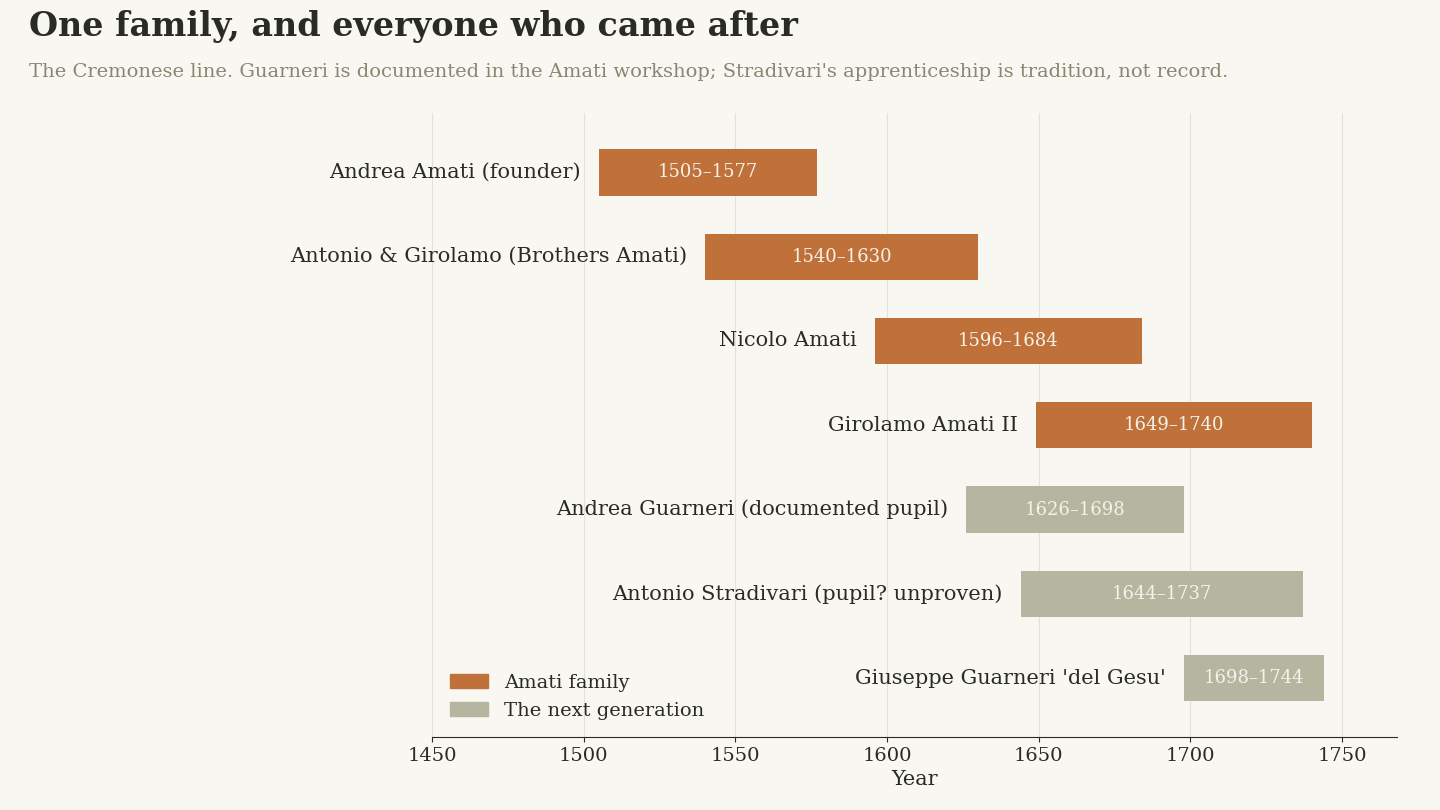
Andrea taught his sons, the Brothers Amati. They in turn produced Nicolo Amati, the finest maker of the line, and Nicolo trained the next generation. We know exactly who, because the parish census counted every soul in the Amati house each year – fifteen apprentices and workmen pass through the records between 1641 and 1686. Andrea Guarneri is there. So is Giovanni Battista Rogeri.
Antonio Stradivari is not.
The idea that Stradivari was Amati’s pupil rests on a single violin of 1666, whose label reads ‘Alumnus Nicolai Amati’ – pupil of Nicolo Amati. He never printed the claim again.
And there is a workshop clue, a really useful detail for attribution. The Amatis, in the centre of their backs placed a tiny central pin, a habit their documented pupils absorbed and carried into their own shops. Stradivari’s instruments do not have it. A man can drop his master’s habits, of course. But small, unthinking habits are exactly what an apprenticeship drums into you.
The theory I find most persuasive is that young Stradivari trained as a woodcarver – he lodged in the house of the carver Francesco Pescaroli, and nobody before or since inlaid a violin like he could – and came to the instrument sideways, studying Amati’s work rather than sweeping Amati’s floor.
Either way, the whole glittering Cremonese story grows out of the Amati workshop – by blood, by apprenticeship, or by imitation so devoted it amounted to much the same thing.
The pupils, real or self-declared, ended up more famous than the masters. It happens. But the DNA is Amati’s.
So what is one worth?
Which brings us, as the teaser is in the title, to money.
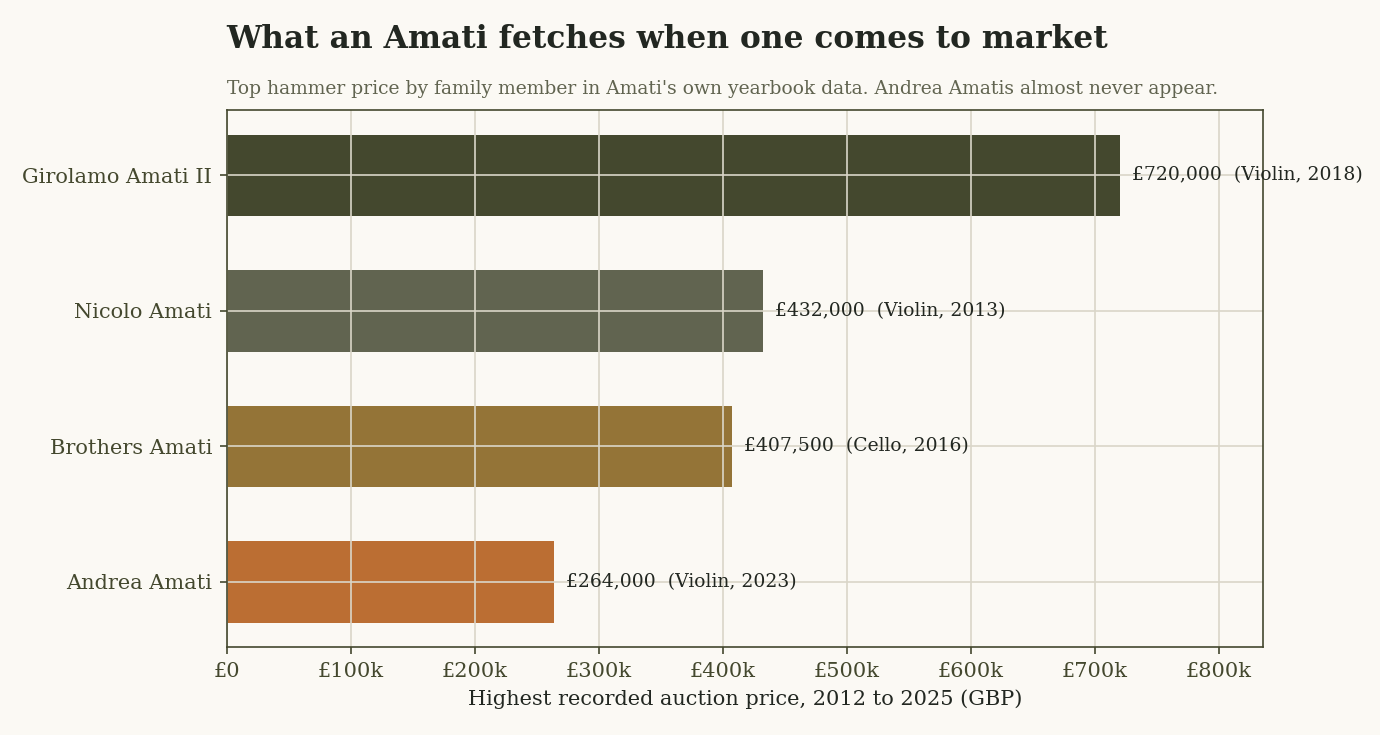
You will almost never see an Andrea Amati come up for sale. They are museum pieces, and museums do not tend to sell. When one does slip out it makes exactly the noise you would expect. A single Andrea Amati violin came up in London in 2023 and sold for £264,000.
His descendants appear a little more often, and the numbers tell the family story rather beautifully. A Nicolo Amati violin has made £432,000. A late Girolamo Amati II reached £720,000. Even the Brothers Amati, the least starry branch of the line, took £407,500 for a cello.
These are not Stradivari prices, since a good Strad now runs to the millions. But they are the prices of the family that taught Cremona the foundations, and I have always thought that made them rather good value. In so far as a six-figure violin can ever be called such a thing.
The real point
Every violin in the world, from the humblest student instrument to the eight-figure Strad, is a footnote to a man in Cremona who worked out the shape and then quietly refined it.
We do not have an Andrea Amati in the next sale. I would tell you if we did.
But if you have an old instrument at home and you have ever wondered where it sits in that very long line, a nineteenth-century copy labelled “after Amati”, a school fiddle, something odder still, we look at them for nothing, and we love doing it.
You never do know what you have.
P.S. See what is coming up under the hammer at amati.com/auctions, or book a free valuation at amati.com/book. And if you are ever in Oxford, the Ashmolean’s 1564 Amati is worth the detour.
* Especially after a few drinks.
Sources: The Metropolitan Museum of Art, The Strad, Britannica and Tarisio’s Cozio archive, cross-checked with Perplexity. On Stradivari’s training: John Dilworth, ‘The Young Stradivari’ (Tarisio), Stewart Pollens’ Stradivari (Cambridge), and Ingles & Hayday’s Stradivari biography. Auction figures from Amati’s own yearbook price data (Claudio Amighetti), 2012 to 2025.
Share this: