Lost at Sea, Lost on the Tonbridge Road
A reassuringly irregular and imprecise blog about the violin world.
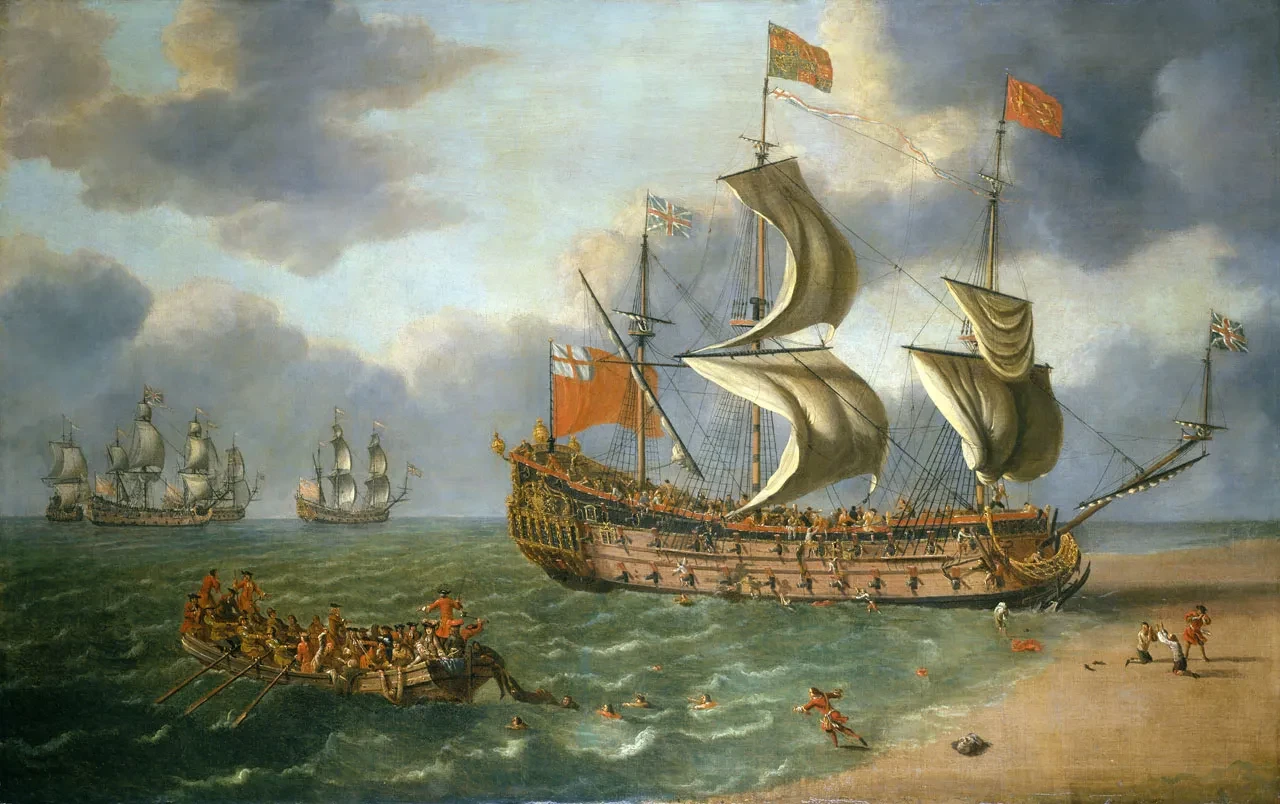
In 2007, three divers found the wreck of the Gloucester off the Yarmouth coast. It was such an important discovery that it was kept secret for fifteen years.
Why was it so important?
Well, the Gloucester was the flagship of a flotilla bearing James Stuart, Duke of York and later King James II, to meet his wife Mary of Modena in Holyrood. It ran into a storm and foundered on a sandbank on the morning of 6th May 1682, and up to 250 passengers and crew were lost – largely, it is said, because James argued with the captain and overruled his orders.
What has this to do with violins? I’m so glad you asked.
Among James’ retinue on the ship were at least six members of the Royal Band, the King’s ‘Twenty-Four Violins’, and two – Joseph Fashion and Edward Greeting – perished in the wreck. The band members played multiple instruments – recorder, oboe and the various bowed family – and one might assume they had them aboard to provide entertainment for James on the voyage, or even to play for Mary at Holyrood.
Then it gets more interesting.
According to the Cremonese historian Don Desiderio Arisi – who knew Stradivari personally and wrote about him in manuscripts still kept in the Cremonese archives – in 1682, the year of the wreck, Stradivari received a commission via a Venetian banker, Michele Monzi, for a ‘set’ of instruments to be presented to King James II of England.
It is true that James did not become king until 1685, so Arisi was probably writing from hindsight. But it is a fairly stunning statement, especially as there seems to be no trace whatsoever of the instruments being completed or delivered.
But possibly there is.
In 1685, an advertisement was published in the London Gazette of 11th June. This extraordinary cutting states:
‘Lost upon May the 26th last in Tonbridge Road between Bromley and the Bull and Bush, a black leather Violin Case with a violin in it, that is all inlade on the sides, with grey-hounds and birds; and within it a printed inscription in Latin, of the place where it was made, and on the finger board ingrain on mother-of-pearl, the Howards coat of Arms; Whoever can bring tidings of the said violin and case to Mr Ralph Aggutther Violin-Maker, over against York Buildings in the Strand, so as it may be had or to Mr William Thompson Vintner at Tunbridge Wells shall be very well rewarded for their pains’.
After only a moment’s thought, this is as good and definitive a description of an inlaid Stradivari violin as you could wish for.
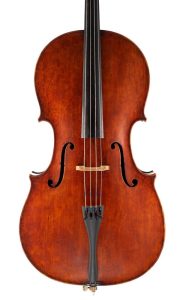
The ‘grey-hounds and birds’ sums up the motif used for the decoration of the ribs in Stradivari’s most fully developed scheme – earlier violins only have a floral arabesque inlay. The ‘printed inscription in Latin’ within the violin almost certainly said ‘Antonius Stradivarius Cremonensis Faciebat Anno…’. And of course only a high-value instrument would warrant an advertisement and a reward.
So. Here is a theory.
In 1682 the King’s ‘Twenty-Four Violins’ suffered a great loss of players – and presumably their instruments – in the wreck of the Gloucester. To make amends, James commissioned Stradivari to make a new set. At that time a set would have been a violin, a small contralto and a large tenor viola, and a cello – like others Stradivari made for the Medici court and for Philip V of Spain.
He may have made contact through the mysterious Venetian banker Michele Monzi, who has not been identified so far. But connections with Italy were profuse, in fact. James’ wife Mary of Modena was a member of the d’Este family; many of the players of the Royal Band were Italian themselves, at least in origin, from Cremona, Brescia, Milan and Venice. And there were many on the continent who supported James and would have wanted to curry favour – he was Catholic, and presented an opportunity for a Catholic reformation and alignment with Europe after his coronation.
Which never happened, of course.
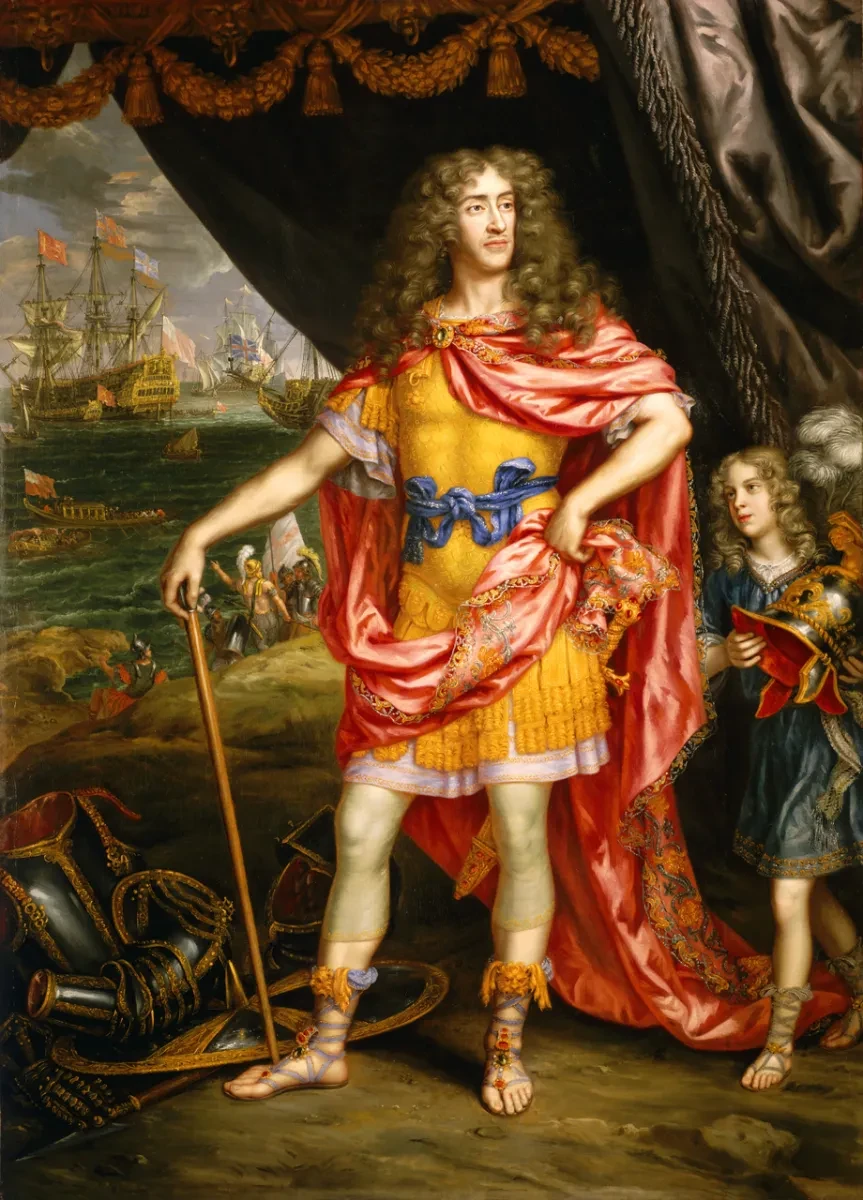
Another intriguing statement in Arisi’s writings adds to the story. In the following year, 1683, he says the ‘King of Modena’ also commissioned Stradivari to make a cello. The ‘King of Modena’ was in fact the younger brother of James’ wife Mary – Francesco II d’Este.
So what happened to the instruments?
I don’t know.
But the advertisement in the London Gazette leads me to think that at least one of the commissioned instruments reached England – possibly a year or so later, possibly by the time James had been crowned King on 23rd April 1685, just weeks before the violin was lost and the advertisement published.
As part of the celebration, James may have been moved to make a gift of appreciation to one of his key supporters: Henry, 7th Duke of Norfolk, head of the leading Catholic family in England. (Not irrelevantly, the Duke’s brother Thomas was his ‘Master of the Robes’ as King.)
To this end, James entrusted the violin to Ralph Agutter, a violin maker in the Strand. Agutter is known to us for a violin lavishly carved with the Stuart coat of arms on its back, once part of the Victoria & Albert Museum collection and catalogued – very significantly – as ‘The King James’. He was clearly in some way in service to the Royal Band, and it was probably he who added the Howard coat of arms to the fingerboard, as described in the advertisement.
Then delivery was arranged to the Howard family’s seat in Arundel, on a coach taking the Tonbridge Road out of London. Near Bromley, by the Bull and Bush, the coach was robbed.
Has the world lost a beautiful inlaid Stradivari of 1682? Or worse – although the Gazette advertisement doesn’t mention them – a complete quintet of violin, violas and cello? There is, so far, no indication in any archive of the royal family or the Howard family of any of this.
But there is one more thing.
There exists a viola – a sad relic of something, cut down from tenor size, with back, ribs and scroll made from suspiciously darkened wood. The instrument had clearly been all but destroyed at some time. The front, certainly by Stradivari, has the remains of the decorative double row of purfling that was a feature of all the inlaid Stradivaris. But it also has a crowned coat of arms – so far unidentified – incised beneath the fingerboard with a heated point, which is not a technique used by Stradivari, as far as we know.
Its history is very sparse, but from at least 1803 it was in England, and the work to remake it was carried out by Bernard Simon Fendt in the workshop of John Betts, the English maker and dealer, around that time.
I don’t think it is unreasonable to speculate that this too was part of the commission for James II – brought to Stradivari in 1682 by the enigmatic Sg. Monzi, in the aftermath of the tragic wreck of the Gloucester.
John Dilworth, London 2026
Our next auction is always coming up. If you have an instrument with a story of its own – a coat of arms, an old label, a family tale that may or may not survive a moment’s thought – it would be fascinating to see it. You can book a valuation at https://amati.com/valuations/.
Photo credit: Royal Museums Greenwich, 2026.
Share this: