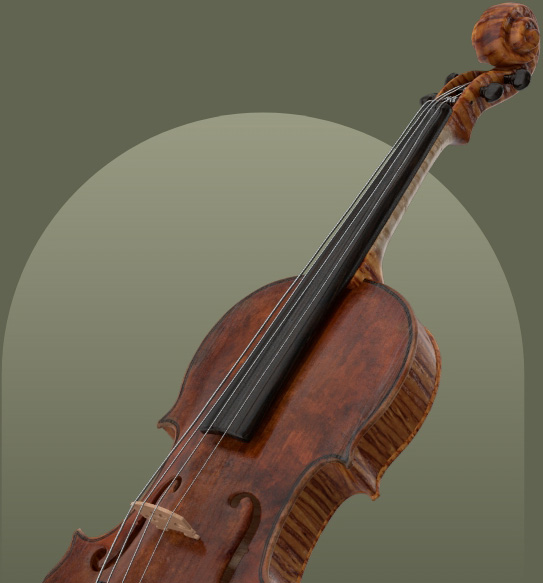
Johann Nikolaus Artmann
Wechmar, c.1774–1846
Johann Nikolaus Artmann (1774-c.1846) was a distinguished German violin maker from Wechmar. He began his training in joinery and instrument making under his father, Georg Valentin Artmann, before refining his skills as a pupil of F. A. Ernst in Gotha. Upon returning to Wechmar in 1799, Artmann devoted himself entirely to violin making after his father"s death. His instruments, influenced by Ernst and built on the Amati-Stradivari model with a characteristic golden-yellow varnish, were highly regarded for their strong tone and responsiveness. Despite modest living conditions and physical challenges, Artmann"s exceptional craftsmanship garnered public praise and ensured his violins were highly valued throughout his lifetime.
Request an expert valuation or learn how our global auctions achieve the highest prices for your instruments.
Maker Overview
Life
Johann Nikolaus Artmann (1774-c.1846) was born in Wechmar, Germany, in 1774 and died around 1846. As the eldest son of Georg Valentin Artmann, a joiner and instrument maker, he initially received comprehensive training in both the joiner"s trade and instrument making from his father. He later became an assistant and pupil of F. A. Ernst in Gotha, where he further refined his violin-making skills. Artmann returned to Wechmar in 1799, and following his father"s death, he committed himself exclusively to violin making. In 1812, he married Barbara Judithe Schüller. Despite earning high esteem and public praise from his Duke, Artmann lived in modest circumstances. It was often remarked with astonishment that he could produce such exquisite work with hands described as malformed or "ungeschlachten Händen," characterized by abnormally wide fingers. After the loss of his wife on December 18, 1842, who succumbed to consumption, Artmann"s health declined, and he passed away four years later from old age.
Characteristics
- Workmanship
- His craftsmanship was significantly influenced by F. A. Ernst. His instruments were meticulously constructed on the Amati-Stradivari model, distinguished by a rather arched form.
- Varnish
- He consistently applied a thin, golden-yellow varnish to his instruments.
- Tone
- "s violins closely mirrored Ernst"s in form, producing a strong, round, and thick tone, coupled with remarkable responsiveness. They were widely regarded as commendable imitations of the Italian masters.
- Value
- Artmann sold his violins for 2 Louisdor; however, their market value increased significantly once they were well played-in, a testament to their quality even during his lifetime.
- J. N. Artmann in Wechmar
prope Gothan. 1835John Dilworth
Influence and legacy
- Formal Training: Artmann received his formal training as a violin maker under the tutelage of F. A. Ernst in Gotha.
- Early Apprenticeship: His initial apprenticeship involved learning the joiner"s trade and instrument making from his father, Georg Valentin Artmann.
- Official Recognition: Artmann received public commendation from his Duke, acknowledging the exceptional quality of his work.
- Enduring Market Value: His instruments were highly valued, with their prices appreciating significantly once they were played-in, serving as a clear testament to their enduring quality even within his lifetime.
Further Information
- Instrument Label: A typical label found within his instruments reads "J. N. Artmann in Wechmar / prope Gothan. 1835".
- Remarkable Dexterity: Despite possessing hands described as malformed or "ungeschlachten Händen" with abnormally wide fingers, he was notably capable of executing the finest craftsmanship with precision.
Biographies
The overview above is drawn from the following published accounts. Read them in the original:
John Dilworth+
ARTMANN, Johann Nikolaus Born 1774, d.c.1846 Wechmar Germany. Son of Georg Valentin Artmann, above. Trained with F. A. Ernst in Gotha. Returned to Wechmar 1799. According to Henley, he worked successfully despite having rather malformed hands. Workmanship strongly influenced by Ernst, on Amati-Stradivari model, with thin golden-yellow varnish. J. N. Artmann in Wechmar / prope Gothan. 1835
Willibald Leo Lütgendorff+
Ältester Sohn des Schreiners und Instrumentenmachers Georg Valentin A.
Er erlernte zunächst bei seinem Vater das Schreinerhandwerk und nebenbei
den Instrumentenbau. Als Gehilfe kam er zu Ernst nach Gotha, dessen Schüler
er nun als Geigenbauer wurde. Natürliches Talent und eine beim Vater schon
erworbene, nicht gewöhnliche Handfertigkeit brachten es bald dahin, dass er
Tüchtiges im Geigenbau leistete. Nach dem Tode seines Vaters kehrte er nach
Wechmar zurück und verheirathete sich 1812 mit Barbara Judithe Schüller
und verlegte sich ausschliesslich auf den Geigenbau. Nach Otto’s Aussage
waren seine Geigen denen von Ernst in der Form sehr ähnlich und hatten einen
starken, runden und dicken Ton, sprachen leicht an und wurden als gute Nachahmungen
italienischer Meister betrachtet. Arthmann verkaufte seine Violinen
zu 2 Louisdor, doch wurden sie, wenn sie gut eingespielt waren, schon zu seinen
Lebzeiten wesentlich theurer bezahlt. Trotzdem er sehr geschätzt war und von
seinem Herzog öffentlich belobt wurde, lebte er doch in den bescheidensten
Verhältnissen Noch heute wird erzählt, dass es geradezu Staunen erregte, Arthmann die feinsten Arbeiten ausführen zu sehen mit seinen ungeschlachten
Händen, deren Finger von einer geradezu abnormen Breite waren. Nachdem
er 1842 am 18. Decbr. seine Ehefrau, die an der Auszehrung starb, verloren
hatte, siechte auch er dahin, bis er vier Jahre später an Altersschwäche starb.
Cecie Stainer+
b. 1774 ; d. 1846. At first a joiner by trade, then became a pupil of Ernst at Gotha. His instruments are made on the Amati pattern, rather arched, with yellow varnish.
Sell your instrument with Amati
Get started by uploading photos of your instrument for our experts to review.
Sell your instrument with Amati
Get started by uploading photos of your instrument for our experts to review.