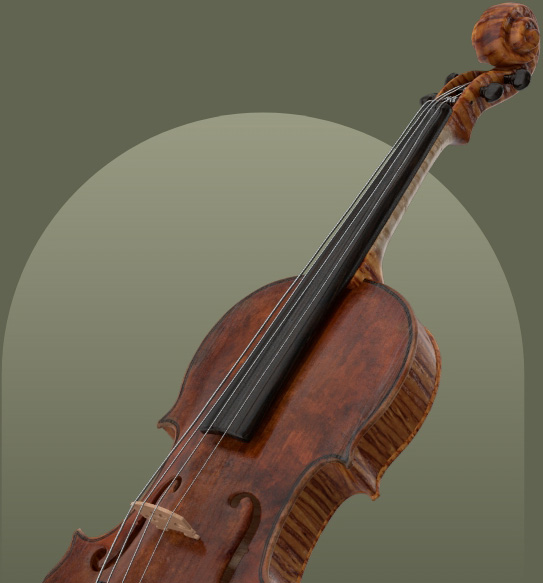
Jan Boumeester
Quakenbruck, c.1629–1681
Jan Boumeester (circa 1629-1681) was a highly significant early Dutch luthier based in Amsterdam from 1653. His workshop was prominent, and his instruments are known for their refined Italianate lines, full arch, Amati-form soundholes, and rich golden orange varnish. He was connected by marriage to fellow luthier Gerrit Menslage, and his workshop continued under family members and Jan Vos after his death. His work is now exceedingly rare.
Request an expert valuation or learn how our global auctions achieve the highest prices for your instruments.
Maker Overview
Life
Jan Boumeester (circa 1629-1681) was a very significant early Dutch maker, born circa 1629 in Quakenbruck, Germany, and dying in 1681 in Amsterdam, Netherlands. He established his workshop in Amsterdam from 1653. in The Brompton's Book of Violin & Bow Makers, Boumeester was the nephew through marriage of Gerrit Menslage, another luthier already established in the city, and both men worked in the Oude Kerk parish. His workshop was evidently one of the most important in Amsterdam, likely employing individuals such as Jan Vos, Gijsbert and Jacobus Verbeeck, Dirck ten Bos, and Boumeester's son, Harmanus. After his death in 1681, the workshop was initially continued by his widow, then by his daughter Margareta, and finally by Jan Vos in 1704. Labels bearing Boumeester's name are reported up to 1688. Sources contain conflicting information regarding his active period; Cecie Stainer's A Dictionary of Violin Makers states he was a maker in Amsterdam about 1637-68, which predates his establishment date given by Dilworth and conflicts with his death date and the reported label dates.
Characteristics
- Workmanship
- His work is described as highly refined, following Italianate lines. Instruments feature a full arch that is well modelled, with slightly elongated soundholes on an Amati form. The volute is slightly large but satisfyingly concentric and beautifully carved.
- Varnish
- Boumeester used a rich golden orange varnish, the effect of which was sufficient to lead to earlier speculation that he was a pupil of Pietro Guarneri of Mantua. A violoncello and a five-stringed bass-viol are noted to have been varnished yellow.
- Purfling
- Unlike many subsequent Amsterdam makers, he used conventional purfling rather than whalebone, which was very elegantly inlaid.
- Known Instruments
- A violoncello of large pattern with a carved scroll and a five-stringed bass-viol with a carved head are attributed to him.
- Labels
- Examples of his labels include "Jean Boumeester / Amsterdam, 1680", "Ian Boumeester / me fecit in Amsterdam / Anno, 1667", "Ian Boumeester / me fecit in Amsterdam, / Anno 1664", and "Jan Boumeester, me fecit in Amsterdam, anno 1637".
- Jean Boumeester
Amsterdam, 1680John Dilworth - Ian Boumeester
me fecit in Amsterdam
Anno, 1667John Dilworth - Ian Boumeester
me fecit in Amsterdam,
Anno 1664John Dilworth
Influence and legacy
- Family Connections: He was the nephew through marriage of Gerrit Menslage, a luthier already established in Amsterdam.
- Speculation: There was earlier speculation that he might have been a pupil of Pietro Guarneri of Mantua, though this is not confirmed.
- Workshop Continuity: After his death in 1681, his workshop was continued first by his widow, then by his daughter Margareta, and subsequently by Jan Vos in 1704.
- Rarity: His work is now exceedingly rare.
Further Information
- Location: Jan Boumeester worked in the Oude Kerk parish in Amsterdam.
- Label Dates: Labels bearing his name are reported to exist up to 1688.
Biographies
The overview above is drawn from the following published accounts. Read them in the original:
John Dilworth+
BOUMEESTER, Jan Born circa. 1629 Quakenbruck Germany, died 1681 Amsterdam Netherlands. Very significant early Dutch maker. Established in Amsterdam from 1653. Nephew through marriage of Gerrit Menslage, a luthier earlier established in the city. Both men worked in the Oude Kerk parish. His work is now exceedingly rare, but his was evidently one of the most important workshops in Amsterdam, probably employing Jan Vos, Gijsbert and Jacobus Verbeeck, Dirck ten Bos, as well as Boumeester’s son Harmanus. After his death in 1681, it was continued at first by his widow, then by his daughter Margareta, and finally by Jan Vos in 1704. Labels are reported with Boomeester’s name up to 1688. Highly refined work on Italianate lines. Full arch, but well modelled, with slightly elongated soundholes on an Amati form. Slightly large volute, but satisfyingly concentric and beautifully carved. Rich golden orange varnish, the whole effect sufficient to lead to earlier speculation that he was a pupil of Pietro Guarneri of Mantua. Unlike many subsequent Amsterdam makers he used conventional purfling rather than whalebone; very elegantly inlaid. Jean Boumeester / Amsterdam, 1680 Ian Boumeester / me fecit in Amsterdam / Anno, 1667 Ian Boumeester / me fecit in Amsterdam, / Anno 1664 [NGV]
Cecie Stainer+
A maker in Amsterdam about 1637-68. A violoncello of large pattern, with carved scroll and varnished yellow, was labelled ” Jan Boumeester, me fecit in Amsterdam, anno 1637.” In a five-stringed bass-viol with carved head and yellow varnish was the label: “Jean Baumeester, Amsterdam, 1667.”
Sell your instrument with Amati
Get started by uploading photos of your instrument for our experts to review.
Sell your instrument with Amati
Get started by uploading photos of your instrument for our experts to review.