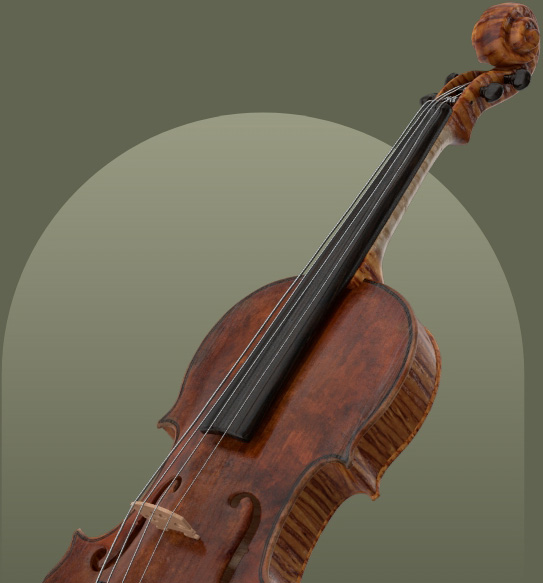
Charles Georges Brugere
Mirecourt, Paris, 1865–1930
Charles Georges Brugere (1865-1930) was a distinguished French luthier, born in Mirecourt, whose father was a guitar maker. His extensive training included an apprenticeship with Etienne Drouin and working for notable makers such as Paul Blanchard, Paul Bailly, and Gand & Bernardel, before managing Eugène Henry's workshop. Establishing his own business in Paris in 1895, Brugere was celebrated for his meticulous craftsmanship, producing approximately 250 violins, often copying Stradivari and Amati models, and distinctive double basses, some adorned with lion heads. He was known for using excellent materials and a high-quality oil varnish, and for successfully improving the tone of double basses. His work garnered him significant recognition, including a silver medal at Lyons in 1894 and another award at Paris in 1900. He retired to Mirecourt in 1920, continuing repair work until his death in 1930.
Request an expert valuation or learn how our global auctions achieve the highest prices for your instruments.
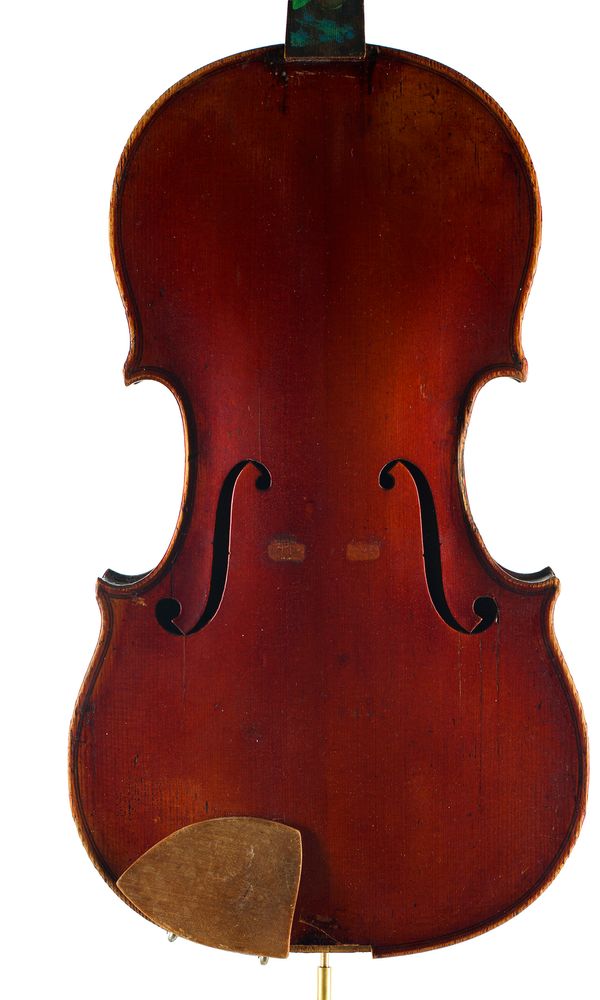
Instruments
Auction Price History
Highest auction price
64 results
| Type | Details | Auction house | Sold | Price |
|---|---|---|---|---|
| Violin | Bearing the maker's label n. 195 and signatures to the table and back Lot 215 | Vichy | December 2025 | £16,443est. € 5.000-6.000 |
| Violin | Bearing the maker's label n. 199 and signature to the table Lot 364 | Vichy | June 2025 | £6,524est. € 3.000-4.000 |
| Violin | Bearing the maker's label Lot 11 | Aguttes | November 2023 | £5,378est. € 5.000-7.000 |
| Violin | Labelled Charles BRUGERE ..., two-piece back, varnish of a red brown colour on a golden ground Lot 21 | Apollium | November 2022 | £3,109est. € 2.500-3.000 |
| Violin | Bearing the maker's label n. 194 and brands to the table and back Lot 268 | Vichy | June 2022 | £12,679est. € 5.000-7.000 |
| Violin | Labelled Charles Brugere Luthier, 11 Faubourg Poissonnière, No. 288, Paris, An. 1927, branded Lot 110 | Tarisio | April 2022 | £9,922est. € 12.000-18.000 |
| Cello | Labelled Charles Brugère Année 1904 N 141. Paris, numbered 141 internally on the back Lot 54 | Ingles & Hayday | June 2021 | £19,200est. £ 12,000-18,000 |
| Violin | Bearing the maker's label n. 173 and signature Lot 205 | Vichy | December 2020 | £9,184est. € 7.000-8.000 |
| Violin | Bearing the maker's label n. 234 and brands Lot 56 | Vichy | December 2020 | £4,368est. € 3.000-4.000 |
| Violin | Two-piece back of medium curl, varnish of a dark reddish brown colour on a golden ground Lot 2455 | Gardiner Houlgate | September 2020 | £4,080est. £ 3,000-4,000 |
| Violin | A violin by Charles Brugere, France, 20th Century Lot 24 | Amati | July 2020 | £2,275est. £ 1,000-1,500 |
| Violin | Labelled Charles Brugere, 11 Rue de Fauv-Poisonniere, Paris 1903 Lot 72 | Brompton’s | March 2020 | £3,000est. £ 3,000-5,000 |
| Violin | Bearing the maker's label n. 309 and brands Lot 260 | Vichy | November 2019 | £4,103est. € 4.000-5.000 |
| Violin | Labelled Charles BRUGERE Luthier, 11 Faubourg Poissonniere, No. 172, Paris An. ... Lot 101 | Brompton’s | March 2019 | £3,120est. £ 2,500-3,500 |
| Violin | Bearing the maker's label n. 153 and brands Lot 67 | Vichy | December 2018 | £7,483est. € 3.500-4.000 |
| Violin | Bearing the maker's label n. 94 Lot 152 | Sunrise | March 2018 | £2,431est. ¥ 400,000-600,000 |
| Violin | Labelled Charles Brugère, Rue du Faub Poissonnière, no 154, Paris 1907, signed to the label B, branded Lot 129 | Tarisio | March 2018 | £14,400est. £ 4,000-6,000 |
| Violin | Bearing the maker's label n. 301 and signature Lot 219 | Vichy | June 2017 | £5,742est. € 5.000-7.000 |
| Violin Bow | Nickel mounted, branded Charles Brugere, ebony frog, minus hair Lot 39 | Apollium | November 2016 | £816est. € 180-250 |
| Violin | One-piece back, ribs and head similar, varnish of a red brown colour on a golden ground Lot 91 | Apollium | November 2016 | £2,040est. € 2.500-2.700 |
| Violin | Labelled Antonius Stradivarius ..., branded internally G. Brugere à Paris, signed to the inside top Lot 206 | Tarisio | October 2016 | £4,923est. $ 7,000-10,000 |
| Violin | Bearing the maker's label n. 4 and signature to the table Lot 374 | Vichy | June 2016 | £8,486est. € 5.000-6.000 |
| Violin | Labelled Charles Brugère Luthier, 11 Faubourg ... Lot 218 | Brompton’s | June 2016 | £1,680est. £ 2,000-4,000 |
| Violin | Labelled Charles Brugere Luthier, 11 Faubourg Poissonnière, No. 237, Paris, An. 1922 Lot 154 | Tarisio | May 2016 | £8,169est. $ 10,000-15,000 |
| Violin | Bearing the maker's label n. 326 and brand to the lower rib Lot 58 | Vichy | December 2015 | £4,430est. € 3.000-4.000 |
| Violin | N. 245, bearing the maker's brands and signature Lot 155 | Vichy | December 2015 | £5,111est. € 5.000-6.000 |
| Violin | Bearing the original label Charles Brugere, 11 Rue de Faub. Poissoniers, Paris 1909 Lot 267 | Brompton’s | December 2015 | £1,440est. £ 1,200-1,800 |
| Viola | Bearing the maker's label and brands Lot 25 | Vichy | June 2015 | £4,379est. € 6.000-8.000 |
| Violin | Bearing the maker's label n° 153 and brand Lot 163 | Vichy | June 2015 | £5,255est. € 4.000-6.000 |
| Violin | Bearing the maker's label n° 253 and brands Lot 308 | Vichy | June 2015 | £2,452est. € 2.500-3.000 |
| Violin | Bearing the maker's label n° 127 and brand Lot 408 | Vichy | December 2014 | £5,462est. € 4.000-6.000 |
| Violin | Labelled Charles Brugere Luthier, 11 Faubourg Poissonniere, No. 237, Paris, An. 1922 Lot 239 | Tarisio | May 2014 | £6,723est. $ 12,000-18,000 |
| Violin | Bearing the maker's label and brands Lot 70 | Vichy | December 2013 | £6,968est. € 7.000-8.000 |
| Violin | Labelled Charles Brugere, Paris, 1905, inscribed to the inside back and the top C. Brugère, Paris, 1905 Lot 331 | Tarisio | November 2012 | £9,737est. $ 12,000-18,000 |
| Violin | Bearing the maker's label n° 289 and signature Lot 405 | Vichy | June 2012 | £3,882est. € 4.000-5.000 |
| Violin | Labelled Charles Brugere Luthier, 11 Faubourg Poissonniere, No. 209 Paris AN 1914, signed internally Lot 256 | Brompton’s | March 2012 | £7,200est. £ 2,500-3,500 |
| Violin | 35.9 cm Workshop of | — | June 2011 | £2,640 |
| Violin | 35.8 cm Paris, 1914 n°209 | — | June 2011 | £4,409 |
| Cello | 76.1 cm Ascribed to | — | April 2010 | £7,856 |
| Violin | 35.5 cm Paris, 1905 | — | October 2009 | £8,033 |
| Violin | Paris, 1893 | — | June 2009 | £622 |
| Violin | 35.5 cm Paris, 1905 | — | October 2008 | £10,123 |
| Violin | 35.8 cm 1900 c. Possibly by | — | October 2007 | £1,998 |
| Violin | 35.9 cm Paris, 1893 #7 | — | July 2006 | £1,200 |
| Violin | Paris, 1911 #192 | — | November 2005 | £3,000 |
| Cello | 1900 c. Attributed to | — | October 2005 | £3,275 |
| Violin | Paris, 1904 #129 | — | June 2005 | £4,747 |
| Violin | 1893 #7 | — | May 2005 | £404 |
| Violin | Paris, 1899 | — | February 2005 | £2,988 |
| Violin | Paris, 1926 | — | February 2005 | £3,840 |
| Violin | Paris, 1808 #170 | — | December 2004 | £6,186 |
| Viola | 40 8 cm Paris 1897 #87 | — | November 2004 | £1,610 |
| Violin | 1891 | — | June 2003 | £6,773 |
| Violin | 1927 | — | June 2002 | £3,585 |
| Violin | 1927 | — | November 2001 | £2,600 |
| Violin | 1929 | — | December 2000 | £2,548 |
| Violin | 1911 | — | March 1999 | £1,800 |
| Violin | 1900 | — | March 1994 | £1,610 |
| Violin | 1905 | — | March 1990 | £4,400 |
| Violin | 1896 | — | March 1990 | £605 |
| Violin Bow | S/E 56 g. | — | November 1989 | £1,100 |
| Violin | 18-- | — | May 1986 | £1,296 |
| Violin | 1909 | — | November 1985 | £3,520 |
| Violin Bow | S/E 60 g. | — | September 1982 | £462 |
No results match those filters.
Maker Overview
Life
Charles Georges Brugere (1865-1930) was born on November 10, 1865, in Mirecourt, France, the son of Charles Joseph Brugère, a guitar maker. He was apprenticed to Etienne Drouin in Mirecourt from 1878 to 1882. Following his apprenticeship, he worked for Paul Blanchard in Lyons for two and a half years, and then for Paul Bailly in Paris for nine months. From December 1885 until 1892, he was employed by Gand & Bernardel in Paris. He served as workshop manager for Eugène Henry from 1892 to 1895, having succeeded Eugène Henry on September 22, 1892, at 151, Rue St. Martin, Paris. In 1895, he established his own business at 11, Faubourg Poissonière. He retired to Mirecourt in 1920, although he continued to perform repair work. He died in 1930.
Characteristics
- Workmanship
- He worked with extreme care, completing only one violin per month, resulting in approximately twelve new instruments annually.
- Production
- He made about 250 violins, often copying Stradivari and Amati models, and also produced four double basses, some of which featured lion heads.
- Patterns
- He primarily followed the Stradivari pattern.
- Materials & Varnish
- He utilized excellent materials and applied a good quality oil varnish, which varied in color from orange-red to golden-brown, or yellow to golden-red.
- Labeling
- Only instruments that he completed entirely himself were labeled with his name. Instruments made by his employees were labeled: "Fait dans I’atelier de Charles Brugère Paris 1899".
- Innovation
- He successfully improved the tone quality of the double bass through modifications in its construction.
- Numbering
- His instruments were consecutively numbered.
- Charles Brugère
année 1893
No. 10
151 Rue St Martin. Paris. Charles Brugère
11 Rue du Faub: Poissonnière 11
No. 94. Paris 1900John Dilworth - Charles Brugère, Luthier
11 Fauborg Poissonnière,
no . 232 Paris An. 1920John Dilworth - Instruments made by his employees labelled: Fait dans I’atelier de Charles Brugère Paris 1899John Dilworth
Influence and legacy
- Apprenticeship: He was apprenticed to Etienne Drouin in Mirecourt from 1878 to 1882.
- Mentorship: He worked as an assistant for Paul Blanchard in Lyons, Paul Bailly in Paris, and Gand & Bernardel in Paris.
- Family Background: His father, Charles Joseph Brugère, was a maker of guitars.
- Awards: He was awarded a silver medal for a double quintet exhibited at Lyons in 1894, and received other awards, including one at Paris in 1900.
- Exhibitions: He exhibited at Lyons in 1894 and was well-represented at the Paris Exhibition in 1900.
- Reputation: His violins and violoncellos were reported to possess a powerful and sweet tone, and his double basses were considered equally excellent on all four strings.
Further Information
- Workshop Locations: He maintained a workshop at 151, Rue St. Martin, Paris, and later at 11, Faubourg Poissonière, Paris.
- Internal Branding: His instruments were numbered and branded internally.
- Labels: Examples of his labels include: "Charles Brugère / année 1893 / No. 10 / 151 Rue St Martin. Paris.", "Charles Brugère / 11 Rue du Faub: Poissonnière 11 / No. 94. Paris 1900", and "Charles Brugère, Luthier / 11 Fauborg Poissonnière,/ no . 232 Paris An. 1920."
Biographies
The overview above is drawn from the following published accounts. Read them in the original:
John Dilworth+
BRUGÈRE, Charles Georges Born 1865, died 1930 Mirecourt France. Son of Charles Joseph Brugère, below. Apprenticed to Etienne Drouin at Mirecourt 1878-1882. Worked for Paul Blanchard in Lyons and Gand and Bernardel in Paris 1885-1892. Workshop manager for Eugène Henry 1892-1895. Established own business at 11, Faubourg Poissonière 1895, retiring in 1920 to Mirecourt, although still carrying out repair work. Made about 250 Stradivari and Amati copies of fine workmanship; also four double basses with lion heads. Excellent materials. Good quality oil varnish of orange-red to golden-brown colours. Silver medal awarded for a double quintet exhibited at Lyons 1894; other awards include Paris 1900. Instruments numbered and branded internally. Charles Brugère / année 1893 / No. 10 / 151 Rue St Martin. Paris. Charles Brugère / 11 Rue du Faub: Poissonnière 11 / No. 94. Paris 1900 Charles Brugère, Luthier / 11 Fauborg Poissonnière,/ no . 232 Paris An. 1920. Instruments made by his employees labelled: Fait dans I’atelier de Charles Brugère Paris 1899
Cecie Stainer+
b. Nov 10, 1865, at Mirecourt; son of Charles Joseph Brugere, a maker of guitars. Apprenticed, 1878, at Mirecourt, to Etienne Drouin. 1882, went to Lyons to work for two and a half years under Paul Blanchard; then after nine months with Paul Bailly at Paris, entered the workshop of Gand & Bernardel, where he remained from Dec, 1885, till 1892.
He succeeded Eugene Henry, Sept. 22, 1892, at 151, rue St. Martin, Paris. As he and three workmen are almost exclusively employed in repairing old instruments, he only makes about twelve new instruments a year; these, whether violins, violas, or violoncellos, are consecutively numbered as made, and only when his own personal work are labelled with his name. He follows the Stradivari pattern, and uses good oil varnish, varying in colour from yellow to golden-red.
He exhibited at Lyons, 1894, a double quintet of instruments ; the violins and violoncellos were reported of powerful and sweet tone, and the double-bass as equally excellent on all four strings; he was awarded the first silver medal.
Willibald Leo Lütgendorff+
Sohn von Charles Joseph Br. und Schüler von Etienne Drouin in Mirecourt.
Er arbeitete als Gehilfe bei Blanchard in Lyon, bei P. Bailly und bei Gand und
übernahm am 22. Sept. 1892 die alte Werkstatt der Familie Henry in der Rue
St. Martin. Er arbeitet ungemein sorgfältig, so dass er in jedem Monat nur
eine Geige fertig bekommt, die er nach Stradivari baut und mit einem gelben
bis goldrothen Lack versieht. Nur in die Geigen, die er vollkommen allein
fertig macht, klebt er seinen Zettel. Er besitzt bereits mehrere silberne Medaillen und war auch 1900 auf der Pariser Ausstellung gut vertreten. Eine Verbesserung der Klangfarbe des Contrabässes ist ihm durch Änderungen in der Bauart recht wohl gelungen.
Sell your instrument with Amati
Get started by uploading photos of your instrument for our experts to review.
Sell your instrument with Amati
Get started by uploading photos of your instrument for our experts to review.