Simon Andrew Forster
London, 1801–1870
Simon Andrew Forster (1801-1870) was a London-based luthier, son of William Forster (III), and a pupil of his father and Samuel Gilkes. He operated workshops in Frith Street and Macclesfield Street, Soho, producing instruments between 1828 and 1840. Known for making instruments in two classes, including a highly finished better class and cheaper ones with spirit varnish, his work included violins, violas, cellos, and double basses. His instruments received prizes at the 1851 Great Exhibition, and a viola from 1843 is housed in the Ashmolean Museum. Forster is also recognized as the co-author of the influential The History of the Violin (1864).
Request an expert valuation or learn how our global auctions achieve the highest prices for your instruments.
Auction Price History
Highest auction price
15 results
| Type | Details | Auction house | Sold | Price |
|---|---|---|---|---|
| Small Cello | Labelled S.A. Forster, Violin, Tenor and Violoncello Maker, No. 5 London., inscribed S.A.F. on the label Lot 74 | Ingles & Hayday | October 2020 | £16,800est. £ 14,000-18,000 |
| Violin | Bearing an indistinct label, signed on the lower rib S.A. Forster, London 92.16 Lot 234 | Brompton’s | March 2015 | £1,140est. £ 1,000-1,500 |
| Small Cello | Labelled S.A. Forster, Violin, tenor and ..., of a golden red orange brown colour Lot 186 | Bonhams | October 2013 | £11,250est. £ 4,000-6,000 |
| Violin | Two-piece back of faint medium curl, varnish of a plum red colour on a golden ground Lot 521 | Gardiner Houlgate | September 2013 | £780est. £ 550-750 |
| Cello | 73.6 cm London, 1831 | — | November 2008 | £31,122 |
| Violin | 35.5 cm London, 1850 c. | — | February 2006 | £9,600 |
| Cello | 1818 | — | July 2003 | £23,500 |
| Violin | 1840 | — | March 2002 | £2,800 |
| Cello | 1830 c. | — | November 1998 | £23,000 |
| Cello | 18-- | — | April 1991 | £9,900 |
| Cello | 1839 | — | November 1989 | £10,450 |
| Cello | 1835 | — | November 1988 | £2,200 |
| Cello | 1830 | — | June 1988 | £8,800 |
| Violin | 1856 | — | June 1984 | £1,698 |
| Cello | 1833 | — | September 1983 | £5,720 |
No results match those filters.
Maker Overview
Life
Simon Andrew Forster (1801-1870) was born in 1801 and died in 1870 in London, UK. He was the son of William Forster (III). He served as a chorister at Westminster Abbey from 1811 to 1817. Simon Andrew Forster established his business first in Frith Street, Soho, and later moved to Macclesfield Street, Soho. He co-authored The History of the Violin with S. A. Sandys, published in 1864, a work that contains significant details about the Forster family. His instruments are dated from 1828 to 1840. George Pearce assisted him from 1834 to 1844.
Characteristics
- Models and Arching
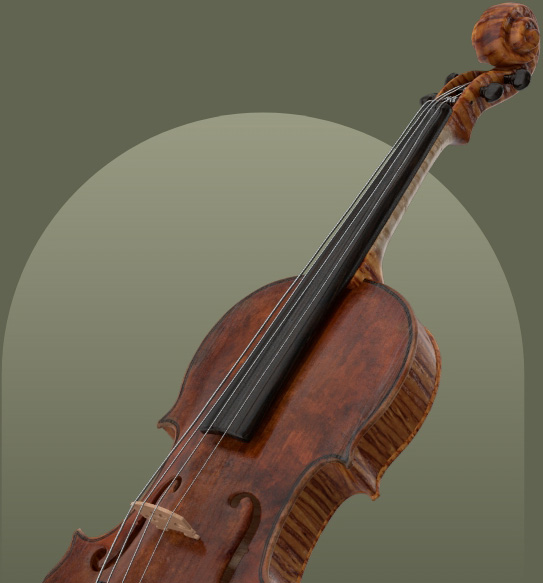
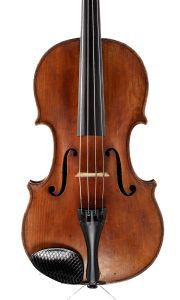
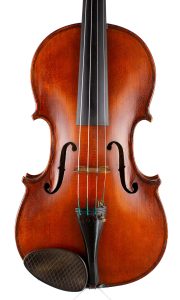
- Instruments were made on the Stainer model with softened arching curves. William Meredith Morris states that he sometimes worked on the Stradivari model and sometimes on the Stainer, but always arched his instruments in a grotesque manner. Cecie Stainer also noted his instruments were "very much arched."
- Classes of Instruments
- Simon Andrew Forster produced instruments in two distinct classes. The better class was highly finished and covered with a good orange-amber varnish. Cheaper instruments were made with an inferior spirit varnish, an unsuccessful attempt to compete with the large number of similar instruments being imported from Germany at the time.
- Awards and Recognition
- His violin, viola, and cello were awarded prizes at the 1851 Great Exhibition in London.
- Notable Surviving Instruments
- Viola no.7, made in 1843, is housed in the Ashmolean Museum, Oxford. He also made fine double basses.
- Labeling
- Instruments were numbered and inscribed at the endpin with "S. A. Forster / Violin, Tenor, and Violoncello maker / No.. London." For his second-class instruments, he used spirit varnish and inscribed them only "Foster, No.," at the tailpin.
- S. A. Forster
Violin, Tenor, and Violoncello maker
No.. LondonJohn Dilworth
Influence and legacy
- Mentorship: Simon Andrew Forster was a pupil of his father, William Forster (III). He also studied under Samuel Gilkes, who worked as an assistant for his father. William Meredith Morris also notes that he was a pupil of his brother.
- Literary Contribution: He is well-known as the co-author, with S. A. Sandys, of The History of the Violin (1864), a significant historical work that includes much detail about the Forster family.
- Exhibition Success: His instruments, including a violin, viola, and cello, received prizes at the 1851 Great Exhibition in London.
- Museum Collections: A viola (no.7, 1843) made by him is preserved in the Ashmolean Museum, Oxford.
Further Information
- Workshop Locations: Simon Andrew Forster's workshops were located in Frith Street, Soho, and later in Macclesfield Street, Soho, London.
- Label Inscription: His instruments bore the label: "S. A. Forster / Violin, Tenor, and Violoncello maker / No.. London."
Biographies
The overview above is drawn from the following published accounts. Read them in the original:
John Dilworth+
FORSTER, Simon Andrew Born 1801, died 1870 London UK. Son of William Forster (III), below. Pupil of his father and of Samuel Gilkes. Also studied music and was a chorister at Westminster Abbey 1811-1817. Established in Frith Street, Soho; later in Macclesfield Street, Soho. Co-author with S. A. Sandys The History of the Violin (1864) wherein much of the detail of the Forster family is contained. Instruments are dated from 1828 to 1840. Stainer model with softened arching curves. Made instruments in two classes. The better class is very highly finished and covered with a good orange-amber varnish. Cheaper instruments made with inferior spirit varnish; an unsuccessful attempt to combat the large numbers of instruments of similar sort then being imported from Germany. Assisted by George Pearce 1834-1844. Violin, viola, and cello awarded prizes at the 1851 Great Exhibition, London. Viola no.7 (1843) is housed in the Ashmolean Museum, Oxford. Also made fine double basses. Numbered and inscribed at the endpin. S. A. Forster / Violin, Tenor, and Violoncello maker / No.. London. [BVMA]
George Hart+
Brother of William, mentioned above. He learned his business from his father and Samuel Gilkes, who worked for William Forster. He made several instruments between the years 1828 and 1840, which are of average merit.
William Meredith Morris+
He was the son of William Forster (1764-1824), born May 13, 1801, died Feb. 2, 1870. He worked at Frith Street, and also at Macclesfield Street, Soho. He is more famous as the collaborator with William Sandys of “The History of the Violin” (London, 1864), than as a violin-maker. All his work that I have seen reflects little or no credit upon him. He was a pupil of his father, of his brother, and of Samuel Gilkes. He worked sometimes on the Stradivari model, some- times on the Stainer, but always arched his instruments in a grotesque manner. I am not sure that he did not sometimes bake his wood, as the tone of some of them is of a wretched character. Label : —
S. A, FORSTER, VIOLIN, TENOR, AND VIOLONCELLO MAKER, NO.- LONDON
Cecie Stainer+
Son of William Forster (1764-1824), b. May 13, 1801, London; d. Feb. 2, 1870. He carried on the business first at Frith Street, then at Macclesfield Street, Soho. He learnt his trade under his father, Samuel Gilkes (a workman in his father’s employ), and his brother William. 1828-40, he made several instruments, very much arched, of no great merit, using the label: ” S. A. Foster, violin, tenor, and violoncello maker. No. , London.” He used spirit varnish for his second-class instruments, and only inscribed them “Foster, No. ,” at the tailpin.
His name is well known as joint-author, with William Sandys, of “The History of the Violin,” published in London, 1864.
Willibald Leo Lütgendorff+
Sohn von William III. F. Erst Schüler seines Vaters und dann von Samuel
Gilkes, der als Gehilfe bei seinem Vater arbeitete. Er kam seinem Vater und
Grossvater zwar nicht gleich, war aber ein feiner Kenner und ist namentlich
bekannt durch seine Mitarbeiterschaft an dem Buche »The history of the Violin
by Sandys and S. A. Forster« (1864).
Sell your instrument with Amati
Get started by uploading photos of your instrument for our experts to review.
Sell your instrument with Amati
Get started by uploading photos of your instrument for our experts to review.