
Giovanni Battista Gabrielli
Florence, 1716–1771
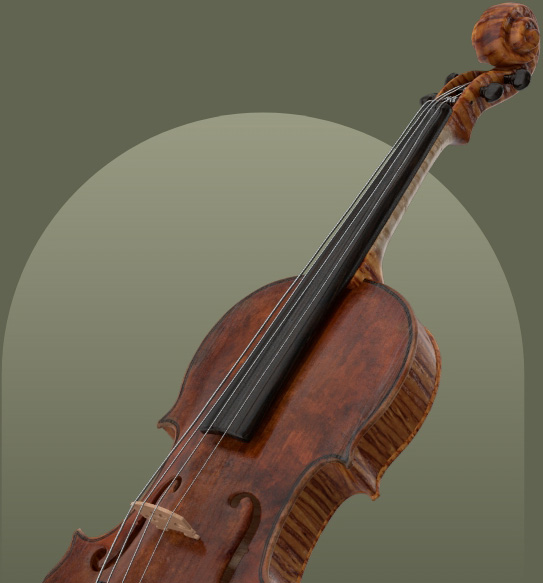
Giovanni Battista Gabrielli (1716-1771) was a pre-eminent Florentine violin maker, active from approximately 1740 to 1770. He is recognized for his craftsmanlike work, which consistently followed the Stainer model, a dominant influence in 18th-century Florence. Gabrielli's instruments feature elegant 'f' holes, often combining Stainer and Stradivari elements, and are finished with a rich golden-yellow or orange varnish. While he used good materials, the finest maple cuts are less common, with beech wood frequently appearing in purfling and interiors. His violoncellos and altos are particularly esteemed for their quality and tone. Gabrielli's instruments are often branded with 'G.B.G.', and his name was frequently misused by dealers for imitations.
Request an expert valuation or learn how our global auctions achieve the highest prices for your instruments.
Auction Price History
Highest auction price
51 results
| Type | Details | Auction house | Sold | Price |
|---|---|---|---|---|
| Violin | Labelled Gio Battista Gabrielli, fece in Firenze, 1757, branded to the button GBG Lot 170 | Tarisio | October 2024 | £54,256est. € 55.000-85.000 |
| Violin | Bearing the maker's label, minor table resorations Lot 225 | Vichy | December 2022 | £40,703est. € 35.000-40.000 |
| Violin | top edge doubled Lot 126 | Skinners | November 2019 | £9,580est. $ 15,000-20,000 |
| Violin | Labelled Joannis Baptista de Gabriellis florentinus fecit 1747 Lot 19 | Ingles & Hayday | March 2018 | £84,000est. £ 50,000-80,000 |
| Violin | Labelled Joannes Baptista de Gabriellis florentinus fecit 176... Lot 184 | Ingles & Hayday | March 2017 | £24,000est. £ 20,000-30,000 |
| Violin | Branded GBG on the button and on the bottom rib by the end pin Lot 24 | Ingles & Hayday | March 2015 | £10,800est. £ 10,000-15,000 |
| Cello | Labelled Joannes Battista de Gabrielli, Florentinus, fecit 1756 Lot 74 | Tarisio | October 2014 | £293,905est. $ 300,000-500,000 |
| Violin | Labelled Gio Batista Gabbrielli, fece in Firenze, 1750, labelled to the inside back S-278 Lot 288 | Tarisio | October 2014 | £37,519est. $ 40,000-60,000 |
| Violin | Labelled Joannes Baptista de Gabrielli, florentinus fecit, 1753 Lot 166 | Tarisio | October 2013 | £16,800est. £ 12,000-18,000 |
| Violin | Illustrated in The Strad (August 1941); labelled Jovanej Batista Gabbrielli Florentiris fecet. Anno 1779 Lot 135 | Ingles & Hayday | October 2013 | £21,600est. £ 15,000-20,000 |
| Violin | Labelled Joannes Baptista Gabrielli, Florentina fecit, 17.., stamped to the rib GBG, head by another hand Lot 327 | Tarisio | November 2012 | £20,598est. $ 12,000-18,000 |
| Violin | Bearing a manuscript label Joannes Baptista de Gabbriellis Florentinus, fecit 1764, branded G.B.G. Lot 354 | Tarisio | November 2012 | £35,577est. $ 30,000-50,000 |
| Viola | Labelled Gio. Batt Gabrielli fece in Firenze nell año 1750 Lot 96 | Sotheby's | October 2012 | £91,250est. £ 40,000-60,000 |
| Violin | 35.3 cm Florence, 1769 | — | December 2011 | £121,531 |
| Violin | 35.4 cm Florence, 1754 | — | May 2011 | £21,850 |
| Violin | 35.2 cm Florence, 1760 c. | — | October 2010 | £39,431 |
| Violin | 35.3 cm Florence, 1766 (with opinion that scroll is later) | — | October 2009 | £43,070 |
| Cello | 74.1 cm 18th C. Attributed to | — | October 2009 | £37,250 |
| Violin | 35.5 cm Florence, 1760 (restored sound post break) | — | December 2008 | £35,834 |
| Viola | 39.4 cm Florence, 1755 | — | June 2008 | £50,134 |
| Violin | 35.6 cm 18th C. Ascribed to | — | May 2008 | £2,993 |
| Violin | 35.5 cm Florence, 1755 | — | May 2008 | £23,947 |
| Violin | 35.4 cm Florence, 1758 | — | October 2007 | £13,708 |
| Violin | Florence, 1760 | — | June 2005 | £25,319 |
| Violin | Florence, 1757 | — | June 2005 | £20,930 |
| Violin | Florenz, 1757 | — | May 2005 | £24,218 |
| Violin | Florence, 1760 c. | — | October 2004 | £26,720 |
| Violin | Florence, 1770 | — | July 2004 | £37,045 |
| Viola | 1763 | — | March 2003 | £45,600 |
| Violin | 1764 | — | November 2002 | £10,158 |
| Violin | 1757 | — | May 2001 | £7,395 |
| Violin | 1770 c. | — | November 1998 | £23,000 |
| Violin | 1751 | — | November 1997 | £29,900 |
| Violin | 1760 c. | — | November 1997 | £11,500 |
| Violin | 17-- | — | June 1996 | £19,550 |
| Viola | 39.1 cm 1753 | — | December 1995 | £28,931 |
| Cello | 1750 | — | October 1995 | £73,000 |
| Violin | 1760 | — | October 1995 | £14,950 |
| Violin | 1770 | — | June 1990 | £39,600 |
| Viola | 39.4 cm 1757 | — | March 1990 | £20,900 |
| Violin | 1767 | — | November 1989 | £28,600 |
| Violin | 1760 c. | — | June 1988 | £18,700 |
| Violin | 1765 c. | — | November 1986 | £11,000 |
| Violin | 17-- | — | November 1986 | £15,400 |
| Violin | 17-- | — | April 1985 | £8,640 |
| Violin | 1761 | — | November 1983 | £11,550 |
| Violin | 1771 | — | June 1983 | £4,400 |
| Violin | 1757 | — | April 1983 | £6,050 |
| Cello | 1759 | — | November 1981 | £21,459 |
| Violin | 1766 | — | November 1981 | £8,140 |
| Violin | 1760 | — | October 1980 | £7,920 |
No results match those filters.
Maker Overview
Life
Giovanni Battista Gabrielli (1716-1771) was a pre-eminent maker of the Florentine school, born in 1716 and dying in 1771 in Florence, Italy. may have received some instruction from Bartolomeo Cristofori, who had previously worked for Nicolò Amati before arriving in Florence in 1709, where he received a royal appointment. While Cristofori's work was decidedly Cremonese in style, Gabrielli consistently worked in the manner of Stainer, which remained the dominant influence in Florence throughout the 18th century. He was active in Florence from about 1740 to 1770. Gabrielli's work is generally well-controlled and craftsmanlike, and he seldom exaggerated the model in the destructive manner seen in many Stainer followers. John Dilworth also notes that many dictionaries list several other makers in the Gabrielli family, such as Antonio, Bartolomeo, and Cristoforo, but their existence is not yet supported by historical research, and these names may be fictitious, used in less convincing imitations of his work. Willibald Leo Lütgendorff identifies him as the most significant violin maker of his name, considering him one of the best Florentine makers of his time, though not reaching the level of the Cremonese masters.
Characteristics
- Workmanship
- Gabrielli's work is generally well-controlled and craftsmanlike, seldom exaggerating the model in the destructive manner of many Stainer followers.
- Scrolls
- His scrolls are nicely contrived, though sometimes a little broad through the second turn.
- 'f' holes
- The 'f' holes are very elegant, often successfully combining elements from both Stainer and Stradivari.
- Varnish
- The varnish is described as rich golden-yellow or orange with good, even consistency by John Dilworth. Cecie Stainer notes he used a transparent yellow or pale red varnish, while Willibald Leo Lütgendorff describes it as mostly light yellow, transparent but somewhat hard.
- Materials
- He used good materials, including excellent wood, though the best cuts of maple are seldom encountered. Much use was made of beech wood in the purfling and interior.
- Model Variation
- His work does vary to some extent, an aspect exacerbated by many speculative attributions. He sought a new model, creating a number of violins that appear too roundly arched.
- Best Works
- His violoncellos and altos are considered his best work and are known for their good tone.
- Joannes Baptistae de
Gabriellis Florentinus
fecit 1767John Dilworth - Gio. Batista de Gabrielli
fece in Firenze 1757John Dilworth
Influence and legacy
- Mentorship: Giovanni Battista Gabrielli may have had some instruction from Bartolomeo Cristofori, who had a Cremonese style.
- Stylistic Influence: Gabrielli consistently worked in the manner of Stainer, which remained the dominant influence in Florence throughout the 18th century.
- Branding: Instruments are often branded on the back button with 'G.B.G.' Sources contain conflicting information regarding other branding, with Willibald Leo Lütgendorff mentioning 'T. B. G.' as a brand mark.
- Labels: Examples of his manuscript labels include "Joannes Baptistae de / Gabriellis Florentinus / fecit 1767" and "Gio. Batista de Gabrielli / fece in Firenze 1757". Cecie Stainer also notes "Gio. Battista Gabrielli, fece in Firenze, 1757" and a similar one dated 1763.
- Museum Holdings: A violin made by Gabrielli in 1745 is held in the Museum Kraus in Florence.
- Reputation: His name was often misused by dealers, leading to incredible distortions such as "Gabbicellis" or "Garbicelli" in imitations.
Further Information
- Branding: Gabrielli's instruments are typically branded on the back button with the initials 'G.B.G.' Willibald Leo Lütgendorff also mentions a brand mark 'T. B. G.'
- Labels: Known manuscript labels include "Joannes Baptistae de / Gabriellis Florentinus / fecit 1767" and "Gio. Batista de Gabrielli / fece in Firenze 1757".
- Museum Collection: The Museum Kraus in Florence possesses a violin crafted by Gabrielli in 1745.
Biographies
The overview above is drawn from the following published accounts. Read them in the original:
John Dilworth+
GABRIELLI, Giovanni Battista Born 1716, died 1771 Florence Italy. Pre-eminent maker of the Florentine school. May have had some instruction from Bartolomeo Cristofori, who had worked for Nicolò Amati before coming to Florence in 1709, where he received royal appointment. What is known of Cristofori’s work is decidedly Cremonese in style, but Gabrielli worked consistently in the manner of Stainer, which remained the dominant influence in Florence throughout the 18th century. Seldom exaggerated the model in the destructive manner of many Stainer followers, and his work is generally well-controlled and craftsmanlike. Scrolls are nicely contrived, if a little broad through the second turn. ‘f’ holes are very elegant, often managing to combine Stainer and Stradivari elements successfully. Varnish is rich golden-yellow or orange with good even consistency. Materials are good, but the best cuts of maple are seldom encountered. Much use made of beech wood in purfling and interior. His work does vary to some extent, but this aspect has been exacerbated by many speculative attributions; imitations of his label are often found in Tyrolean work. Most dictionaries list several other makers in the Gabrielli family: Antonio, Bartolomeo, Cristoforo, etc. but their existence is not yet supported by historical research, and these may be fictitious names used in the less convincing imitations. Branded on back button: ‘G.B.G.’. Manuscript labels: Joannes Baptistae de / Gabriellis Florentinus / fecit 1767 Gio. Batista de Gabrielli / fece in Firenze 1757
Cecie Stainer+
A maker in Florence about 1740-70. Many well made instruments are known, of good tone; he used excellent wood, and a transparent yellow or pale red varnish ; his violoncellos and altos are considered his best work; they are often branded with his initials, G. B. G.
and ” Gio. Battista Gabrielli, fece in Firenze, 1757″ ; a similar one dated 1763.
Willibald Leo Lütgendorff+
Der bedeutendste Geigenmacher dieses Namens. Er erreicht zwar die
Cremoneser nicht, ist aber doch einer der besten Florentiner seiner Zeit. Seine
Arbeit ist geschmackvoll, das Holz gut, sein Lack meist von hellgelber Farbe,
durchsichtig aber etwas hart. Er suchte augenscheinlich nach einem neuen
Modell und machte eine Anzahl Geigen, die allzurund gewölbt erscheinen. Am
besten gelangen ihm Violen und Violoncelli. Ausser seinen Zetteln verwendete
er auch eine Brandmarke T. B. G. — Er gehört zu den Meistern, deren Name
von Händlern gerne missbraucht wurde, wesshalb man auch den unglaublichsten
Entstellungen seines Namens begegnen kann (»Gabbicellis«, »Garbicelli« etc.). —
Eine Geige von ihm aus dem Jahre 1745 besitzt das Museum Kraus in Florenz.
Sell your instrument with Amati
Get started by uploading photos of your instrument for our experts to review.
Sell your instrument with Amati
Get started by uploading photos of your instrument for our experts to review.
Florentine School
- Antonio Felice Carcassi worked 1770–1776
- Fredimaur worked 1736–1760
- Gaspero Piattellini worked 1738–1780
- Giovanni Baptista Birmetti worked 1770–1775
- Giovanni Bianchi worked 1746
- Leopoldo Franciolini worked 1760–1785
- Lorenzo And Tomaso Carcassi worked 1750–1780
- Luigi (Aloysius) (I) Piattellini worked 1750–1791