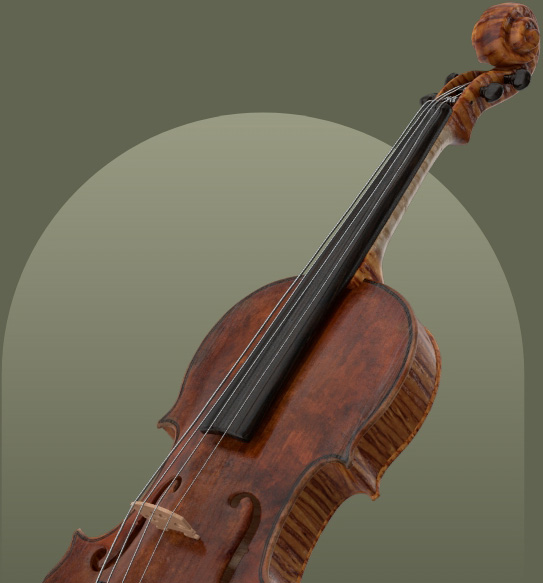
Franz Geissenhof
Fussen, Vienna, 1753–1821
Franz Geissenhof (1753-1821) was a prominent Viennese luthier, known as the "Viennese Stradivari." A pupil of Johann Georg Thir, he initially used Stainer models but transitioned to the Stradivari form by 1800, producing highly distinguished instruments. His craftsmanship was strong and confident, utilizing excellent wood and evolving varnish techniques. He made violins, violas, and rare cellos, and his instruments are found in notable collections.
Request an expert valuation or learn how our global auctions achieve the highest prices for your instruments.
Auction Price History
Highest auction price
42 results
| Type | Details | Auction house | Sold | Price |
|---|---|---|---|---|
| Violin | Labelled Franciscus Geissenhof fecit. Viennae Anno 1814, branded F G on the button Lot 30 | — | March 2026 | £24,000est. Estimate £ 20,000-30,000 |
| Violin | Labelled Franciscus Geissenhof fecit Viennae Anno 1815, branded FG on the button Lot 33 | Ingles & Hayday | October 2025 | £50,400est. £ 20,000-30,000 |
| Violin | Labelled Franciscus Geissenhof fecit. Viennae Anno 1812 and H. Voigt Wien reparirt 1879, branded F.G. Lot 21 | Ingles & H. | March 2024 | £45,600est. £ 15,000-20,000 |
| Violin | Labelled Francifcus Geissenhof fecit., Viennae Anno 1800 ..., branded to the button F.G. Lot 109 | Tarisio | October 2023 | £15,688est. € 12.000-18.000 |
| Violin | Labelled Franciscus Geissenhof fecit. Viennae Anno 1804, branded to the button F. G. Lot 120 | Tarisio | October 2023 | £26,146est. € 18.000-25.000 |
| Violin | Labelled Franciscus Geissenof fecit. Viennae 1795, branded FG on the button Lot 12 | Ingles & Hayday | November 2021 | £16,800est. £ 12,000-16,000 |
| Violin | Labelled Franciscus Geissenhof fecit, Viennae anno 1819, branded to the button FG Lot 149 | Tarisio | November 2020 | £11,779est. $ 8,000-12,000 |
| Violin | Labelled Antonius Stradivarius Cremonensis Faciebat Anno 1713 Lot 6 | Ingles & Hayday | October 2019 | £14,400est. £ 12,000-18,000 |
| Violin | Labelled Franciscus Geissenhof fecit. Viennae anno 1803 Lot 182 | Tarisio | May 2019 | £13,741est. $ 20,000-30,000 |
| Violin | Labelled Franciscus Geissenhof fecit. Viennae Anno 1812, branded F G on the button Lot 26 | Ingles & Hayday | March 2019 | £33,600est. £ 18,000-25,000 |
| Viola | Labelled Franciscus Geissenhof fecit, Viennae Anno 1794, branded to the button FG Lot 57 | Tarisio | May 2016 | £9,138est. $ 12,000-18,000 |
| Violin | Silver mounted, round stick stamped Franciscus Geissenhof fecit Viennae Anno 1808 Lot 127 | Ingles & Hayday | November 2015 | £24,000est. £ 20,000-30,000 |
| Violin | Labelled Franciscus Geissenhof, fecit Viennae, Anno 1816, branded, original neck nailed into the block Lot 190 | Tarisio | October 2014 | £20,400est. £ 12,000-18,000 |
| Cello | Bearing the maker's label, branded F.G. internally and to the nut Lot 225 | Vichy | June 2014 | £32,897est. € 25.000-30.000 |
| Violin | Labelled Franciscus Geissenhof fecit Viennae Anno 1801 Lot 150 | Tarisio | March 2014 | £13,200est. £ 10,000-15,000 |
| Violin | Labelled Franciscus Geissenhof, fecit Viennae, Anno, 1814, branded to the button F. G. Lot 218 | Tarisio | May 2013 | £15,412est. $ 12,000-18,000 |
| Violin | Labelled Franciscus Geissenhoff fecit, Viennae, 1799, branded to the button F. G. Lot 334 | Tarisio | November 2012 | £16,478est. $ 15,000-22,000 |
| Cello | Property of a retired musician Lot 155 | Brompton’s | October 2012 | £58,800est. £ 30,000-50,000 |
| Violin | Bearing an original label Franciscus Geissenhof, fecit, Viennae Anno 1808 (indistinct) Lot 395 | Brompton’s | June 2012 | £9,000est. £ 8,000-12,000 |
| Violin | 35.6 cm Vienna, 1820 c. | — | October 2009 | £8,156 |
| Violin | 36.0 cm Vienna, 1802 | — | October 2009 | £8,898 |
| Violin | 35.7 cm Vienna, 1808 | — | October 2008 | £27,500 |
| Violin | 35.7 cm Vienna, 1820 c. | — | October 2006 | £9,195 |
| Violin | 1812 | — | March 2003 | £14,400 |
| Violin | 1817 | — | March 2001 | £16,600 |
| Violin | 1820 | — | March 2001 | £11,400 |
| Violin | 1802 | — | March 1999 | £3,450 |
| Violin | 1790 c. | — | November 1998 | £12,075 |
| Violin | 1804 | — | November 1998 | £3,220 |
| Violin | 1810 c. | — | October 1997 | £9,200 |
| Viola | 38.4 cm 1800 c. | — | March 1997 | £8,050 |
| Violin | 1788 | — | November 1996 | £2,091 |
| Violin | 1805 | — | November 1996 | £1,533 |
| Violin | 1790 c. | — | May 1996 | £7,141 |
| Violin | 1785 c. | — | March 1996 | £4,140 |
| Violin | 1806 | — | June 1994 | £4,025 |
| Violin | 1802 | — | March 1994 | £5,750 |
| Violin | 1795 | — | April 1993 | £5,175 |
| Violin | 17-- | — | March 1990 | £6,600 |
| Violin | 1814 | — | April 1987 | £1,870 |
| Violin | 1799 | — | June 1984 | £3,736 |
| Violin | 1815 | — | January 1981 | £1,369 |
No results match those filters.
Maker Overview
Life
Franz Geissenhof (1753-1821) was born in Füssen, Germany, and died in Vienna, Austria. Sources contain conflicting information regarding his birth year, with some stating 1753 and others 1754. He was a pupil and successor of Johann Georg Thir, taking his citizenship oath on July 29, 1780. Geissenhof is known as the Viennese Stradivari and is recognized as the finest maker of that school. He was active from 1779, with a viola d'amore cited by Vannes from this period. Initially, he utilized high-built Stainer models, but by 1800, he had transitioned to the Stradivari form, producing a series of highly distinguished instruments in that style. His last known work is dated 1817. The dramatic evolution and variety of his work have unfortunately led to significant deception and forgery, with his label and imitated brand frequently found in inferior instruments.
Characteristics
- Workmanship
- He exhibited strong, confident workmanship and a high degree of finish.
- Varnish
- His varnish evolved from the dark, thin, and slightly opaque recipe common in Tyrolean work to finely transparent, subtly-tinted coatings found on his later instruments. Some darker colored varnishes display a finely crackled texture.
- Materials
- Excellent wood was used throughout his instruments.
- Models
- He worked after Italian models, particularly the Stradivari model of 1716.
- Instrument Types
- He produced several double-purfled Maggini violin copies, a good number of violas, and rare cellos; only one double bass is recorded.
- Sound
- Willibald Leo Lütgendorff notes that the sound of his violins is "nicht sehr gross" (not very big).
- Labels
- On his labels, he did not always fill in the year, which has resulted in years (up to 1840) being added by other hands on genuine instruments with authentic labels.
- Branded on back button: ‘F. G.’ Franciscus Geissenhof fecit
Viennae Anno 1782John Dilworth
Influence and legacy
- Training: He was a pupil of Johann Georg Thir.
- Mentorship: He was the teacher of J. B. Schweizer.
- Collections: An excellent viola by him was part of the Vienna Music and Theater Exhibition. The Stift Schotten in Vienna possesses two of his violins from 1800 and 1809, while the Stift Klosterneuburg holds one from 1810. Edw. Speyer in Ridgehurst owned a violin from 1804.
Further Information
- Branding: His instruments are sometimes branded on the back button with 'F. G.'
- Label Inscription: An example label reads: Franciscus Geissenhof fecit / Viennae Anno 1782.
- Workshop Location: He resided at Singerstrasse No. 922.
Biographies
The overview above is drawn from the following published accounts. Read them in the original:
John Dilworth+
GEISSENHOF, Franz Born 1753 Füssen Germany, died 1821 Vienna Austria Pupil and successor of Johann Georg Thir. Known as the Viennese Stradivari, and recognised as the finest maker of that school. Teacher of Schweitzer. Active from 1779 (viola d’amore cited by Vannes). Initially used high-built Stainer models but by 1800 he had converted to the Stradivari form and made a series of very distinguished instruments in that style, with strong confident workmanship and a high degree of finish. Varnish also developed from the dark thin and slightly opaque recipe commonplace in Tyrolean work, to the finely transparent subtly-tinted coatings found on later work. Some darker coloured varnishes have a finely crackled texture. Excellent wood used throughout. Last known work dated 1817. Several double-purfled Maggini violin copies known; also a good number of violas; cellos are rare, and only one double bass recorded. The dramatic evolution of his work, and its variety has led to a great deal of deception and forgery, and his label and imitated brand are found in a great deal of inferior work. Branded on back button: ‘F. G.’ Franciscus Geissenhof fecit / Viennae Anno 1782
George Hart+
The initials F. G. sometimes branded on the button. Stradivari model. Good work.
Cecie Stainer+
b. 1754; d. 1821. A maker in Vienna. He made fairly good instruments on the Stradivari pattern. Sometimes branded them with his initials, ” F. G.” J. B. Schweizer was a pupil of his.
Willibald Leo Lütgendorff+
Er stammte vielleicht aus Vils und war Schüler und seit 1781 Nachfolger
von Joh. Gg. Thir und legte am 29. Juli 1780 den Bürgereid ab. Er wohnte
Singerstrasse No. 922. Ein hervorragender Meister, der nach italienischen Vorbildern
und besonders nach dem Stradivari-Modell von 1716 arbeitete. In Bezug
auf die Arbeit kann er als der beste Wiener Meister bezeichnet werden. Leider
ist der Ton seiner Geigen nicht sehr gross. Eine vorzügliche Viola von ihm befand
sich in der Wiener Musik – und Theater-Ausstellung. Das Stift Schotten in Wien besitzt zwei Geigen von ihm aus den Jahren 1800 und 1809 und das Stift Klosterneuburg eine solche von 1810, Herr Edw. Speyer in Ridgehurst eine solche
von 1804. Auf seinen Zetteln füllte er die Jahreszahlen nicht immer aus, wesshalb
auch in echten Geigen mit echten Zetteln von fremder Hand ausgefüllte
Jahreszahlen (bis 1840) vorkommen. Er gebrauchte auch F. G. als Brandmarke.
Sell your instrument with Amati
Get started by uploading photos of your instrument for our experts to review.
Sell your instrument with Amati
Get started by uploading photos of your instrument for our experts to review.