Carl Nicolas Sawicki
Vienna, 1792–1850
Carl Nicolas Sawicki (1792/93–1850) was a Polish violin maker who established himself in Vienna and became one of the leading makers of the Viennese school. He was born on 8 December 1792 or 1793 at Stanislau (now Ivano-Frankivsk, Ukraine), in Galicia, and died in Vienna on 13 October 1850.
Auction Price History
Highest auction price
3 results
| Type | Details | Auction house | Sold | Price |
|---|---|---|---|---|
| Violin | 35.5 cm Vienna, 1846 | — | May 2008 | £7,226 |
| Cello | 74.8 cm Vienna, 1838 | — | March 2008 | £8,750 |
| Violin | 36.0 cm Vienna, 1841 | — | April 2006 | £10,800 |
No results match those filters.
Maker Overview
- Nicolaus Sawicki
fecit N.S.
Viennae Anno 1848John Dilworth - Smae. C.R. Apostolicae Maiestati
Ferdinando Imo Austriae imperatori
dedicavit in signum Venerationis et Submissionis
Carol Nicol. Sawicki Leopolitanus Vienna A. 1837John Dilworth - C. Nicol Sawicki fecit
Anno 1826John Dilworth - Viennae Nicolaus Sawicki
fecit
Viennae Anno 18..John Dilworth
Sawicki came from a noble Polish family and was initially intended for a religious career. While attending the grammar school in Lemberg (now Lviv), he lived with a violin maker who introduced him to the craft. He subsequently went to Vienna for further training, where he is recorded as having studied with Franz Xaver Werner and Franz Geissenhof. He obtained permission to establish his own workshop in Vienna in 1823 and rapidly acquired a reputation as one of the city’s leading violin makers.
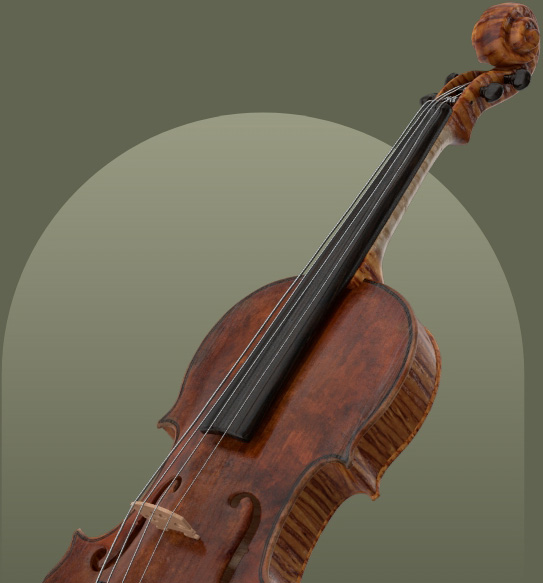
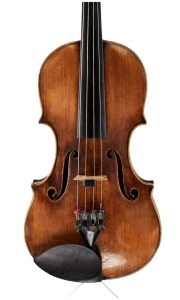
He worked principally on large Stradivari and Guarneri del Gesù models, producing violins, violas and cellos. His instruments are characterised by precise and refined workmanship, carefully selected figured maple and close-grained spruce, and a transparent varnish ranging from golden yellow and orange to deeper red. His copies of Guarneri del Gesù were particularly highly regarded, and he also made copies of Paganini’s celebrated Guarneri del Gesù, the Il Cannone.
Sawicki’s reputation was firmly established during his lifetime. His instruments were played by prominent musicians including the Viennese violinist Franz Xaver Pecháček and the Oldenburg court Kapellmeister Friedrich August Pott. The Polish violinist Karol Lipiński commissioned two instruments from him. Sawicki’s work was also recognised at the Vienna industrial exhibitions, where he received awards in 1835 and 1845.
His association with Niccolò Paganini is particularly significant. During Paganini’s stay in Vienna in 1828, Sawicki made a replacement fingerboard for Paganini’s 1743 Guarneri del Gesù, known as the Il Cannone. The original Sawicki fingerboard, which was subsequently removed during conservation, survives in the archives and measures approximately 262 mm. The work provides direct physical evidence of Sawicki’s intervention on one of the most celebrated violins in existence.
Paganini subsequently provided Sawicki with a testimonial dated 10 August 1828, praising his ability both as a maker of new violins and as a repairer of stringed instruments. Contemporary and later sources also record Sawicki’s highly successful copies of Paganini’s violin.
Sawicki also produced unusually elaborate instruments. A violin made in 1818, described historically as a Kunstgeige, was richly decorated and became associated with the highest circles of Viennese society. Another surviving instrument, dated 1837, bears a dedication to Emperor Ferdinand I: “Smae. C.R. Apostolicae Maiestati Ferdinando Imo Austriae imperatori dedicavit in signum Venerationis et Submissionis”. A further violin dated 1848 is known for its extensive mother-of-pearl inlay.
An 1834 Sawicki violin is preserved in the collection of the Kunsthistorisches Museum in Vienna. It is made on a Stradivari model and retains its original neck and probably its original fittings, providing an important documented example of Sawicki’s construction.
Sawicki’s surviving instruments are relatively uncommon, and his reputation has resulted in his name appearing on instruments of lesser quality. His authentic work is distinguished by its exceptionally careful workmanship, sophisticated modelling and attractive varnish. His importance within the Viennese school is further demonstrated by the esteem in which he was held by contemporary musicians and by the surviving documentary evidence of his work for Paganini and the Austrian imperial court.
Biographies
The overview above is drawn from the following published accounts. Read them in the original:
John Dilworth+
SAWICKI, Carl Nicolas Born 1792 Lviv Ukraine, died 1850 Vienna Austria. Finest maker of the Vienna school. Very distinguished and accurate workmanship. Fine copies of Stradivari and Guarneri. Excellent golden-orange or red varnish of good depth and transparency. Handsomely flamed maple and close straight-grained spruce. Violins, violas, and cellos known. One violin of 1848 with extensive mother of pearl inlay. Unfortunately his authentic work is relatively rare and false labels are found optimistically placed in inferior work. Nicolaus Sawicki / fecit N.S. / Viennae Anno 1848 Smae. C.R. Apostolicae Maiestati / Ferdinando Imo Austriae imperatori / dedicavit in signum Venerationis et Submissionis / Carol Nicol. Sawicki Leopolitanus Vienna A. 1837 C. Nicol Sawicki fecit / Anno 1826 Viennae Nicolaus Sawicki / fecit / Viennae Anno 18.. N.S.
Cecie Stainer+
b. 1792, Poland , d. 1850. He settled in Vienna and made some very good violins.
Willibald Leo Lütgendorff+
Von Geburt ein Pole. Er hat in Prag oder Wien gelernt und war seit dem Jahre 1824 einer der besten Wiener Geigenmacher. Er arbeitete vorzugsweise nach Guarneri del Gesù und hat u. A. eine so getreue Copie von Paganini’s Geige angefertigt, dass der grosse Geiger selbst ganz entzückt war und Savicki in einem Zeugniss vom 10. August 1828 für ein »ausserordentliches Genie« erklärte »sowohl in der Verfertigung neuer Violinen als in der unübertrefflichen Art, alle Streichinstrumente zu repariren«.
Henri Poidras+
Vienna circa 1830. This skilled maker has made very fine copies of Guarnerius del Gesu.
Sell your instrument with Amati
Get started by uploading photos of your instrument for our experts to review.
Sell your instrument with Amati
Get started by uploading photos of your instrument for our experts to review.