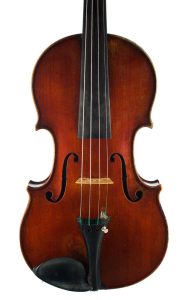
George (I) Gemunder
Astoria, Ingelfingen, Long Island, New York, 1816–1899
George (I) Gemunder (1816-1899) was a highly acclaimed American violin maker, known for his exceptional craftsmanship and skill as a copyist. He apprenticed with J. B. Vuillaume and was recognized as America's greatest maker, earning numerous international awards. Gemunder was notable for his successful use of native American woods and authored Progress in Violin Making. His sons continued his work after he suffered a stroke.
Request an expert valuation or learn how our global auctions achieve the highest prices for your instruments.
Auction Price History
Highest auction price
45 results
| Type | Details | Auction house | Sold | Price |
|---|---|---|---|---|
| Violin | Labelled George Gemünder fecit, Astoria, L. I., Anno 1875, branded to the inside back G. Gemunder Lot 180 | Tarisio | November 2024 | £16,024est. $ 15,000-22,000 |
| Violin | Labelled George Gemünder fecit, Astoria, L. I., Anno 1878, inscribed G. Gemunder Astoria, N. Y. 1882 Lot 183 | Tarisio | November 2024 | £30,635est. $ 18,000-25,000 |
| Violin | Labelled George Gemünder, Astoria, New York, 1879, inscribed Geo. Gemünder, Astoria - New York ... Lot 113 | Tarisio | March 2023 | £17,904est. $ 18,000-25,000 |
| Violin | Labelled George Gemünder fecit, Astoria, L. I., Anno 1887. IHS, branded to the inside back G. Gemünder Lot 117 | Tarisio | June 2022 | £15,296est. $ 12,000-18,000 |
| Violin | Labelled George Gemünder fecit, Astoria, L. I., Anno 1883, inscribed Geo. Gemünder Astoria ... Lot 116 | Tarisio | June 2022 | £13,384est. $ 12,000-18,000 |
| Violin | Labelled George Gemünder fecit, Astoria, L. I., anno 1885, inscribed to the inside top Lot 179 | Tarisio | May 2019 | £14,905est. $ 15,000-22,000 |
| Violin | Labelled George Gemunder, New York, 1851, inscribed to the inside back London premium Violin, 1851 Lot 217 | Tarisio | November 2018 | £16,442est. $ 10,000-15,000 |
| Violin | Bearing the maker's label Lot 277 | Skinners | November 2016 | £5,918est. $ 6,000-8,000 |
| Violin | Labelled Geo: Gemunder, New York, 1901 Lot 229 | Tarisio | May 2015 | £7,497est. $ 10,000-15,000 |
| Violin | Lot 91 | Bonhams | October 2014 | £5 |
| Violin | Early and rare work of the maker before moving to New York in 1852, labelled George Gemünder ... Lot 247 | Tarisio | October 2014 | £12,757est. $ 12,000-18,000 |
| Violin | Lightly craquelled varnish of a red colour on the golden brown ground Lot 91 | Bonhams | October 2014 | £5,750est. £ 3,000-4,000 |
| Violin | Labelled Georges Gemünder fecit, Astoria, L.I., Anno 1894. IHS, inscribed George Gemunder, Astoria ... Lot 208 | Tarisio | May 2014 | £5,308est. $ 6,000-9,000 |
| Violin | Labelled George Gemünder fecit, Astoria, L.I., Anno 1890 Lot 203 | Tarisio | May 2013 | £6,165est. $ 7,000-10,000 |
| Violin | Bearing the maker's label Lot 320 | Skinners | April 2013 | £3,304est. $ 3,000-5,000 |
| Violin | Labelled George Gemünder fecit, Astoria, L.I., 1886, inscribed Geo. Gemünder, Astoria, New York, 1886 Lot 330 | Tarisio | November 2012 | £8,988est. $ 12,000-18,000 |
| Violin | Lot 318 | Bonhams | October 2012 | £9,375 |
| Violin | Labelled George Gemunder, fecit Astoria ..., of a golden orange red brown colour Lot 318 | Bonhams | October 2012 | £9,375 |
| Violin | Labelled George Gemünder fecit, Astoria, L. I., Anno 1893 Lot 374 | Tarisio | February 2012 | £1,593est. $ 2,500-4,000 |
| Violin | 36.1 cm New York, 1860 | — | December 2011 | £5,415 |
| Violin | 35.8 cm Astoria, 1889 | — | November 2011 | £11,277 |
| Violin | 36.0 cm Astoria, 1885 | — | November 2011 | £14,285 |
| Violin | 35.9 cm Astoria, 1890 Workshop of | — | April 2010 | £11,784 |
| Violin | 35.9 cm New York, 1858 | — | April 2010 | £8,439 |
| Violin | 35.5 cm New York, 1857 | — | December 2009 | £16,800 |
| Violin | 36.2 cm Astoria, 1889 | — | October 2009 | £7,786 |
| Violin | 35.8 cm New York, 1889 | — | October 2009 | £12,605 |
| Violin | 35.7 cm New York, 1877 | — | May 2008 | £5,119 |
| Violin | 36.2 cm New York, 1878 | — | May 2007 | £8,065 |
| Violin | 35.8 cm New York, 1875 | — | October 2006 | £5,175 |
| Violin | 36.0 cm Attributed to | — | May 2006 | £3,679 |
| Violin | Astoria, 1889 | — | May 2005 | £6,106 |
| Violin | Astoria, 1888 | — | May 2004 | £4,182 |
| Violin | New York | — | May 2004 | £20,910 |
| Violin | 1870 c. | — | October 2003 | £5,019 |
| Violin | 1877 | — | May 2003 | £6,609 |
| Violin | 1885 | — | October 2002 | £11,472 |
| Violin | 1880 | — | June 2002 | £4,731 |
| Violin | 1884 | — | November 2001 | £8,777 |
| Violin | 1886 | — | November 1999 | £8,625 |
| Violin | 1889 | — | March 1986 | £1,517 |
| Violin | 1894 | — | March 1986 | £1,138 |
| Violin | 1894 | — | February 1982 | £1,070 |
| Violin | 1887 | — | January 1981 | £1,858 |
| Violin | 1892 | — | March 1980 | £1,271 |
No results match those filters.
Maker Overview
Life
George (I) Gemunder (1816-1899) was born in 1816 in Ingelfingen, Baden-Württemberg, and passed away in 1899. He apprenticed with J. B. Vuillaume in Paris. Sources contain conflicting information regarding his emigration to America; John Dilworth states he emigrated in 1847, while Cecie Stainer and Willibald Leo Lütgendorff indicate 1849. He initially joined his brother August in Boston, and the two worked together until 1852. George (I) Gemunder then established himself in New York City, later moving to Astoria, New York State, in 1874. After suffering a stroke in 1889, his sons took over his work. He was widely known as America's greatest maker, a reputation supported by numerous accolades. He was awarded prizes and medals at the London exhibitions of 1851, 1884, and 1885, Paris in 1867, New York in 1870, Vienna in 1873, Philadelphia in 1876, Amsterdam in 1883, Nice in 1883-4, and New Orleans in 1885. He was also the author of Progress in Violin Making, published in 1881, or as a brochure in 1883.
Characteristics
- Craftsmanship
- George (I) Gemunder was an extremely skillful craftsman and copyist, working on most classical models.
- Notable Work
- A violin he entered in the Vienna exhibition of 1873 was mistaken for an original Guarneri del Gesù violin, which ironically prevented it from receiving a prize.
- Materials
- He made extensive and highly successful use of native American wood, including both pine and maples.
- Product Range
- Instruments were available in several grades, related to the model and finish, with 'antiqued' work charged extra.
Influence and legacy
- Apprenticeship: George (I) Gemunder was a pupil of J. B. Vuillaume in Paris.
- Early Training:, he also learned from his father, Joh. G.
- Awards and Recognition: He received numerous prizes and medals at international exhibitions, including London (1851, 1884, 1885), Paris (1867), New York (1870), Vienna (1873), Philadelphia (1876), Amsterdam (1883), Nice (1883-4), and New Orleans (1885).
- Publications: He authored Progress in Violin Making, published in 1881 or 1883.
- Family Continuity: After he was disabled by a stroke in 1889, his sons continued his work.
Biographies
The overview above is drawn from the following published accounts. Read them in the original:
John Dilworth+
GEMÜNDER, George (I) Born 1816 Ingelfingen, Baden-Württemberg, died 1899, Worked USA. Apprenticed to J. B. Vuillaume in Paris. Emigrated to America in 1847 to join his brother August, above, in Boston. The two worked together until 1852 when George established himself in New York City, moving to Astoria, New York State 1874. Disabled by a stroke in 1889, after which the work was taken over by his sons. Known as America’s greatest maker with good reason. Prizes and medals awarded at the London exhibitions of 1851, 1884, and 1885, Paris 1867, New York 1870, Vienna 1873, Philadelphia 1876, Amsterdam 1883, Nice 1883-4, and New Orleans 1885. Author of Progress in Violin Making (1881). An extremely skilful craftsman and copyist, he worked on most classical models. One violin entered in the Vienna exhibition of 1873 was taken to be an original Guarneri del Gesù violin, and so ironically could not be given a prize. Made extensive and highly successful use of native American wood, both pine and maples. Instruments in several grades related to the model and finish; ‘antiqued’ work charged extra.
Cecie Stainer+
Brother of August Gemunder, b. 1816, Ingelfingen; d. Jan. 15, 1899. Pupil of Vuillaume in Paris. Went to New York in 1849. He made excellent copies of many celebrated violins. In 1881 he published “George Gemunder’s Progress in Violin Making.”
Willibald Leo Lütgendorff+
Sohn von Joh. G., bei dem er auch gelernt hat. Später kam er zu Vuillaume
in Paris. 1849 wanderte er nach Amerika aus und verstand es, durch gute
Arbeit Anerkennung zu finden. Auch er machte gern laut Reclame und veröffentlichte
1883 gelegentlich der Weltausstellung in Amsterdam eine Brochure
»George Gemünder’s Progress in Violinmaking«.
Sell your instrument with Amati
Get started by uploading photos of your instrument for our experts to review.
Sell your instrument with Amati
Get started by uploading photos of your instrument for our experts to review.
Pupils
Frank Barstow Pupil
Francis Elmer Davenport Pupil