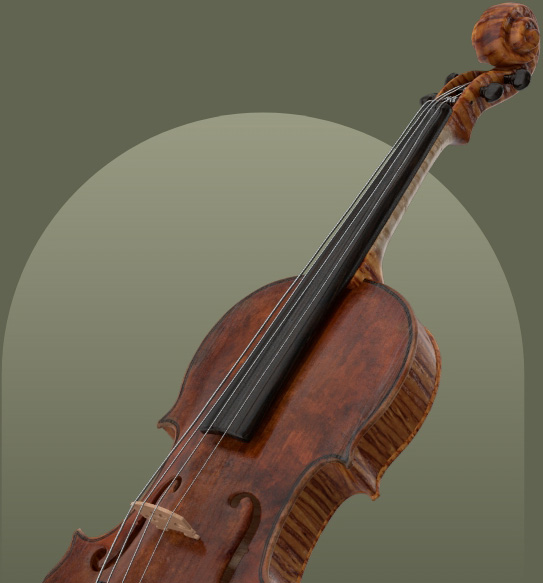
Giuseppe Guadagnini
Como, Milan, Pavia, 1753–1805
Giuseppe Guadagnini (1753-1805), also known as 'il Soldate', was the second son and pupil of the renowned Giovanni Battista Guadagnini. He worked in various Italian cities including Turin, Pavia, Como, Milan, and Parma, eventually settling in Pavia. His instruments, which include violins, altos, and violoncellos, are characterized by a rustic yet personal style, often following Stradivari and Guarneri patterns. While his work is considered distinct from his father's, his instruments are noted for their good tone and unique construction details, such as prominent upper corners and a Storioni-like scroll.
Auction Price History
Highest auction price
15 results
| Type | Details | Auction house | Sold | Price |
|---|---|---|---|---|
| Violin | Labelled Giuseppe Guadagnini Figlio di Giovanni Battista fece in Como nella Contrada di Porta Sala Lot 190 | Tarisio | May 2025 | £115,791est. $ 100,000-150,000 |
| Viola | Labelled Josef Guadagnini Cremonensis Fecit Papiae anno 179... Lot 37 | Tarisio | July 2020 | £27,835est. $ 50,000-80,000 |
| Violin | Labelled Josef Guadagnini Cremonensis, Fecit Papiae anno 1803 Lot 68 | Tarisio | July 2020 | £78,867est. $ 100,000-150,000 |
| Violin | Violin, 1785 c. Lot 108 | Brompton’s | October 2016 | £120,000est. £ 100,000-150,000 |
| Violin | Scroll possibly later, unlabelled Lot 35 | Ingles & Hayday | March 2015 | £96,000est. £ 90,000-140,000 |
| Violin | 35.7 cm Italy, Possibly 19th C. Ascribed to | — | October 2011 | £15,840 |
| Violin | 35.7 cm Italy, 1801 c. Possibly by | — | April 2009 | £25,399 |
| Violin | 35.6 cm Como, 1780 c. Ascribed to | — | November 2008 | £30,933 |
| Violin | Ascribed to | — | July 2004 | £14,400 |
| Violin | 1785 c. Attributed to | — | July 2004 | £8,365 |
| Violin | 1772 | — | July 2003 | £117,600 |
| Violin | 1785 c. | — | November 2002 | £86,250 |
| Violin | 1780 | — | July 2000 | £41,900 |
| Cello | Pavia, 1791 | — | June 1989 | £82,500 |
| Viola | 41.0 cm | — | March 1989 | £41,800 |
No results match those filters.
Maker Overview
Life
Giuseppe Guadagnini (1753-1805), also known as 'il Soldate', was the second son of Giovanni Battista Guadagnini. Sources contain conflicting information regarding his birth year; John Dilworth states he was born in 1753 in Milan, while Cecie Stainer indicates he was born about 1736. He died in 1805 in Pavia, Italy. He began his career as a pupil and assistant to his father in Turin, working alongside his brothers Gaetano, Carlo, and Fillippo. He left the family business in Turin sometime before 1782 to work independently. He worked in Pavia around 1780-1781, then in Como and Milan, before returning to Pavia. George Hart notes that he ultimately settled in Pavia, Lombardy, where he made a great number of instruments. Cecie Stainer also mentions he worked at Milan, Como, and Parma around 1793. Willibald Leo Lütgendorff places him in Parma in 1760, Como in 1763, and Pavia in 1790. Lütgendorff also states that he eventually fell into decline.
Characteristics
- Style
- Giuseppe Guadagnini's style is described by John Dilworth as a little rustic but imbued with great personality, reflecting some of his father's work. George Hart notes that the work and character of his instruments varied.
- Models
- He made a quantity of violins, altos, and violoncellos. His models were generally based on Stradivari, with some instances where the sound-holes partook of the character of Giuseppe Guarneri. Willibald Leo Lütgendorff describes his models as flat and broad.
- Construction Details
- His instruments generally feature prominent outward-pointing upper corners. The scroll is described as a little Storioni-like, with an extended last turn and small chamfers. He also loved double purfling.
- Varnish
- The varnish is typically orange-brown to pale golden-amber. George Hart notes that his varnish was inferior to that of his predecessors.
- Wood
- The wood used was often hard and plain.
- Tone
- Sources contain conflicting information regarding the tone of his instruments. Cecie Stainer and George Hart state that his instruments generally have a good tone, while Willibald Leo Lütgendorff suggests he was less successful with the tone.
- Joseph Guadagnini Cremonensis
fecit Papiae anno 1790John Dilworth - Giuseppe Guadagnini
filio di Giov.Battista Giuseppe Guadagnini fil.
Johannes Battista Parmae 1768John Dilworth - Giuseppe Guadagnino Figlio di Giovanni
Battista fece in Como nella Contrada di
Porta Sala 178.John Dilworth
Influence and legacy
- Mentorship: Giuseppe Guadagnini was a pupil and assistant to his father, Giovanni Battista Guadagnini.
- Family Workshop: He worked alongside his brothers Gaetano, Carlo, and Fillippo in his father's business in Turin.
- Design Influences: He built instruments following the patterns of Stradivari and Giuseppe Guarneri.
- Market Value: Cecie Stainer notes that his work was much inferior to that of his father, and consequently, his instruments have less market value.
- Notable Instruments: The Kölner Conservatorium der Musik (Cologne Conservatory of Music) possesses a good violin by him.
- Historical Valuation: Willibald Leo Lütgendorff states that his best works still reached prices up to 2200 M (Marks).
Further Information
- Workshop Locations: Giuseppe Guadagnini worked independently in Pavia (c.1780-1781, 1790), Como (1763, 178.), Milan, and Parma (1760, c.1793).
- Labels: Examples of his labels include "Joseph Guadagnini Cremonensis / fecit Papiae anno 1790", "Giuseppe Guadagnini / filio di Giov.Battista", "Giuseppe Guadagnini fil. / Johannes Battista Parmae 1768", and "Giuseppe Guadagnino Figlio di Giovanni / Battista fece in Como nella Contrada di / Porta Sala 178."
- Internal Markings: Besides his labels, the letters "S. J. F. (?) SS. S. GG. F. P." can sometimes be found next to the bar.
Biographies
The overview above is drawn from the following published accounts. Read them in the original:
John Dilworth+
GUADAGNINI, Giuseppe (Giuseppe Antonio Santo) (I) Born 1753 Milan, died 1805 Pavia Italy. Second son of Giovanni Battista Guadagnini, above. Known as ‘il Soldate’. Pupil and assistant of his father alongside his brothers Gaetano, Carlo, and Fillippo. Left the family business in Turin some time before 1782, working independently in Pavia, c.1780-1781, then in Como and Milan, but returning to Pavia. A more active violin maker than his brothers, his style is a little rustic but imbued with great personality reflecting a little of his father’s work. Various models, generally with prominent outward pointing upper corners, scroll a little Storioni-like, with extended last turn and small chamfers. Varnished orange-brown to pale golden-amber. Joseph Guadagnini Cremonensis / fecit Papiae anno 1790 Giuseppe Guadagnini / filio di Giov.Battista Giuseppe Guadagnini fil. / Johannes Battista Parmae 1768 Giuseppe Guadagnino Figlio di Giovanni / Battista fece in Como nella Contrada di / Porta Sala 178. [Rosengard]
George Hart+
Second son of Giovanni Battista. Worked with his father for some time at Turin. He ultimately went to Lombardy, and settled in Pavia, where he made a great number of instruments. The work and character belonging to these instruments is varied. The model is that of Stradivari. In some instances the sound-holes partake of the character of Giuseppe Guarneri. The varnish is inferior to that of his predecessors, and the wood often hard and plain. Some of his Violins bear the labels of his father, and were doubtless made when they were living together.
Cecie Stainer+
Second son of Giambattista, grandson of Lorenzo, b. about 1736; d.about 1805. First a pupil of his father in Turin (about 1751), then worked at Milan, Como, and Parma (about 1793). Had not so much ability as other members of his family ; he made a quantity of violins, altos, and violoncellos on the Stradivari pattern. His work was much inferior to that of his father, whose label he often used, and consequently have less market value ; but his instruments generally have a good tone.
Willibald Leo Lütgendorff+
Zweiter Sohn von Giambattista I. G., dessen Schüler er wohl gewesen sein
dürfte. Er nennt sich einen Cremoneser, ob er dort geboren ist, oder vielleicht dort gelernt hat, ist unbekannt. Er baute nach Stradivari und Guarneri. Flaches
breites Modell, gute Arbeit, weniger gelingt ihm der Ton; 1760 befand er sich in Parma, 1763 wohnte er in Como in der Contrada di Porta, 1790 in Pavia. Zuletzt
kam er ganz herunter. Seine besten Arbeiten erreichen immerhin Preise
bis 2200 M. Er liebte auch doppelte Einlagen und ausser seinen Zetteln findet
man neben dem Balken auch die Buchstaben: »S. J. F. (?) SS. S. GG. F. P.«
Eine gute Violine von ihm besitzt das Kölner Conservatorium der Musik.
Sell your instrument with Amati
Get started by uploading photos of your instrument for our experts to review.
Sell your instrument with Amati
Get started by uploading photos of your instrument for our experts to review.