Matthew Hardie
Edinburgh, Jedburgh, 1755–1826
Popularly known as the ‘Scottish Stradivari’. Apprenticed as a joiner. In military service 1778-1782. Established as a professional repairer by 1784, his first instruments date from c.1790 from an address in Lawnmarket, Edinburgh. — John Dilworth
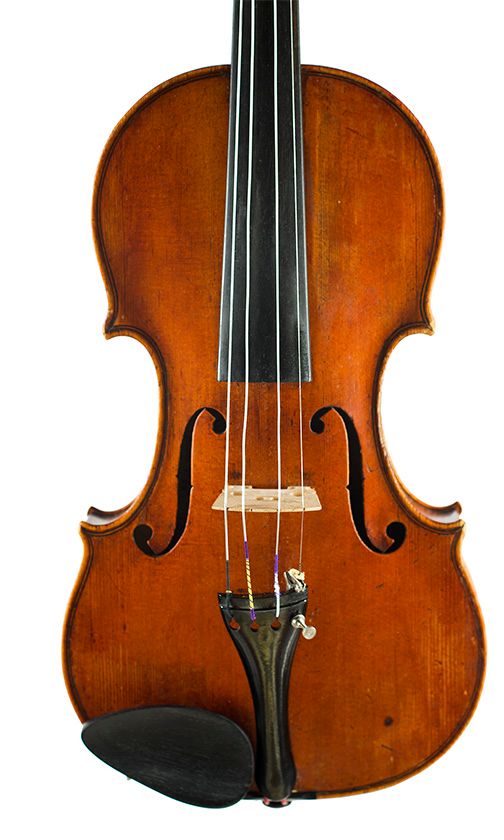
Instruments
Auction Price History
Highest auction price
45 results
| Type | Details | Auction house | Sold | Price |
|---|---|---|---|---|
| Violin | Labelled Made by Mat. Hardie & Son, Edinburgh, scroll later Lot 318 | Ingles & Hayday | March 2023 | £11,400est. £ 10,000-15,000 |
| Violin | Violin, 1824 Lot 1176 | McTear’s | March 2020 | £312 |
| Violin | Original label, original neck and tailpiece, in a remarkable state of preservation Lot 111 | Brompton’s | May 2019 | £8,400est. £ 7,000-10,000 |
| Viola | Labelled Made by, Mat. Hardie & Son, Edinburgh, 1823 Lot 20 | Tarisio | March 2018 | £23,600est. £ 15,000-22,000 |
| Violin | Unlabelled Lot 2 | Ingles & Hayday | October 2017 | £8,400est. £ 5,000-7,000 |
| Violin | Lot 78 | Bonhams | October 2014 | £1 |
| Viola | Labelled Mat. Hardie & Son, Edinburgh, 1823 Lot 108 | Tarisio | October 2014 | £18,447est. $ 30,000-50,000 |
| Violin | Labelled Matthew Hardie, Edinburgh, 1813 Lot 168 | Tarisio | October 2014 | £5,900est. £ 5,000-8,000 |
| Violin | Labelled Mathew Hardie Edinburgh 1811, later scroll Lot 455 | Brompton’s | December 2013 | £1,968est. £ 1,000-1,500 |
| Violin | Labelled Maker Matthew Hardie, Edinburgh 18... Lot 89 | Brompton’s | June 2013 | £6,000est. £ 1,200-1,800 |
| Violin | Labelled Matthew Hardie Edinburgh, 1802 Lot 7 | Ingles & Hayday | May 2013 | £7,200est. £ 5,000-7,000 |
| Violin | Lot 84 | Bonhams | October 2012 | £4,000 |
| Violin | 35.7 cm Edinburgh | — | October 2011 | £1,208 |
| Cello | 74.3 cm 1800 c. Ascribed to | — | October 2010 | £15,021 |
| Cello | 74.7 cm Edinburgh, 1810 c. | — | November 2008 | £6,669 |
| Cello | 75.2 cm Edinburgh, 1823 | — | February 2006 | £28,800 |
| Cello | 73.5 cm Edinburgh, 1820 c. | — | February 2006 | £9,600 |
| Violin | Edinburgh, 1810 c. Attributed to | — | July 2004 | £1,554 |
| Violin | 1810 | — | November 2002 | £3,160 |
| Violin | 1822 | — | November 2001 | £5,585 |
| Cello | 1818 | — | March 2000 | £11,500 |
| Violin | 1822 | — | March 1999 | £3,220 |
| Cello | 1810 c. | — | November 1998 | £10,925 |
| Violin | 1810 c. | — | November 1998 | £2,300 |
| Violin | 1810 c. | — | March 1997 | £3,105 |
| Cello | 1822 | — | June 1995 | £9,775 |
| Violin | 1812 | — | June 1994 | £2,875 |
| Cello | 1816 | — | March 1994 | £2,200 |
| Violin | 1800-25 | — | November 1993 | £2,070 |
| Cello | 1822 | — | June 1993 | £8,050 |
| Viola | 41.1 cm 1821 | — | November 1991 | £990 |
| Cello | 1822 | — | June 1991 | £9,350 |
| Violin | 1824 | — | June 1991 | £1,980 |
| Violin | 1815 | — | April 1991 | £3,740 |
| Violin | 1810 | — | June 1989 | £242 |
| Violin | 1829 | — | March 1989 | £3,630 |
| Violin | 1824 | — | March 1989 | £2,860 |
| Violin | 1821 | — | March 1989 | £1,980 |
| Viola | 41.8 cm 1848 | — | November 1988 | £3,300 |
| Violin | 1817 | — | September 1988 | £3,960 |
| Violin | 1821 | — | March 1988 | £715 |
| Violin | 1850 c. | — | April 1987 | £154 |
| Viola | 41.1 cm 1822 | — | November 1985 | £594 |
| Viola | 41.1 cm 1823 | — | September 1983 | £1,870 |
| Violin | 1821 | — | January 1982 | £605 |
No results match those filters.
Maker Overview
Life
Matthew Hardie (1755-1826) was born in Jedburgh, Scotland UK, in 1755 and died in Edinburgh in 1826, specifically in St. Cuthbert's Poorhouse on August 30, 1826, and was buried in Greyfriars' Churchyard.
Popularly known as the 'Scottish Stradivari', Hardie was initially apprenticed as a joiner and served in the military from 1778 to 1782.
By 1784, he was established as a professional repairer, with his first instruments dating from approximately 1790 from an address in Lawnmarket, Edinburgh.
His address changed frequently, and he evidently struggled economically, leading to imprisonment for debt in 1795 and again in 1825.
His training as a maker remains unclear, but by 1792, he had established contact with the London dealers Longman & Broderip, possibly through the Edinburgh dealer Robert Bremner.
From 1822, his son Thomas assisted him at 10 Paul's Work, Edinburgh.
Characteristics
- Models
- Hardie made sophisticated copies of both Stradivari and Amati models.
Sources contain conflicting information regarding which model he primarily copied; while some English writers asserted he copied N. Amati, Mr. Honeyman stated he copied Stradivari, and William Meredith Morris clarifies that Hardie copied both, with examples of his art seen on both Amati and Stradivari models.
His Stradivari copies are described as very closely observed, beautifully made, and finely varnished, comparable to the best work by Panormo in London rather than the mass-produced Stainer copies prevalent at the time.
His Amati copies are noted to compare very favorably with the best work of Benjamin Banks, though Hardie's tone is decidedly larger.
- Workmanship
- His work is generally very fine and excellent, deserving more attention than it has received from English connoisseurs and writers.
He was a prolific maker, and his instruments are described as carefully made with good tone.
Matthew Hardie made no attempt at originality, aiming to copy faithfully, yet he was original in spite of himself.
The principal measurements are generally in strict keeping with the original, but his individuality is evident in other aspects.
- Varnish
- His varnish is generally a light orange-brown, described as a spirit varnish, thinly laid on, with a color ranging from yellow to dark yellow or yellowish-brown.
The basis was probably gamboge, or gamboge and aloes, which could oxidize almost black over time.
Lütgendorff notes that the thinly applied spirit varnish of yellowish-brown color is inconspicuous.
- Soundholes
- The soundholes of his Amati copies are artistic but tend to arrest attention, speaking to the eye with a sort of mute humor, in contrast to N. Amati's artistic and quiet soundholes.
In his Stradivari copies, the lower circles of the soundholes tend to be slightly oval and generally rather close to the edge.
The soundholes in his Stradivari copies are a trifle short, with a specimen measuring 2 15/16 inches in length, and the distance between them at the upper turns was about 1 3/4 inches.
- Scrolls & Buttons
- The volutes of the scroll often show point marks, similar to Guadagnini, and some Amati-like instruments feature an extra quarter-turn to the volute.
The button is usually rather longer and more oval than those of Amati or Stradivari.
- Edges & Margins
- His margins are moderately full, but the edges are not always as strong as they should be, contrasting with modern taste for stronger, delicately rounded edges.
- Wood
- Many, perhaps the majority, of Hardie's backs are very plain, though some examples feature exceedingly handsome and well-marked wood, cut so the curl ran at a moderate inclination.
He was evidently badly off for timber at more than one period of his life, with stories of nail-marked wood.
The linings are mostly of cedar.
- Tone
- His instruments have a fine tone, described as good even in his inferior instruments and beautiful in his best.
The inner strings are full and mellow, and the first string is sweet and silvery, with a lingering echo.
His tone is decidedly larger than that of Benjamin Banks, though it might lose some quality in gaining quantity.
- Made by Matthew Hardie Edinburgh
1810John Dilworth - Matthew Hardie Edinburgh, 1809John Dilworth
- Made by Matt: Hardie & Son
EdinburghJohn Dilworth
Influence and legacy
- Training: Hardie's training as a maker is unclear, though he was presumably a cabinetmaker or modeler by trade and may have been a pupil of John Blair, who later worked with him.
- Influence: He was very influential in the fledgling Scottish school of the time and was also a fine teacher, as evidenced by the large number of his capable pupils.
- Associates & Students: His son, Thomas Hardie, assisted him from 1822.
He may have employed other local makers whose known style strongly reflects Hardie's own, notably David Stirrat and John McGeorge.
A coterie of cultured men gathered around him, becoming infected with the fiddle-making fever, including Peter Hardie (his cousin and a student at Edinburgh University), David Stirrat, John Blair, George M'George, and Alexander Yoole the solicitor.
- Fame: Hardie's fame must have spread far and wide in his own day, with numerous instruments of his make found in the south of England, and some even in South Wales and the west of Ireland, as early as the beginning of the 19th century.
His fame reached the far limits of the British Isles before he ceased working, possibly surpassing that of makers like Banks, Forster, or Duke in their lifetimes.
- Family Continuity: His son, Thomas Hardie (born 1804, died January 19, 1856), worked with him in Edinburgh.
- Economic Struggles: Despite his prolific output and skill, he experienced financial decline in his old age, reportedly making some of his best violins while imprisoned for debt, and ultimately died in a poorhouse.
Further Information
- Workshop Locations: Hardie's first instruments date from approximately 1790 from an address in Lawnmarket, Edinburgh.
From 1822, he worked at 10 Paul's Work, Edinburgh.
- Instrument Types: He made violins, violas, and violoncellos.
Several fine Stradivari-model cellos and small violas are extant.
- Labels: Examples of his labels include 'MADE BY MATT. HARDIE & SON, EDINBURGH, 1797', 'MADE BY MATTHEW HARDIE, EDINBURGH, 1810', and 'MATTHEW HARDIE, EDINBURGH 1809', with the last two figures in the date often handwritten.
Biographies
The overview above is drawn from the following published accounts. Read them in the original:
John Dilworth+
HARDIE, Matthew Born 1755 Jedburgh, died 1826 Edinburgh, Scotland UK. Popularly known as the ‘Scottish Stradivari’. Apprenticed as a joiner. In military service 1778-1782. Established as a professional repairer by 1784, his first instruments date from c.1790 from an address in Lawnmarket, Edinburgh. This address changed frequently, and Hardie evidently struggled economically, being imprisoned for debt in 1795 and 1825. His training as a maker is unclear, but by 1792 he was in some sort of contact with the London dealers Longman & Broderip, possibly through the agency of the Edinburgh dealer Robert Bremner. From an early stage he made sophisticated copies of Stradivari models, particularly the ‘long pattern’, comparable with the best work being done in London by Panormo rather than the mass-produced Stainer copies which then predominated. Assisted by his son Thomas from 1822 at 10 Paul’s Work, Edinburgh, where he may have employed other local makers whose known style strongly reflects Hardie’s own, notably David Stirrat and John McGeorge. His work is generally very fine, and he was very influential in the fledgling Scottish school of the time. His Stradivari copies are very closely observed, beautifully made, and finely varnished, generally in a light orange-brown. There are a few mannerisms; the volutes of the scroll often show point marks, similar to Guadagnini, and also like Guadagnini, there is a tendency for the lower circles of the soundholes to be slightly oval, and generally rather close to the edge. More Amati-like instruments also occur, some with an extra quarter-turn to the volute. There are several fine Stradivari-model cellos extant, and also small violas. Made by Matthew Hardie Edinburgh / 1810 Matthew Hardie Edinburgh, 1809 Made by Matt: Hardie & Son / Edinburgh [Rattray]
George Hart+
He was the best maker Scotland has had. The model is that of Amati; the work throughout excellent. The linings are mostly of cedar. He died about 1825-6.
William Meredith Morris+
He was born in Edinburgh in the year 1755, died in St. Cuthbert’s Poorhouse, Aug. 30, 1826, and was buried in Greyfriars’ Churchyard. His work is excellent, and deserves much more attention than has been given it by English connoisseurs and writers. All English writers on the violin assert that Hardie copied N. Amati, a fact which is denied by Mr. Honeyman, who says that he copied Stradivari. Dogma should be based on truth. There is such a thing as a logical principle of contradiction — a thing cannot both be and not be at the same time. The truth is, Matthew Hardie copied both Amati and Stradivari, and it is so self-evident that I am astounded that any one who undertakes to write on the subject should be ignorant of it. I have both seen and handled genuine examples of his art, some of which were on the Amati and some on the Stradivari model. So far as my experience goes, Hardie made about as many copies of the one as he did of the other. Except as regards varnish, his Amati copies will compare very favourably with the best work of Benjamin Banks. His tone is decidedly larger than that of Banks, but what it gains in quantity it often loses in quality. He was a prolific maker, and his fame must have spread far and near in his own day, since there were numerous instruments of his make to be found in the south of England, and some even in South Wales and the west of Ireland, so long ago as the early part of last century. One beautiful violin on the Amati model was for over fifty years in the possession of the Barham family, Trecwn, in far-away Pembrokeshire. The old squire of Trecwn bought it somewhere about 1830 of one of his tenants, a Mr. Campbell, who hailed from Scotland. In 1880 the last member of the Barham family died, and the beautiful old ” Hardie ” disappeared. I played on this fiddle more than once, and have a vivid recollection of its clear, responsive Maggini-like tone. The Hardies have a sort of traditional bias towards the Maggini tone. In my time, in the capacity of expert, I have examined about thirty of the violins of this maker, the majority of which, so far as my recollection goes, were on the grand Amati model. What particularly struck me was the indisputable evidence produced in each case as to the pedigree of the instrument, showing that the purchase was made by a deceased member of the family of the owner, either from the maker himself, or from some one else during the lifetime of the maker. It proved, as already stated, that Hardie’s fame had reached to the far limits of the British Isles before he had laid down his tools. I doubt whether the fame of Banks, Forster, or Duke had spread so far in their own lifetime. It is not just, therefore, on the part of English authors to ignore this remarkable man’s work. Hart, Haweis, and one or two more animadvert rather severely on the sins of omission of continental writers, forgetful of the fact that they themselves do scant justice to Scottish makers of renown. Scotland has produced quite an army of fiddle-makers, some of whom have left us examples of their art that will in many respects vie with our classical chefs d’oeuvre. Had the early Hardies, M’George, Stirrat, &c., been more fortunate in the production of varnish, much of their work would be equal to the best work of English makers.
Matthew Hardie made no attempt at originality : he did his best to copy faithfully, but he was original in spite of himself. The principal measurements are generally in strict keeping with the original, but the stringency of figures does not imprison the personality of the man. When there is a strict watch set over self in the definition of the outline, individuality bursts the bonds in sunder and runs up the sides of the arch, only to sit down there and laugh at the man with the gouge. The sound-holes of the Amati copies are noteworthy. Here the truth of the foregoing remarks will become evident to any one who makes a close examination of the work. The sound-holes of N. Amati are artistic and quiet ; they are always so cut and set in the table as not to call attention to themselves. Hardie’s sound-holes are artistic enough, but they arrest one’s attention, and speak to the eye with a sort of mute humour.
I had always imagined old Matt. Hardie to be a strange mixture of veneration and irony even before I had read a line about him. His life is written in his work. Look at his Strad copies ! The strong plates, the correct outline, and the graceful arching are evidence of a mind that was prostrate at the feet of the gods, but the saucy corners, and the up-tossed head betray something very akin to cynicism.
We have a parallel in the world of letters. Shelley, the poet, was an iconoclast in his calmer moments, but he prayed earnestly to the Deity in an Alpine thunderstorm. The only difference is that the proportion of veneration and cynicism is reversed. It is said that Hardie made many cheap instruments of poor wood, with imitation purfling, in his early days. It is quite possible, though I have never seen any poor instruments of his make. Most great makers have turned out indifferent work at one period or another of their life. Art is very much the creature of circumstances, and bears her dignity according as these smile or frown. There are artists living among us to-day who are capable of great things, but who are too poor to buy timber for the fashioning of their idols. They may see the god in the tree, as Michael Angelo saw his ” David ” in the rough slab of marble, but neither the right tree nor the right stone is always to be had for the asking. Hardie was evidently badly off for timber at more than one period of his life, if the story of the nail-marked wood be true. There is nothing very artistic about nail-holes, and little of value about weather-beaten, half-rotten paling slabs to make them desirable for fiddle-wood. Many, perhaps the majority, of Hardie’s backs are very plain, but I have seen a few with exceedingly handsome and well-marked wood, cut so that the curl ran at a moderate inclination (vide illustration). The button is usually rather longer and more oval than the buttons of Amati or Stradivari. The sound-holes in the Stradivari copies are a trifle short ; the exact length in a specimen recently examined by me being 2 15/16in. The holes also did not recline so much, and the distance between them at the upper turns was about 1 3/4 in. His margins are moderately full, but the edges are not always so strong as they should be. The modern taste has improved upon the classical practice in respect to the edges. Nowadays, in high-class work, the edges are left stronger and withal delicately rounded — a custom which is much to be commended from the point of view of utility, and not to be deprecated artistically. Hardie’s varnish is a spirit one, thinly laid on ; the colour is yellow — dark yellow to yellowish-brown. The basis is probably nothing more than gamboge, or gamboge and aloes, which in process of time is oxidised almost black, according to the nature of the menstrua and the method of application. Hardie’s tone is good, even in his inferior instruments, and beautiful in his best. The inner strings are full and mellow, and the first string is sweet and silvery. The tone has a lingering echo which is pathetic and appealing.
Hardie was an enthusiast in his art, and his enthusiasm was of the contagious sort. Quite a coterie of cultured men gathered around him, who became infected with the fiddle-making fever. Among them were Peter Hardie, of Dunkeld, his cousin and a student at the Edinburgh University, David Stirrat, John Blair, George M’George, Alexander Yoole the solicitor, and others. Matthew Hardie was himself an educated man, and his society was sought by these men as much on account of his refined wit as on account of his fiddle lore. Many a congenial hour did these men of like passions pass together in the atelier in Low Calton. What a pity the sympathetic brush of Sir Joshua was not there to trace on canvas those faces radiant with the joy of the fiddle, or the faithful pen of a Boswell to give posterity word-pictures of those unique personalities ! Labels : —
(O MADE BY MATT. HARDIE & SON, EDINBURGH, 1797
(2) MADE BY MATTHEW HARDIE, EDINBURGH, 1810
(3) MATTHEW HARDIE, EDINBURGH 1809
The last two figures in the date are handwritten.
Cecie Stainer+
b. 1755 ; d. 1826, and his son, Thomas, b. 1804 ; d Jan. 19, 1856. They worked together in Edinburgh and made good violins, violas, and violoncellos on the Amati pattern ; his instruments have a fine tone, and the work is neatly finished.
Willibald Leo Lütgendorff+
Einer der bedeutendsten schottischen Geigenmacher, den man auch gern den
schottischen Stradivari nennt. Er war vermuthlich von Hause aus Kunsttischler
oder Modelleur und dürfte ein Schüler von John Blair gewesen sein, der später
mit ihm arbeitete. Er scheint eine echte Arbeit von Stradivari gekannt zu
haben, die er fortan nachahmte. Wenn Hart sagt, dass er Amati copirt hat, so
scheint dies auf einem Irrthum zu beruhen. Obwohl er sehr fleissig war, kam
er in seinem Alter doch in Vermögensverfall, er soll einige seiner besten Geigen
im Schuldgefängniss gemacht haben und starb schliesslich im Armenhause.
Seine Geigen sind sorgfältig gemacht und klingen gut, nur der dünn aufgetragene
Spirituslack von gelbbrauner Farbe ist unscheinbar. Wenn Vidal von
ihm kurz sagt: »lutherie ordinaire« so thut er ihm offenbar Unrecht. H. war
auch ein trefflicher Lehrer, wie die grosse Zahl seiner tüchtigen Schüler beweist.
Sell your instrument with Amati
Get started by uploading photos of your instrument for our experts to review.
Sell your instrument with Amati
Get started by uploading photos of your instrument for our experts to review.