Charles (II) Harris
Adderbury, London, 1791–1851
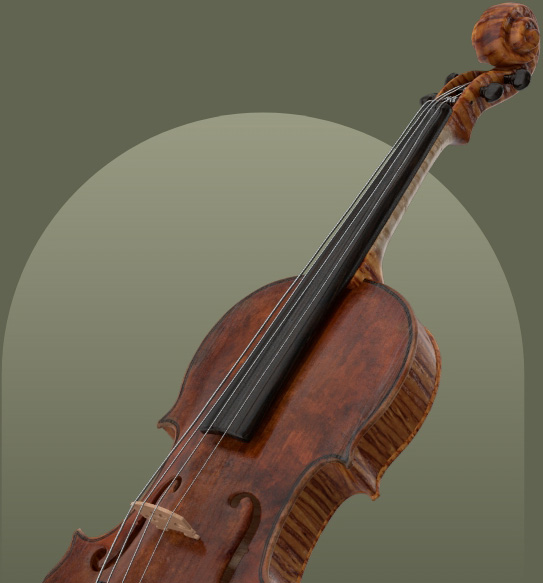
Charles (II) Harris (1791-1851) was a distinguished English luthier, the eldest son and pupil of Charles Harris (I). He trained under his father alongside Samuel Gilkes and worked for John Hart until 1828. After inheriting an estate in Steeple Aston, Oxfordshire, he became known as ‘Lord Harris’ but continued his craft, notably training William Ebsworth Hill in Oxford. His instruments are characterized by precise, well-finished workmanship, often featuring a golden amber or yellow varnish and following Stradivarian or Amatisé models, with his cellos being particularly esteemed.
Auction Price History
Highest auction price
34 results
| Type | Details | Auction house | Sold | Price |
|---|---|---|---|---|
| Violin | A violin by Charles Harris II, Oxfordshire, circa 1820 Lot 60 | Amati | March 2022 | £3,792est. £ 3,000-5,000 |
| Violin | Labelled Made by: Charles Harris, ref 1407... Lot 182 | Brompton’s | March 2018 | £2,360est. £ 2,000-4,000 |
| Pochette | Signed in ink to the inner back Lot 1400 | Gardiner Houlgate | December 2017 | £936est. £ 500-800 |
| Violin | Indistinctly labelled Lot 116 | Brompton’s | December 2016 | £2,400est. £ 2,000-4,000 |
| Violin | Indistinctly labelled Lot 400 | Brompton’s | December 2015 | £1,560est. £ 1,200-1,800 |
| Violin | Labelled Charles Harris, Oxford, 1823, of an aged red brown colour Lot 286 | Bonhams | May 2014 | £5,522est. £ 800-1,200 |
| Violin | 35.4 cm 1830 c. Probably by | — | December 2011 | £4,320 |
| Violin | 36.1 cm Adderbury, 1820 | — | September 2011 | £2,400 |
| Violin | 36.0 cm Addebury, 1826 | — | June 2011 | £4,200 |
| Violin | 35.6 cm Attributed to | — | March 2011 | £3,000 |
| Cello | 76.2 cm 1830 c. | — | November 2006 | £13,200 |
| Violin | 35.1 cm England, 1st half 19th C. Attributed to | — | July 2006 | £1,800 |
| Cello | 1825 | — | October 2001 | £13,475 |
| Cello | 1820 | — | November 2000 | £13,800 |
| Viola | 1824 | — | March 1999 | £1,500 |
| Cello | 1830 | — | March 1999 | £2,645 |
| Viola | 38.7 cm 1829 | — | November 1998 | £2,530 |
| Violin | 1835 | — | November 1998 | £4,600 |
| Viola | 38.7 cm 1817 | — | November 1997 | £2,185 |
| Cello | 1820 | — | July 1997 | £4,600 |
| Violin | 1800 c. | — | November 1996 | £4,232 |
| Violin | 1825 | — | November 1996 | £2,070 |
| Cello | 1818 | — | March 1996 | £8,625 |
| Cello | 1820 | — | June 1995 | £2,645 |
| Violin | 1819 | — | March 1992 | £825 |
| Cello | 1817 | — | November 1991 | £4,840 |
| Violin | 1819 | — | June 1991 | £840 |
| Cello | 1800 c. | — | November 1990 | £3,960 |
| Violin | 1800 | — | November 1989 | £880 |
| Violin | 1800 | — | March 1989 | £528 |
| Violin | 1825 | — | June 1988 | £825 |
| Violin | 1825 | — | November 1987 | £528 |
| Violin | 1821 | — | March 1986 | £683 |
| Violin | 1800 c. | — | November 1983 | £1,100 |
No results match those filters.
Maker Overview
Life
Charles (II) Harris (1791-1851) was the eldest son and pupil of his father, Charles Harris (I), and a fellow apprentice of Samuel Gilkes under his father. He worked for John Hart for some time, specifically until 1828. In 1828, he inherited an estate in Steeple Aston, Oxford, where he became known as 'Lord Harris', continuing his work as a violin maker despite his new status, as documented by John Dilworth. Willibald Leo Lütgendorff states he first lived in Oxford (Alderbury) and then went to London, noting that little is known of him because he worked extensively for John Hart.
Characteristics
- Workmanship
- His work was well finished, very precise, and exhibited neat workmanship, though William Meredith Morris notes it was not to be compared with that of his father.
- Varnish
- He used yellow varnish as 'golden amber coloured varnish'.
- Model
- His work recalls that of contemporary London makers such as Lockey Hill or Thomas Kennedy, and he used a generally Stradivarian or Amatisé model. Willibald Leo Lütgendorff mentions he liked a long model with narrow ribs.
- Features
- George Hart notes a well-cut scroll but sound-holes that were not well formed.
- Signature
- Instruments were signed internally.
- Specialty
- His cellos are particularly admired.
Influence and legacy
- Mentorship: He was the son and pupil of his father, Charles Harris (I), and a fellow apprentice of Samuel Gilkes under his father, as detailed by Cecie Stainer and John Dilworth.
- Pupils: He trained William Ebsworth Hill in Oxford around 1835-1838.
- Status: After inheriting an estate in Steeple Aston, Oxford, in 1828, he became known as 'Lord Harris', as documented by John Dilworth.
Biographies
The overview above is drawn from the following published accounts. Read them in the original:
John Dilworth+
HARRIS, Charles (II) Born 1791 London, died 1851 Steeple Aston, Oxfordshire UK. Son and pupil of his father Charles Harris (I), above. Worked for John Hart until 1828 when he inherited an estate in Steeple Aston, Oxford where he became known as ‘Lord Harris’. He continued working as a violin maker despite his new status and trained William Ebsworth Hill in Oxford c.1835-1838. His work is very precise and recalls that of contemporary London makers such as Lockey Hill or Thomas Kennedy, with golden amber coloured varnish and a generally Stradivarian or Amatisé model. Cellos are particularly admired. Signed internally. [BVMA]
George Hart+
Neat workmanship. Well-cut scroll. Sound-holes not well formed. Yellow varnish. Worked for a short time for John Hart.
William Meredith Morris+
Son and apprentice of his father, Charles Harris, sen. He worked for John Hart for some time. Very good work, but it is not to be compared with that of his father.
Cecie Stainer+
Eldest son of Charles Harris. Was a fellow apprentice of Samuel Gilkes under his father, and also worked for John Hart for a little time. His work was well finished, he used yellow varnish.
Willibald Leo Lütgendorff+
Ältester Sohn, Schüler seines Vaters Charles I. H. und als solcher Mitschüler
von Samuel Gilkes. Er wohnte erst in Oxford (Alderbury) und ging
dann nach London. Von ihm ist wenig bekannt, da er viel für John Hart
arbeitete. Seine Geigen sind im Ganzen gut, er liebte ein langes Modell, schmale
Zargen und gelben Lack.
Sell your instrument with Amati
Get started by uploading photos of your instrument for our experts to review.
Sell your instrument with Amati
Get started by uploading photos of your instrument for our experts to review.