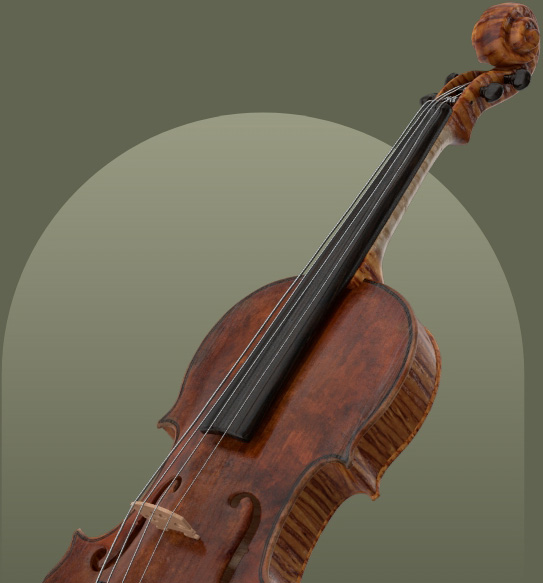
Otto Mockel
Berlin, 1869–1937
Otto Mockel (1869-1937) was a German violin maker, son and pupil of Oswald Möckel, who also trained with Carl Grimm. He worked in London before establishing his own shop in Dresden and later succeeding his father's business in Berlin. Mockel was known for his early work on classical models, particularly Guarneri forms, and for developing a new theory for plate treatment. He was a recognized expert, prolific writer, founder of the magazine Die Geige, and author of the influential book Die Kunst des Geigenbaues.
Request an expert valuation or learn how our global auctions achieve the highest prices for your instruments.
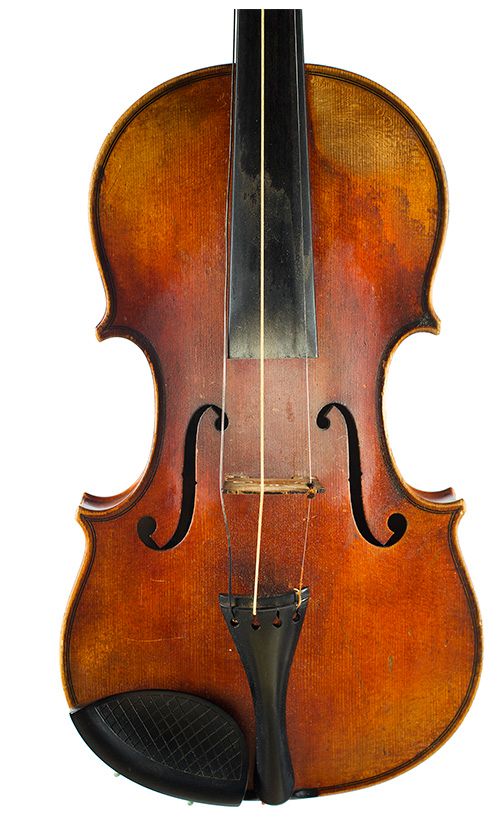
Instruments
Auction Price History
Highest auction price
23 results
| Type | Details | Auction house | Sold | Price |
|---|---|---|---|---|
| Violin | Labelled Otto Möckel fec. Berlin anno 1931, branded to the inside back and inside table OM and a leaf Lot 93 | Tarisio | February 2024 | £8,708est. € 6.000-9.000 |
| Violin | Labelled Otto Möckel fecit Berlin 1936, branded to the inside back 18 19 1937 and to the top block OM Lot 91 | Tarisio | October 2023 | £9,413est. € 5.000-8.000 |
| Violin | Labelled Otto Möckel, fecit Berlin anno 1931, branded to the inside back 18 18 541, branded O M Lot 120 | Tarisio | October 2022 | £5,754est. € 4.000-6.000 |
| Violin | Labelled Copie ... / Jos. Guarnerius / Otto Möckel fec. Berlin anno 1919 Lot 328 | Freeman's | May 2019 | £9,219est. $ 10,000-12,000 |
| Violin | A violin by Otto Möckel, Dresden, 1909 Lot 132 | Amati | March 2019 | £9,480est. £ 4,000-6,000 |
| Violin | Labelled Otto Moeckel, fece Berlin 1922 Lot 206 | Brompton’s | June 2018 | £10,800est. £ 10,000-15,000 |
| Violin | Labelled Copie nach Ant. Stradivarius 1709, Otto Möckel fec Berlin anno 1918, branded O. M. Lot 133 | Tarisio | March 2018 | £13,200est. £ 4,000-6,000 |
| Violin | Lot 113 | Bonhams | October 2014 | £2,750 |
| Violin | 35.5 cm Berlin, 1931 | — | June 2010 | £5,760 |
| Violin | 35.5 cm Berlin, 1929 | — | November 2008 | £3,592 |
| Violin | 35.5 cm Berlin, 1932 Workshop of | — | November 2008 | £1,397 |
| Cello | 75.3 cm Berlin, 1915 c. | — | May 2007 | £5,778 |
| Violin | Berlin, 1934 | — | November 2005 | £3,316 |
| Violin | Berlin, 1936 | — | November 2005 | £2,842 |
| Cello | Berlin, 1910 c. | — | May 2005 | £6,600 |
| Violin | Berlin, 1927 | — | May 2005 | £5,651 |
| Violin | 1917 | — | March 2003 | £4,200 |
| Viola | 1935 | — | November 2001 | £900 |
| Violin | 1927 | — | March 1995 | £5,290 |
| Violin | 1889 | — | February 1990 | £1,155 |
| Violin | 1893 | — | September 1987 | £748 |
| Violin | 1899 | — | November 1986 | £1,980 |
| Violin | 1909 | — | October 1986 | £682 |
No results match those filters.
Maker Overview
Life
Otto Mockel (1869-1937) was born in 1869 and died in 1937 in Berlin, Germany. He was the son and pupil of Oswald Möckel and also trained with Carl Grimm. From 1890 to 1892, he worked in London for Richard Bruckner before rejoining his father in Berlin. He established himself independently in Dresden from 1908 to 1912, then succeeded to his father's shop in Ansbacher Strasse, Charlottenburg, Berlin, where he was eventually succeeded by Curt Jung.
Characteristics
- Workmanship
- His early work focused on classical models, particularly the Guarneri forms, culminating in a fusion of Brescian and Cremonese ideas.
- Innovation
- He developed a new theory for the treatment of the top and back plates, which led to surprising results and contributed significantly to understanding the principles used by the greatest violin makers.
Influence and legacy
- Mentorship: Otto Mockel was a pupil of his father, Oswald Möckel, and also received training from Carl Grimm.
- Studies: He was a finely educated artist with theoretical training who extensively studied the old Italian masters.
- Recognition: He was acknowledged as a pre-eminent expert and connoisseur.
- Publications: Mockel was a prolific writer on the violin, founding the magazine Die Geige in 1928 and authoring the important and influential work Die Kunst des Geigenbaues (The Art of Violin-makers) in Leipzig in 1930.
- Impact: His new theory on plate treatment led to surprising results and helped to identify the fundamental principles employed by the greatest violin makers.
Biographies
The overview above is drawn from the following published accounts. Read them in the original:
John Dilworth+
MÖCKEL, Otto Born 1869, died 1937 Berlin Germany. Son and pupil of Oswald Möckel, above. Also trained with Carl Grimm. Worked in London for Richard Bruckner 1890-1892, before rejoining his father in Berlin. Established independently in Dresden 1908-1912, then succeeded to his father’s shop in Ansbacher Strasse, Charlottenburg, Berlin, in which he himself was eventually succeeded by Curt Jung. Early work on classical models, particularly focused on the Guarneri forms, culminating in a fusion of Brescian and Cremonese ideas. Acknowledged as a pre-eminent expert and connoisseur, and a prolific writer on the violin. Founder of the magazine ‘Die Geige’ in 1928, author of the important and influential work Die Kunst des Geigenbaues (The Art of Violin-makers) (Leipzig, 1930). Otto Möckel fec. anno 19..
Willibald Leo Lütgendorff+
Schüler seines Vaters Oswald M. Zu seiner weiteren Vervollkommnung
ging er für mehrere Jahre nach London, ist jetzt Werkführer bei seinem Vater
und sowohl im Neubau wie in der Reparatur von Streichinstrumenten hervorragend
tüchtig. Er ist ein feingebildeter Künstler, der auch theoretische Schulung besitzt
und die alten italienischen Meister eingehend studirt hat. Er stellte eine
neue Theorie der Bearbeitung von Decke und Boden auf, die zu überraschenden
Resultaten geführt hat und viel dazu beitragen dürfte, die Grundsätze zu erkennen,
nach denen die grössten Geigenmacher gearbeitet haben.
Sell your instrument with Amati
Get started by uploading photos of your instrument for our experts to review.
Sell your instrument with Amati
Get started by uploading photos of your instrument for our experts to review.