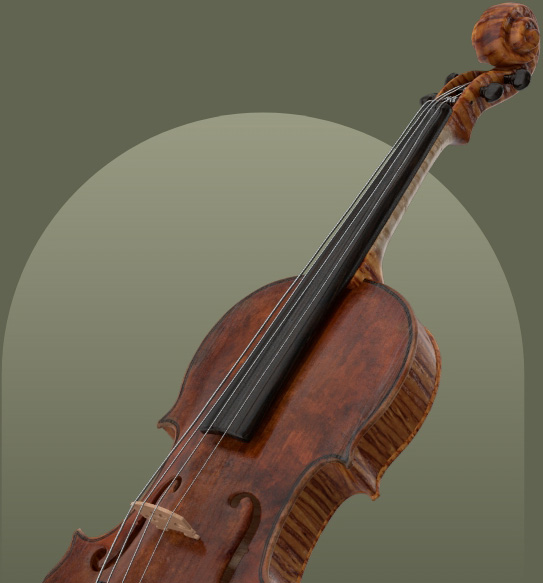
Max Mockel
Berlin, Charlottenburg, 1873–1937
Max Mockel (1873-1937) was a German violin maker, the son and pupil of Oswald Möckel, known for his prolific work on Stradivari and Guarneri models and his refined craftsmanship. He worked in various cities including Warsaw, Moscow, and St. Petersburg before returning to Berlin to establish his own business in Charlottenburg. Mockel also developed his own oil varnish with the help of a chemist and authored two books on violin making.
Request an expert valuation or learn how our global auctions achieve the highest prices for your instruments.
Auction Price History
Highest auction price
8 results
| Type | Details | Auction house | Sold | Price |
|---|---|---|---|---|
| Violin | Labelled Max Möckel Berlin 1925 Lot 138 | Ingles & Hayday | March 2020 | £3,600est. £ 4,000-6,000 |
| Violin | Lot 198 | Brompton's | May 2018 | £358 |
| Violin | Lot 201 | Bonhams | October 2014 | £3 |
| Violin | Handsome Amati one-piece back, whole of a lightly craquelled red colour Lot 201 | Bonhams | October 2014 | £3,750est. £ 3,000-4,000 |
| Violin | Labelled Max Möckel Berlin 1934 Lot 2 | Sotheby's | March 2012 | £4,750est. £ 2,500-3,500 |
| Violin | 35.7 cm 1914 | — | June 2008 | £3,120 |
| Cello | 75.9 cm Charlottenburg, 1905 | — | February 2007 | £2,640 |
| Violin | 1924 | — | November 1986 | £825 |
No results match those filters.
Maker Overview
Life
Max Mockel (1873-1937) was born in 1873 and died in 1937 in Berlin, Germany. He was the son and pupil of Oswald Möckel., he worked in Warsaw from 1897, then in Moscow, and from approximately 1899 to 1902 in St. Petersburg. Willibald Leo Lütgendorff notes that he opened his own workshop on October 1, 1899, after working with Geisser in St. Petersburg. He returned to Berlin in 1914 and established a business in Charlottenburg from 1920.
Characteristics
- Models
- Max Mockel was a prolific maker, working on Stradivari and particularly Guarneri del Gesù models.
- Varnish
- He was assisted by a Russian chemist, Dr. Golonin, in preparing his own oil varnish. Lütgendorff states that in conjunction with chemist Golonin, he produced an excellent violin varnish that resembled those of the old masters.
- Workmanship
- His work is described as very refined.
- Production
- He made an average of 50 instruments per year, which sold quickly at good prices.
- Max Möckel Geigenmacher
St. Petersburg, anno 1902John Dilworth - Max Möckel
Berlin 1930John Dilworth - Max Möckel
CharlottenburgJohn Dilworth
Influence and legacy
- Training: He was the son and pupil of Oswald Möckel.
- Mentorship: He worked with Geisser in St. Petersburg.
- Awards: Max Mockel received awards at Liège in 1954.
- Publications: He authored Das Konstruktions gehemnis der alten Italienischen Meister (The Construction Secrets of old Italian Masters), published in Berlin in 1925, and Die Kunst der Messung im Geigenbau (The Art of Geometry in Violin Making), published in Berlin in 1935.
Further Information
- Workshop Locations: He worked in Warsaw, Moscow, St. Petersburg, and later established a business in Charlottenburg, Berlin.
- Labels: Examples of his labels include "Max Möckel Geigenmacher / St. Petersburg, anno 1902", "Max Möckel / Berlin 1930", and "Max Möckel / Charlottenburg".
Biographies
The overview above is drawn from the following published accounts. Read them in the original:
John Dilworth+
MÖCKEL, Max Born 1873, died 1937 Berlin Germany. Son and pupil of Oswald Möckel, below. Worked in Warsaw from 1897, then in Moscow, and c.1899-1902 in St. Petersburg. Returned to Berlin 1914 and established a business in Charlottenburg from 1920. Prolific maker on Stradivari and Guarneri models. Assisted in preparing his own oil varnish by a Russian chemist, Dr Golonin. Very refined work. Awards at Liège 1954. Author of Das Konstruktions gehemnis der alten Italienischen Meister (The Construction Secrets of old Italian Masters) (Berlin, 1925) and Die Kunst der Messung im Geigenbau (The Art of Geometry in Violin Making) (Berlin, 1935). Max Möckel Geigenmacher / St. Petersburg, anno 1902 Max Möckel / Berlin 1930 Max Möckel / Charlottenburg
Willibald Leo Lütgendorff+
Zweiter Sohn und Schüler seiner Vaters Osw. M. Im Jahre 1897 ging er
nach Russland, arbeitete in Warschau und Moskau und zuletzt bei Geisser in
St. Petersburg. Am 1. October 1899 eröffnete er seine eigene Werkstatt. Er
arbeitet nach Stradivari und besonders nach Guarneri del Gesù und macht im
Jahre durchschnittlich 50 Instrumente, die rasch zu guten Preisen verkauft sind.
Durch den ersten Leibarzt Dr. Golonin wurde er auf ein im Handel nicht mehr
vorkommendes Präparat aufmerksam gemacht, aus dem er in Verbindung mit
dem Chemiker Golonin einen trefflichen Geigenlack herstellt, der dem der alten
Sell your instrument with Amati
Get started by uploading photos of your instrument for our experts to review.
Sell your instrument with Amati
Get started by uploading photos of your instrument for our experts to review.