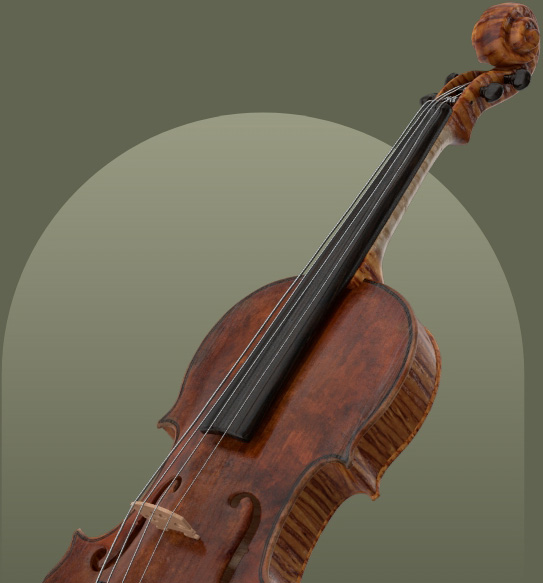
Santo SERAFIN
Auction price history
Highest auction price
£112,000
| Type | Details | Sold | Price |
|---|---|---|---|
| Violin | 35.5 cm (head later) [Attributed to] | May 2007 | £12,097 |
| Violin | 35.2 cm Venice, 18th C. [Attributed to] | May 2006 | £49,099 |
| Violin | Venice, 1743 (scroll replacement, various restorations) | December 2005 | £59,069 |
| Violin | Venice, 1740 c. | March 2004 | £112,000 |
| Violin | 1730 | November 2001 | £70,800 |
| Violin | 1720 | March 2000 | £27,600 |
| Violin | 1739 | November 1999 | £73,000 |
| Violin | 17-- | November 1995 | £34,500 |
| Violin | 1759 | May 1993 | £62,333 |
| Violin | 1750 | November 1992 | £48,400 |
| Violin | 1735 | March 1992 | £57,200 |
| Violin | 1740 c. | March 1992 | £49,500 |
| Violin | 1747 | April 1987 | £30,800 |
| Violin | 1725-50 | May 1986 | £61,600 |
Maker Overview
History
Santo SERAFIN (1699-1776) is celebrated as one of the most distinguished Venetian violin makers. While John Dilworth states he was born in Udine in 1699 and died in Venice in 1776, other sources present conflicting dates. Karel Jalovec, for instance, suggests a birth year of 1668 in Udine and a death around 1748, a period aligning with Cecie Stainer's notation of his activity in Venice from about 1710 to 1748. Serafin moved to Venice in 1717, though Willibald Leo Lütgendorff and Karel Jalovec indicate his presence in Venice from at least 1710. Prior to settling in Venice, he worked for a period in his birthplace, Udine, according to Lütgendorff and Henri Poidras.
His earliest recorded label dates to 1725. Santo SERAFIN was admitted to the musicians' guild in 1733, the same year he established his own shop. This workshop, located on the Calle dei Stagneri and previously owned by Zuanne Curci, was known by the sign ‘alla Madonna dei Sette Dolori’ and was situated near the premises of other notable makers like Montagnana, Sellas, and Sopran. Although this workshop closed in 1744, Serafin continued to be documented as an instrument maker until 1758, according to John Dilworth.
Craft
- Innovation: Santo SERAFIN's work is considered unique among Venetian makers for its highly articulate craftsmanship, careful symmetry, burnished wood finish, and consistent quality, as noted by John Dilworth. Dilworth highlights an unprecedented aspect of his style: long, broad, and elegantly shaped corners that taper thinner than the edges, a departure from most Italian practice where the edge typically swells slightly at the corner. While George Hart claims Serafin lacked originality, merely copying Amati or Stainer, Karel Jalovec credits him with forming a characteristic model by combining various influences.
- Materials: Serafin consistently used materials of the highest quality. John Dilworth, George Hart, Willibald Leo Lütgendorff, Henri Poidras, and Karel Jalovec all emphasize his use of handsome, flawless, and fine woods. Hart specifically mentions his "sides and backs are simply beautiful to perfection," and his method of cutting the wood invariably displayed the grain in even stripes. Lütgendorff describes the wood of his tops as very beautiful, with backs mostly small-figured.
- Methods: Serafin's workmanship is renowned for its exquisite finish and high level of consistency. His violins are typically of a medium-high arched Amati model, sometimes showing Staineresque affectations (Dilworth). Willibald Leo Lütgendorff asserts that, regarding the care of execution, Serafin is only surpassed by Stradivari. He made the F-holes and scrolls throughout his life in the style of Stainer, and his high arching also reflected Stainer's models. Dilworth describes his scrolls as superbly cut, though not entirely concentric, featuring a broad first turn at the throat and an extended last turn behind the eye. Cecie Stainer notes his workmanship was almost as beautifully finished as Stradivari's. The varnish on his instruments varied in tone, from pale golden-yellow to rich red-brown. While Dilworth notes it rarely showed the crackled deterioration seen in other Venetian makers' work, Cecie Stainer observes that his varnish could be brilliant but also dry and easily cracked. Other sources describe his varnish as transparent red, yellow-brown, yellow-red (Jalovec), rich red (Hart), or orange/red of best quality (Poidras). His interior work typically featured rather large blocks and mortised linings (Dilworth).
Influence
- Training and Mentorship: Santo SERAFIN himself claimed to be a pupil of Nicolaus Amati, a claim echoed by Henri Poidras and Karel Jalovec. However, Willibald Leo Lütgendorff suggests that his earlier instruments indicate training with a Tyrolean master, positing that he might have later joined Amati. John Dilworth notes he may have been influenced by Francesco Gofriller, who worked in Udine from 1714, and that aspects of his scroll design might link him to the Montagnana workshop, where he may have been employed before establishing his own business.
- Schools/Tradition: Serafin's work represents a distinct blend of influences. He primarily followed the Amati pattern, but also incorporated characteristics of the Stainer model, particularly in his sound-holes, scrolls, and arching (Dilworth, Hart, Jalovec, Cecie Stainer). His mature works show influence from both Amati and Francesco Ruggeri (Lütgendorff). While his instruments often reflect German characteristics of Stainer, George Hart emphasizes that a "strong Italian flavour" in his Stainer copies elevates them above the German school of imitators.
Legacy
- Famous Owners: A violoncello by Santo SERAFIN was in the possession of Mr. H. B. Heath, as mentioned by George Hart.
- Modern Recognition: Willibald Leo Lütgendorff asserts that Serafin "may unarguably be considered the most significant Venetian violin maker." His instruments, including violins, cellos, and double-basses, are highly regarded for their tone. Cecie Stainer mentions a beautiful violoncello by Serafin was exhibited in the South Kensington Museum in 1872. Notably, his double-basses are particularly celebrated for their excellent tone.
Further Information
- Technical Characteristics: Serafin was known for branding his instruments, typically above the tail-pin or on the lower ribs, as stated by George Hart, Cecie Stainer, Henri Poidras, and John Dilworth. His scrolls are also marked with a distinctive U-shaped cut beneath the throat (Dilworth). He used elaborate, well-printed labels, with early designs featuring complex frames of foliage and shells, a scroll of music manuscript on the left, and an inverted violin and bow on the right. Later labels featured straight borders of repeated arabesques. Some labels explicitly mention "Ad exemplar Hieronymi Amati / Cremonensium" [After the example of Hieronymus Amati / of Cremona] (Dilworth), further supporting his claimed lineage. Common label examples include: "Sanctus Seraphin Utinensis / Fecit Venetijs Anno 1740" [Sanctus Seraphin of Udine / Made in Venice in the year 1740] and "Sanctus Seraphin / Utinensis Fecit / Venetijs Ann.1729" [Sanctus Seraphin / of Udine Made / in Venice in the year 1729].
- Historical Uncertainties: There are notable discrepancies regarding Santo SERAFIN's birth and death dates, with sources providing differing years (1699-1776 versus 1668-~1748). His claim of being a pupil of Nicolaus Amati is also met with alternative suggestions, such as early training with a Tyrolean master, as discussed by Willibald Leo Lütgendorff. Furthermore, there is conflicting information regarding his originality, with George Hart stating he showed none, while John Dilworth and Karel Jalovec suggest his work possessed unique and characteristic qualities.
Summary
Santo SERAFIN, a prominent Venetian violin maker, is celebrated for the exceptionally high quality and refined craftsmanship of his instruments. Active for much of the 18th century, he established his own workshop in Venice in 1733. His work skillfully blended the models of Amati and Stainer, resulting in instruments noted for their articulate construction, careful symmetry, and consistent finish. Serafin meticulously selected the highest quality woods, and his distinctive varnish ranged from pale golden-yellow to rich red-brown. While sources present conflicting details regarding his exact birth and death dates (1699-1776 or 1668-~1748) and the extent of his originality, his instruments are consistently praised for their clear, strong, and sweet tone. He famously branded his instruments and used ornate labels, underscoring his desire for his work to be recognized. Though violas by Serafin are currently unknown and cellos are rare, his violins and double-basses are highly valued, establishing him as a significant figure in Italian violin making, often considered the most important Venetian luthier.
Biographies
John Dilworth
SERAFIN, Santo Born 1699 Udine, died 1776 Venice Italy. Santo Serafin is one of the most celebrated of Venetian makers, his workmanship consistently on a very high level. However, his preference for the Stainer or Amati model and the rarity of his cellos make his instruments less common on the very front rank of the concert platform than those of Gofriller or Montagnana. Moved to Venice in 1717, possibly influenced by Francesco Gofriller, the son of Matteo, who worked in Udine from 1714. His earliest recorded label is dated 1725 and he was admitted to the musicians’ guild in 1733. In those years probably working for various established violin makers in Venice, but earliest work is nevertheless highly individual and refined. His own shop, previously the workplace of the violin maker Zuanne Curci, was established from 1733 and identified by the sign ‘alla Madonna dei Sette Dolore’. Located the Calle dei Stagneri, it was close to the premises of Montagnana, Sellas, and Sopran. In 1744 this workshop was closed but Santo appears to have remained active and continued to be referred to as an instrument maker in documents up to 1758. His work is unique amongst Venetian makers; distinguished by his highly articulate craftsmanship, careful symmetry, a burnished wood finish, and above all a consistency throughout his production. His violins are almost invariably of a medium-high arched Amati model, some showing Staineresque affectations. Varnish is in a variety of tones from pale golden-yellow to rich red-brown, but rarely show the crackled deterioration in the surface that is characteristic of other Venetian makers. The materials are uniformly of the highest quality. Although the interior work is conventional with rather large blocks and morticed linings, there are certain unprecedented aspects to his style. The long broad and elegantly shaped corners are tapered thinner than the edges; the reverse of most Italian practice in which the edge swells slightly at the corner. The scrolls are superbly cut but are not entirely concentric, with a broad first turn at the throat and an extended last turn behind the eye. This seems to be the only mannerism which links Serafin with the Montagnana workshop (which may have provided Serafin with employment before he was able to establish his own business). He was a prolific violin maker, but violas are at present unknown and cellos rare. It was obviously important to him to have his work identified; he had several well-printed and ornate labels, the lower ribs generally carry a large name brand, and the scrolls are marked with a distinctive, carefully applied u-shaped cut at the end of the pegbox mortice beneath the throat. Name brand on lower ribs. Early labels have a complex frame of foliage and shells, scroll of music manuscript on left, and inverted violin and bow on right. Later labels with straight borders of repeated arabesques. Sanctus Seraphin Utinensis / Fecit Venetijs Anno 1740 Sanctus Seraphin / Utinensis Fecit / Venetijs Ann.1729 Sanctus Seraphin / Utinensis Fecit / Venetijs Ann.17.. / Ad exemplar Hieronymi Amati / Cremonensium [Pio]
Sell your instrument with Amati
Get started by uploading photos of your instrument for our experts to review.
Sell your instrument with Amati
Get started by uploading photos of your instrument for our experts to review.