Georgio (Zorzi) Serafin
Venice, 1726–1755
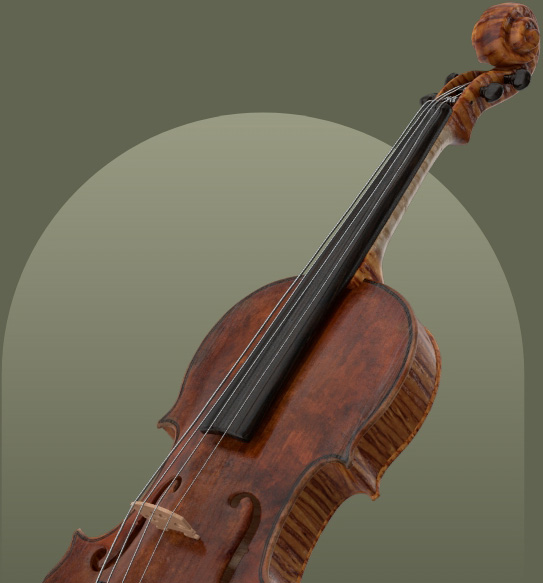
Georgio (Zorzi) SERAFIN (1726-1755) was a Venetian luthier, either the nephew or grandson of Santo Serafin, who worked for and later succeeded Montagnana's business in Venice. His workshop was significant, and he was appointed luthier to several institutions. His violins are often Amatisé with sophisticated workmanship, though sources conflict on the gracefulness of his scrolls. He used excellent materials and various varnishes, including a Montagnana-like dark red. His instruments were often branded on the lower rib, and his soundholes were slender and curving, though the tone is noted as weak.
Request an expert valuation or learn how our global auctions achieve the highest prices for your instruments.
Auction Price History
Highest auction price
5 results
| Type | Details | Auction house | Sold | Price |
|---|---|---|---|---|
| Violin | Lot 53 | Aguttes | March 2026 | £86,679 |
| Violin | 35.5 cm Venice, 1770 c. | — | March 2011 | £168,000 |
| Violin | 35.1 cm Mid-18th C. Attributed to | — | February 2007 | £12,000 |
| Violin | 1743 | — | November 1989 | £63,800 |
| Violin | 1742 | — | May 1980 | £4,180 |
No results match those filters.
Maker Overview
Life
Georgio (Zorzi) SERAFIN (1726-1755) was born in 1726 and died in 1755 in Venice, Italy., he was the nephew and pupil of Santo Serafin. However, Willibald Leo Lütgendorff and Karel Jalovec state that he was the grandson of Santo Seraphin. Georgio Serafin worked for Montagnana and succeeded to his business in 1751, at which time he married Montagnana's daughter, Antonia. He continued to operate the business at the sign 'alla Cremona' in the Calle de Stagneri, acknowledging Montagnana in the business's title until 1768. He was appointed luthier to the Ospedaletto, the Mendicanti, and La Pietà. His workshop, assisted by his son Giovanni Battista and Anselmo Bellosio, was of major importance in Venice during this period, despite the relative rarity of Georgio Serafin's own labelled work.
Characteristics
- Workmanship
- His violins are described as somewhat Amatisé and often full-arched. John Dilworth notes his workmanship as sophisticated, though not reaching the refinement and finish of his uncle Santo.
- Scrolls
- Sources contain conflicting information regarding his scrolls. John Dilworth describes them as "a little graceless, with open turns and a weak chamfer," while Willibald Leo Lütgendorff states "die Schnecke ist hübsch geschnitzt" (the scroll is beautifully carved), and Karel Jalovec mentions "the scrolls gracefully carved."
- Varnish
- Some instruments feature a very fine Montagnana-like clotted dark red varnish, while others have a plainer golden-brown or yellow-brown varnish.
- Soundholes
- His soundholes are characterized as quite slender and curving.
- Materials
- He consistently used excellent materials.
- Tone
- Both Willibald Leo Lütgendorff and Karel Jalovec note that the tone of his instruments is weak.
- Georgius Seraphin, Sancti Nepos
fecit Venetiis 1741John Dilworth
Influence and legacy
- Mentorship:, he was a pupil of Santo Serafin.
- Professional Affiliation: He worked for Montagnana, eventually succeeding his business.
Further Information
- Workshop Location: He worked at the sign 'alla Cremona' in the Calle de Stagneri, Venice.
- Branding: His instruments were often branded on the lower rib.
- Label Example: An example of his label reads "Georgius Seraphin, Sancti Nepos / fecit Venetiis 1741 [Pio]."
Biographies
The overview above is drawn from the following published accounts. Read them in the original:
John Dilworth+
SERAFIN, Georgio (Zorzi) Born 1726, died 1755 Venice Italy. Nephew and pupil of Santo Serafin, below. Worked for Montagnana and succeeded to the business in 1751, marrying his daughter Antonia. Continued to work at the sign ‘alla Cremona’ in the Calle de Stagneri, acknowledging Montagana in the title of the business until 1768. Appointed luthier to the Ospedaletto, the Mendicanti, and La Pietà. Assisted by his son Giovanni Battista and Anselmo Bellosio, the workshop was of major importance in this period in Venice, despite the relative rarity of Giorgio Serafin’s own labelled work. Violins are somewhat Amatisé, often full-arched, the workmanship sophisticated but nowhere near that of his uncle Santo in refinement and finish. Scrolls especially are a little graceless, with open turns and a weak chamfer. Some have very fine Montagnana-like clotted dark red varnish; others a plainer golden-brown. Soundholes quite slender and curving. Excellent materials. Often branded on lower rib. Georgius Seraphin, Sancti Nepos / fecit Venetiis 1741 [Pio]
Willibald Leo Lütgendorff+
Enkel von Santo Seraphin, von dem er jedoch nur wenig mehr als den Namen erbte. Die Arbeit, das Holz und der Lack sind gut; auch die Schnecke ist hübsch geschnitzt; nur der Ton ist zu schwach. Er verwendete auch eine Brandmarke.
Karel Jalovec+
Venice. 1742—1749. Grandson of Santo Seraphin. His workmanship, as well as the wood and varnish he used are very good, the scrolls gracefully carved, the tone, however, is weak. Yellow-brown varnish.
Sell your instrument with Amati
Get started by uploading photos of your instrument for our experts to review.
Sell your instrument with Amati
Get started by uploading photos of your instrument for our experts to review.