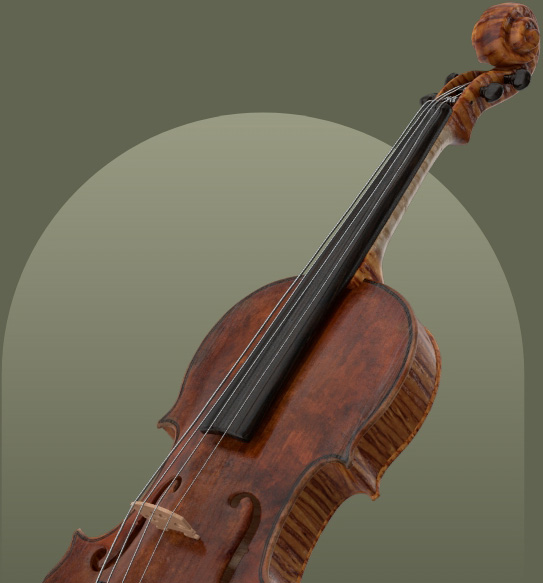
Pietro (II) Guarneri
Cremona, Venice, 1695–1762
Pietro (II) Guarneri (1695-1762) was a distinguished Cremonese luthier, the eldest son and pupil of Giuseppe Guarneri, ‘filius Andreae’. He established his career in Venice, where he worked from around 1717 until his death, though some sources suggest an earlier period in Mantua. Renowned for his cellos, violins, and a viola, his instruments are celebrated for their outstanding materials, superb and transparent golden-orange varnish, and distinctive craftsmanship that blended Cremonese tradition with Venetian influences. His work exhibits unique characteristics in model, soundholes, and purfling, setting him apart from his family's immediate lineage.
Request an expert valuation or learn how our global auctions achieve the highest prices for your instruments.
Auction Price History
Highest auction price
10 results
| Type | Details | Auction house | Sold | Price |
|---|---|---|---|---|
| Violin | Rosenberg collection, unlabelled, scroll probably by Giuseppe Guarneri Filius Andreae Lot 128 | Ingles & Hayday | June 2023 | £624,000est. £ 200,000-300,000 |
| Violin | Violin, 1750 c. Perlman Lot 167 | Tarisio | November 2022 | £446,805est. $ 500,000-800,000 |
| Violin | Labelled Petrus Guarnerius Filius Joseph Cremonensis fecit Venetiis Anno 1746 Lot 186 | Ingles & Hayday | October 2017 | £504,000est. £ 300,000-500,000 |
| Violin | 35.5 cm Venice, 1735-1740 c. | — | December 2011 | £39,101 |
| Violin | 35.4 cm Venice, 1734 (the scroll possibly by another) | — | April 2010 | £107,403 |
| Violin | 35.4 cm 18th C. Attributed to | — | October 2009 | £10,625 |
| Violin | Ascribed to | — | November 2005 | £3,360 |
| Cello | 1725 | — | April 1985 | £148,500 |
| Violin | 1750 Venice | — | November 1982 | £66,000 |
| Violin | 1742 Venice | — | April 1982 | £68,200 |
No results match those filters.
Maker Overview
Life
Pietro (II) Guarneri (1695-1762) was born on April 14, 1695, in Cremona, Italy, the eldest son and pupil of Giuseppe Guarneri, ‘filius Andreae’., he left Cremona around 1717 to work in Venice, where he remained for the rest of his life, dying in 1762. However, Cecie Stainer states that he worked first in Mantua and then in Venice until about 1760. Willibald Leo Lütgendorff notes that a third Pietro Guarneri is believed to have lived in Mantua from 1720 to 1750, which may contribute to the differing accounts regarding Pietro (II)'s early career location. His own labels date from approximately 1730, and he was most prolific between 1740 and 1750. He died in Venice.
Characteristics
- Instruments
- Pietro (II) Guarneri is rightly famed for his cellos, which combine the virtues of the Venetian instrument with those of his own tradition. He also made numerous violins and at least one viola.
- Violin Characteristics
- His violins exhibit variety, with some showing a preponderance of Amati characteristics and others a broader, flatter Stradivari style, but with more rounded 'c' bouts and prominent upper corners. George Hart notes that his work and model differ entirely from his brother's and his father Andrea's, featuring increased breadth between the sound-holes, a rounder and more perpendicular sound-hole, more contracted middle bouts, and a more raised model.
- Edgework and Scroll
- The edge is usually broad and deeply worked. The scroll is deeply cut, beautifully concentric, and abounds in individuality of design, with the ear brought out with much effect.
- Soundholes
- The soundholes are notable, often set widely apart and of a fluid shape, with the upper eye and wing contrastingly small compared with the open treatment of the lower wing and finial.
- Purfling
- The purfling is splendidly executed, with corners worked up to an extreme point of delicacy characteristic of Niccolo Amati's works. It is embedded after the manner of Amati's 'grand' instruments, but to a greater extent.
- Materials
- Materials are often outstandingly fine. Pietro Guarneri used some of the finest wood, with bellies invariably wide in grain and very even.
- Varnish
- The varnish is superb, of the richest description, and its transparency is unsurpassed. Its quality is limpid golden orange, sometimes of a golden tint, sometimes of a pale red, on which the light plays with delightful variety. A most beautiful violoncello is known with a golden amber colour tinted with rose, rather similar to that of Montagnana.
- Arching and Tone
- His instruments are rather arched, possess splendid varnish, and a fine rich tone.
- Petrus Guarnerius Filius Joseph
Cremonensis fecit Venetijs
Anno 1750John Dilworth
Influence and legacy
- Training: Pietro (II) Guarneri was the pupil of his father, Giuseppe Guarneri, ‘filius Andreae’.
- Venetian Workshops: Upon arriving in Venice, there were several busy workshops, including those of Gofriller, Montagnana, Tononi, Serafin, and the important guitar-maker Matteo Sellas, any of whom could have provided employment to the young Cremonese maker.
- Conflicting Influences: Sources contain conflicting information regarding his primary influences. Willibald Leo Lütgendorff states that he later leaned more towards his uncle Pietro's models, leading to potential confusion between their works. Cecie Stainer also suggests he followed the patterns of his uncle Pietro and may have been his pupil while in Mantua.
Further Information
- Labels: His labels include "Petrus Guarnerius Filius Joseph / Cremonensis fecit Venetijs / Anno 1750", and "Petrus Guarnerius filius Joseph Cremonensis fecit Venetiis, anno 1739". Another similar label is dated 1755.
- Notable Instruments: A most beautiful violoncello is known, with sides and back made of beautifully marked maple, and an admirable golden amber varnish tinted with rose.
Biographies
The overview above is drawn from the following published accounts. Read them in the original:
John Dilworth+
GUARNERI, Pietro (II) Born 1695 Cremona, died 1762 Venice Italy. Eldest son and pupil of Giuseppe Guarneri, ‘filius Andreae’, above. He left Cremona in about 1717 to work in Venice where he remained for the rest of his life. There were several busy workshops there at the time; not only the well-known violin makers Gofriller, Montagnana, Tononi, and Serafin, but also the important guitar-maker Matteo Sellas, any or all of whom would presumably have been happy to provide the young Cremonese with employment. His own labels date from c.1730, and he was at his most prolific from 1740-1750. Rightly famed for his cellos which unsurprisingly combine the virtues of the Venetian instrument with those of his own tradition, he also made numerous violins and at least one viola. The violins come in some variety, as do most Venetians, showing in some a preponderance of Amati, in others a broader flatter Stradivari style, but with more rounded ‘c’ bouts and prominent upper corners. The edge is usually broad and deeply worked, and the scroll also deeply cut and beautifully concentric. The soundholes are also notable, often set widely apart and of a fluid shape, the upper eye and wing contrastingly small compared with the open treatment of the lower wing and finial. Materials are often outstandingly fine and the varnish a limpid golden orange. Petrus Guarnerius Filius Joseph / Cremonensis fecit Venetijs / Anno 1750
George Hart+
Brother of Giuseppe Guarneri. In this maker, again, there is much originality, his work, together with his model, differing entirely from that of his brother, and in outline from that of his father Andrea. There is increased breadth between the sound-holes ; the sound-hole is rounder and more perpendicular ; the middle bouts are more contracted, and the model is more raised. The scroll abounds in individuality of design. The ear is brought out with much effect; the purfling is splendidly executed, the corners being worked up to that extreme point of delicacy which is characteristic of the works of Niccolo Amati. The purfling is embedded after the manner of Amati in his “grand” instruments, but to a greater extent. The varnish is superb ; its quality is of the richest description, and its transparency unsurpassed. Its colour varies ; it is sometimes of a golden tint, sometimes of a pale red, on which the light plays with delightful variety. Pietro Guarneri used some of the finest wood. The bellies are invariably wide in grain and very even.
Cecie Stainer+
Son of Giuseppe Giovan Battista Guarneri, grandson of Andrea, b. April 14, 1695, at Cremona. Worked first in Mantua and then in Venice till about 1760. He followed the patterns of his uncle Pietro, and may have been his pupil while in Mantua. His work is very good; his instruments are rather arched, have splendid varnish, and a fine rich tone. A most beautiful violoncello is known, the sides and back made of maple, beautifully marked, the varnish admirable, a golden amber colour tinted with rose, rather similar to that of Montagnana. In it is the label : ” Petrus Guarnerius filius Joseph Cremonensis fecit Venetiis, anno 1739″; a similar label is dated 1755-
Willibald Leo Lütgendorff+
Sohn von Giuseppe (»Joseph«),Schüler seines Vaters, später aber schloss er sich mehr an seinen Oheim Pietro an und machte recht hübsche Geigen nach dessen Modellen, wesshalb man ihre Arbeiten leicht verwechselt. In seinen letzten Jahren soll es ihm sehr schlecht gegangen sein. Ein dritter Pietro G. soll 1720—1750 in Mantua gelebt haben.
Sell your instrument with Amati
Get started by uploading photos of your instrument for our experts to review.
Sell your instrument with Amati
Get started by uploading photos of your instrument for our experts to review.