
Andrea Guarneri
Cremona, 1623–1698
Request an expert valuation or learn how our global auctions achieve the highest prices for your instruments.
Instruments
Auction Price History
Highest auction price
47 results
| Type | Details | Auction house | Sold | Price |
|---|---|---|---|---|
| Violin | Labelled Andreas Guarnerius Cremonensis fecit Mantuae Sub tit. Sanctae Theresiae 1732 Lot 197 | Ingles & H. | October 2024 | £108,000est. £ 100,000-150,000 |
| Violin | Ex Alice Schoenfeld, labelled Andrea Guarnerius fecit Cremone sub titulo Sanctae Teresia 1676 Lot 149 | Tarisio | May 2024 | £259,147est. $ 250,000-400,000 |
| Violin | Labelled Andreas Guarnerius alumnus Nicola Amati fecit Cremonae sub titulo Sanctae Teresiae 1682 Lot 26 | Ingles & Hayday | March 2023 | £204,000est. £ 100,000-150,000 |
| Violin | Violin, 1690 c. Lot 176 | Tarisio | November 2020 | £117,791est. $ 100,000-150,000 |
| Violin | Labelled Andreas Guarnerius fecit Cremona Sub titulo ..., table later probably early 19th century English Lot 162 | Ingles & Hayday | March 2020 | £50,400est. £ 40,000-60,000 |
| Violin | Composite violin Lot 240 | Tarisio | March 2020 | £48,000est. £ 20,000-30,000 |
| Violin | French table of 18th Century in the Guersan style, later upper ribs Lot 125 | Vichy | June 2019 | £43,576est. € 40.000-50.000 |
| Viola | Labelled Andrea Guarnerius fecit Cremonae sub, titulo Sanctae Teresiae 1690 Lot 45 | Tarisio | May 2019 | £989,778est. $ 800,000-1,200,000 |
| Violin | Labelled Andreas Guarnerius fecit Cremonae sub titulo Sanctae Teresiae 1681 Lot 240 | Ingles & Hayday | March 2019 | £144,000est. £ 180,000-250,000 |
| Violin | Labelled Andreas Guarnerius alumnus, Nicola Amati fecit Cremonae, sub titulo Sanctae ..., head later Lot 223 | Tarisio | March 2019 | £197,100est. £ 150,000-220,000 |
| Violin | A violin by Andrea Guarneri, Cremona, 1681 Lot 113 | Amati | October 2018 | £189,600est. £ 40,000-80,000 |
| Violin | Showing the hand of Giuseppe Guarneri filius Andreae, labelled Andreas Guarnerius Cremonae sub ... Lot 190 | Tarisio | October 2017 | £287,500est. £ 250,000-400,000 |
| Violin | Labelled Andreas Guarnerius alumnus Nicola Amati, fecit Cremona, sub titolo Sanctae Teresie, 1682 Lot 129 | Tarisio | June 2015 | £131,500est. £ 150,000-220,000 |
| Violin | Front later, labelled Nicolaus Amatus, Cremonen. Hieronymi Filii ac Antonij Nepos Fecit 167... Lot 22 | Ingles & Hayday | March 2015 | £60,000est. £ 30,000-50,000 |
| Violin | Unlabelled, table probably by another hand Lot 105 | Ingles & Hayday | October 2014 | £26,400est. £ 14,000-18,000 |
| Violin | Labelled Andreas Guarnerius fecit Cremone sub titulo Sanctae Teresiae 1667 Lot 125 | Ingles & Hayday | October 2014 | £336,000est. £ 180,000-250,000 |
| Violin | Lot 270 | Bonhams | May 2014 | £68,500 |
| Violin | Illustrated on p. 318-319 of Four Centuries of Violin Making; made in collaboration with Joseph filius Lot 266 | Brompton’s | October 2013 | £240,000est. £ 200,000-300,000 |
| Violin | Labelled Andreas Guarnerius alumnus Nicolaus Amati fecit Cremonae sub titulo Sanctae Teresiae 1655 Lot 126 | Ingles & Hayday | October 2013 | £84,000est. £ 60,000-80,000 |
| Violin | The very fine table of this instruments is the work of Carlo Antonio Testore Lot 312 | Brompton’s | March 2013 | £91,200est. £ 80,000-120,000 |
| Violin | Bearing the maker's label Lot 225 | Vichy | June 2012 | £65,990est. € 55.000-60.000 |
| Violin | Lot 113 | Bonhams | October 2011 | £12,500 |
| Violin | 35.8 cm Ascribed to | — | October 2011 | £12,500 |
| Violin | 35.2 cm Late 17th C. Attributed to | — | October 2010 | £24,409 |
| Violin | 35.1 cm Cremona, 1680 c. (dimentions altered) | — | October 2010 | £87,000 |
| Violin | 35.3 cm Cremona, 1695 | — | November 2008 | £95,793 |
| Violin | 35.1 cm 18th C. Ascribed to | — | October 2008 | £12,500 |
| Violin | 35.3 cm Cremona, 1690 c. | — | October 2007 | £59,489 |
| Violin | 35.3 cm Cremona, 1680 c. | — | November 2006 | £126,046 |
| Violin | 35.9 cm Cremona, 1710 c. | — | November 2006 | £229,600 |
| Violin | Italy, 1680 c. | — | November 2005 | £38,400 |
| Violin | Cremona, 1687 | — | October 2005 | £115,404 |
| Violin | Cremona, 1670 c. | — | July 2004 | £48,000 |
| Violin | 1675 (composite) | — | October 2001 | £39,007 |
| Violin | 1673 | — | November 1999 | £87,300 |
| Violin | 1677 | — | November 1998 | £89,500 |
| Violin | 1645 c. | — | March 1998 | £63,100 |
| Violin | 1676 | — | November 1992 | £137,500 |
| Violin | 1698 | — | November 1991 | £28,600 |
| Violin | 1674 c. | — | June 1991 | £39,600 |
| Violin | — | November 1990 | £16,500 | |
| Violin | 1679 | — | March 1990 | £33,000 |
| Cello | 1697 | — | June 1989 | £121,000 |
| Violin | 1662 | — | June 1989 | £126,500 |
| Violin | 1655 | — | November 1988 | £93,500 |
| Violin | 1694 | — | May 1986 | £34,100 |
| Violin | 1656 | — | May 1981 | £12,100 |
No results match those filters.
Maker Overview
Life
Andrea Guarneri (1623 or c. 1626 – 1698), son of Bartolommeo, was the progenitor of the renowned Cremonese violin-making family, the Guarnerius. Sources contain conflicting information regarding his birth year, with John Dilworth stating 1623, while Cecie Stainer and Willibald Leo Lütgendorff's account of him being 15 years old in 1641 suggests circa 1626. He was born and died in Cremona, Italy, and was buried in the Church of San Domenico on December 8, 1698.
Andrea Guarneri was the first apprentice of Nicolò Amati, beginning around 1640. He resided in the Amati household until 1646 and returned between 1650 and 1653., he is mentioned in the records of the parish of St. Faustino and Giovita in 1641 as a co-resident of the Amati house. Amati held him in high regard, choosing him as a witness for his marriage to Lucrezia Pagliari on May 23, 1645. On December 31, 1652, Andrea Guarneri married Anna Maria Orcelli (who died on January 13, 1695) in the Church of San Clemente. This marriage produced seven children, including four daughters and three sons.
After his apprenticeship, Andrea Guarneri established his own workshop in the Piazza San Domenico, now known as Piazza Roma. This was the first significant violin-making shop in Cremona outside of the Amati atelier. His workshop was identified by the sign of St. Theresa, which also appeared on his labels. His eldest son, Pietro, later moved to Mantua, while his younger son, Giuseppe, became his assistant and successor. Through his sons, Andrea's influence on the trajectory of violin making became immensely significant.
Characteristics
- General Character
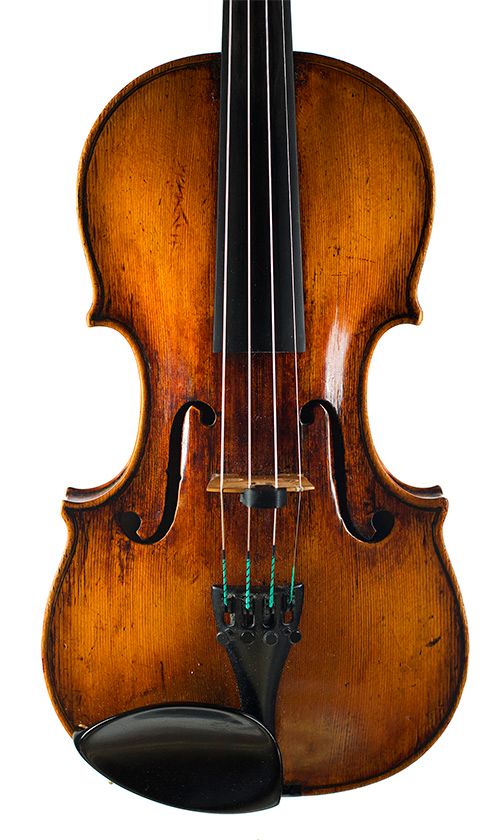
- Andrea Guarneri's work possesses great character and is closely allied to the Amati form. While it may lack the perfection of Amati's execution, certain touches give it immediate distinction.
- Arching
- The arch is generally rather pinched, though later models show a flatter arching. The pattern is slightly arched.
- Purfling
- The purfling points are strongly deflected across the corners.
- Scroll
- The eye of the scroll has a heavy tail leading into the first turn. Later, the scroll showed signs of originality and much character.
- Varnish
- His varnish is described as a rich golden amber, or a light orange color of beautiful hue. It varied greatly in color, from golden yellow to orange, or even darker rose color. It sometimes had considerable body but could lack the transparency of lighter varnishes.
- Sound-holes
- The F-holes were changed over time, and the sound-holes generally vary but are often straight.
- Instrument Models
- Andrea Guarneri initially adhered closely to his teacher's models, but later his violins became larger than those of his teacher. He developed his own scroll and changed the F-holes.
- Violas
- His contralto violas are considered the first great instruments of their type from Cremona. Three violas are known, suggesting Maggini's work in size and general style.
- Cellos
- His cellos, built on a highly arched and voluptuous model, are of very great importance. He made violoncellos in two sizes, often using plain wood that possessed singular tone-producing qualities.
- Violins
- His violins are among his finest efforts, with excellent workmanship, though not possessing the fine finish of Amati. Violins in good condition are very rare.
- Tone
- The tone is generally good, and his violoncellos are particularly well-regarded. The tone of his violins is described as brilliant but not carrying well.
- Workmanship
- The work is neat but not highly finished.
- Wood
- He generally used good wood.
- Other Instruments
- Besides full-sized violins, he also crafted “halbe” (half) violins.
- Andreas Guarnerius Cremonae sub
titulo Sanctae Teresia. 16..John Dilworth
Influence and legacy
- Mentorship: Andrea Guarneri was the first apprentice of Nicolò Amati, beginning around 1640. He lived in the Amati house during his apprenticeship.
- Fellow Students: He was a fellow student of Antonio Stradivari in the workshop of their common master, Niccolò Amati.
- Stylistic Influence: He was initially influenced by Antonio and Girolamo Amati, making instruments on a large pattern, and then for many years followed Nicolò Amati's pattern. Around 1670, the influence of Stradivari began to be felt, and Andrea Guarneri became one of Stradivari's earliest followers, though he always retained an original and distinctive style.
- Family Dynasty: Andrea Guarneri was the head and patriarch of the celebrated Guarnerius family of violin makers.
- Succession: His younger son, Giuseppe Giovan Battista, became his assistant and successor in the workshop.
- Continuity: Two of his sons, Pietro Giovanni and Giuseppe Giovan Battista, also became violin makers, ensuring the continuation of the family's legacy.
- Historical Significance: Andrea Guarneri is recognized as the pioneer of the Guarneri family, and his influence was crucial for the later extraordinary works of his nephew, Giuseppe Guarneri “del Gesù.”
Further Information
- Workshop Location: His workshop was located in the Piazza San Domenico, now known as Piazza Roma, in Cremona.
- Workshop Sign: The workshop was identified by the sign of St. Theresa.
- Labels: Examples of his labels include: “Andreas Guarnerius Cremonae sub / titulo Sanctae Teresia. 16..”; “Andreas Guarnerius fecit Cremonen sub titulo Sanctae Teresiae, 1650” (similar labels are dated 1670, 1675, 1690, and 1696); and “Sub disciplina, Andreae Guarnerii in ejus officina sub titulo S. Teresiae Cremonae, 1676.”
- Notable Instruments: The Royal Collection of Old Musical Instruments in Berlin possesses a “halbe” (half) violin made by Andrea Guarneri from the year 1644.
Biographies
The overview above is drawn from the following published accounts. Read them in the original:
John Dilworth+
GUARNERIUS, Andrea Born 1623, died 1698 Cremona Italy. First apprentice of Nicolò Amati from c.1640. He lived in the Amati house until 1646, but returned 1650-1653, before establishing his own workshop in the Piazza San Domenico, the first significant violin making shop in the city other than the Amati atelier. It was identified by the sign of St Theresa which also appears on his labels. His eldest son, Pietro, moved to Mantua, but the younger, Giuseppe, became his assistant and successor. Through them Andrea’s influence on the course of violin making became enormously important. His own work is possessed of great character and is closely allied to the Amati form. In execution it lacks the perfection of Amati, but certain touches give it immediate distinction. The arch is generally rather pinched, the purfling points strongly deflected across the corners, and the eye of the scroll has a heavy tail leading into the first turn. His varnish is a rich golden amber. Perhaps his most important work is in the development of the viola and cello. Contralto violas from his hand are the first great instruments of their type from Cremona, and his cellos, built on a highly arched and voluptuous model, are also of very great importance. Andreas Guarnerius Cremonae sub / titulo Sanctae Teresia. 16..
George Hart+
The name of ” Guarnerius ” is probably known to every possessor of a Violin throughout the world. The familiar style is attached to scores of copies and non-copies every week, and despatched to the four quarters of the globe. Little did Andrea imagine that he was destined to be the means of lifting his patronymic of Guarneri to such a giddy height! Andrea Guarneri, like Andrea Amati, was the pioneer of the family: but for his influence we might never have had the extraordinary works of his nephew, Giuseppe. How full of interest would the smallest events of Andrea’s workshop life prove if we could only ascertain them ! We know that in early years he was working at the side of Stradivari in the shop of their common master, Niccolo Amati. With what delight would any record, or even anecdote, of those golden days in the history of the Violin be received by the lovers of the instrument! The bare idea that these three men were living in daily close converse is sufficient to awaken interest of a lively nature in the mind of a lover of Fiddles. Unhappily, however, no Boswell was at hand to dot down events, of small value when passing, but of great consequence to after time. Andrea Guarneri for some years worked upon the model of his master, though he afterwards changed the character of the sound-hole.* At the same time the form of the instrument became flatter, and the scroll showed signs of originality. The varnish is much varied, but is generally of a light orange colour of beautiful hue ; it sometimes has considerable body, but when so, lacks the transparency of light-coloured varnishes. The Violoncellos are of two sizes. The wood in the Violoncellos is often very plain, but possesses singular tone-producing qualities. The Violins of this maker are among his finest efforts; the workmanship is excellent, but has not the fine finish of Amati.
Cecie Stainer+
b. about 1626 at Cremona; d. there Dec. 7, 1698 ; was buried in the Church of San Domenico the following day. He was descended from an ancient and noble Cremonese family, and was the head of the celebrated family of makers known by the Latin form of their name,” Guarnerius.”
Pupil of Antonio and Girolamo Amati; later, about 1641, of Nicola Amati, a fellow student being Antonio Stradivari. He was one of the witnesses at N. Amati’s marriage in 1645, but was not with him in 1646, but was again there in 1653. While influenced by Ant. and Gir. Amati he made on a large pattern, but then for many years followed Nicola’s pattern. About 1670 the character of his sound-holes changed, his model became flatter, and the scroll showed much character; this was probably when the influence of Stradivari began to be felt, one of whose earliest followers he became; but throughout he always retained a quite original and distinctive style of his own.
Some of his instruments are beautifully made, especially his violins, which, in good condition, are very rare ; violas, of which three are known, suggest, both in size and in a general way, Maggini’s work ; a violoncello is known, very beautiful not only in wood and varnish, but also in tone. As a rule he used good wood and excellent varnish, which varied greatly in colour from a golden yellow to orange, or even darker rose colour. The sound-holes also vary, but are generally straight; the pattern is slightly arched, the sides often low ; the tone is brilliant, but does not carry well; the work is neat, but not highly finished.
Labels: ” Andreas Guarnerius fecit Cremonen sub titulo Sanctae Teresiae, 1650″ (similar labels are dated 1670, 1675, 1690, and 1696);
and ” Sub disciplina, Andreae Guarnerii in ejus officina sub titulo S. Teresiae Cremonae, 1676.”
He married, in the Church of San Clemente, Dec. 31, 1652, Anna Maria Orcelli (d. Jan. 13, 1695). He lived in Piazza San Domenico, now Piazza Roma. Two of his sons, Pietro Giovanni and Giuseppe Giovan Battista, were makers.
Willibald Leo Lütgendorff+
Sohn des Bartolommeo und der Stammvater der berühmten Cremoneser
Geigenmacherfamilie. In fast allen Urkunden wird der Name allerdings
Guarnieri geschrieben, auf den Zetteln der einzelnen Mitglieder der Familie
findet man aber stets die Schreibart Guarnerius vorgezogen. Andrea war einer
der ersten Schüler Nicola Amati’s und kommt bereits 1641 in den Acten der
Pfarrei St. Faustino und Giovita mit der Bemerkung vor, dass er ein Mitbewohner
des Hauses Amati und 15 Jahre alt sei. Es lässt darauf schliessen,
dass Amati ihn besonders schätzte, da er ihn zum Zeugen bei seiner Vermählung
mit Lucrezia Pagliari genommen hatte (23. Mai 1645). Wenige Jahre
später, am 31. December 1652, heirathete er selbst Anna Maria Orcelli
(† 13. Januar 1695), aus welcher Ehe sieben Kinder, vier Töchter und drei
Söhne, hervorgingen. Andrea’s Geigen sind grösser als die seines Lehrers,
wenn er sich auch anfangs genau an dessen Modelle gehalten hat. Später
nahm er die Wölbung flacher, veränderte die F-Löcher und erfand eine eigene
Schnecke, sein Lack ist verschieden, gewöhnlich orangefarben. Der Ton ist
recht gut, und am besten sind seine Violoncelli, die er, wie fast alle Cremoneser
in zwei Grossen machte. Ausser vollen Geigen fertigte er auch »halbe« an; eine
solche aus dem Jahre 1644 besitzt die kgl. Sammlung alter Musikinstrumente,
in Berlin. — Zwei von seinen Söhnen sind gleichfalls Geigenmacher geworden.
Sell your instrument with Amati
Get started by uploading photos of your instrument for our experts to review.
Sell your instrument with Amati
Get started by uploading photos of your instrument for our experts to review.
Pupils
Pietro (I) Guarneri Pupil
