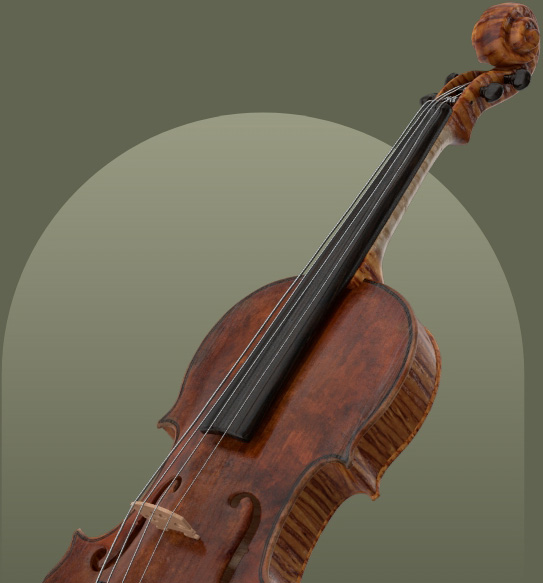
Michele Deconet
Kehl, Venice, Venice mid, 1713–1799
Michele Deconet (1713-1799) was a prolific and distinctive instrument maker born in Kehl, France, who primarily worked in Venice, Italy, and also in Padua. Initially a soldier and musician, he developed a unique style despite questions regarding his formal guild membership. His instruments are characterized by an admirable flat model, a slightly pinched arch, and a distinctive scroll carving technique. Early works featured a thick red Venetian varnish, which later evolved into paler yellow or golden-brown hues. He is noted for sharing technical features with Peter Guarneri of Venice and is sometimes considered a follower of the Cremona school or a pupil of Montagnana, whose varnish his own resembled.
Request an expert valuation or learn how our global auctions achieve the highest prices for your instruments.
Auction Price History
Highest auction price
31 results
| Type | Details | Auction house | Sold | Price |
|---|---|---|---|---|
| Viola | Illustrated in Masterpieces of Italian Violin Making (Rattray); Larger than life; The Strad 2005 Calendar Lot 20 | Tarisio | March 2024 | £78,000est. £ 60,000-90,000 |
| Violin | Labelled Andreas Guarnerius fecit Cremone, sub titulo S. Teresiae anno 16..., f-holes slightly recut Lot 58 | Tarisio | March 2024 | £47,200est. £ 40,000-60,000 |
| Violin | Labelled Michele Deconet fecit, Venetijs Anno 1760 Lot 195 | Tarisio | November 2023 | £142,788est. $ 150,000-220,000 |
| Violin | Labelled Michele Deconet fecit Venetiis Anno 1769 Lot 92 | Ingles & Hayday | March 2023 | £132,000est. £ 40,000-60,000 |
| Violin | Unlabelled, table later Lot 127 | Tarisio | October 2021 | £11,976est. € 15.000-22.000 |
| Violin | Labelled Michele Deconet fecit, Venetijs Anno 1753, head later, branded to the lower rib DC Lot 132 | Tarisio | July 2021 | £42,745est. $ 50,000-80,000 |
| Violin | Labelled Micael Deconet, Fecit Venetiis 1750 Lot 178 | Tarisio | November 2020 | £133,648est. $ 190,000-250,000 |
| Violin | Unlabelled Lot 258 | Freeman's | November 2015 | £28,618est. $ 30,000-40,000 |
| Violin | Padova 1859, and inscribed by him Lot 237 | Tarisio | May 2013 | £38,530est. $ 25,000-40,000 |
| Violin | 35.4 cm Venice, 1770 c. Attributed to & probably by | — | April 2010 | £8,642 |
| Violin | 35.7 cm 18th C. Ascribed to | — | October 2009 | £18,537 |
| Violin | 35.4 cm Italy, mid 18th C. (the table later) Possibly by | — | March 2009 | £21,250 |
| Violin | 35.5 cm Venise, 1777 | — | December 2008 | £38,906 |
| Violin | 35.5 cm Venice, 1753 | — | October 2008 | £43,875 |
| Violin | 35.5 cm Venice, 1754 | — | November 2007 | £72,000 |
| Viola | 39.9 cm Venice, 1750 c. Dimensions slightly reduced in the treble bouts. | — | March 2007 | £63,250 |
| Violin | 35.4 cm Venice, 1760 c. | — | February 2007 | £57,600 |
| Violin | 36.1 cm Early 18th C. Ascribed to | — | October 2006 | £12,937 |
| Violin | 34.9 cm Venice, 1750 c. Probably by | — | July 2006 | £18,000 |
| Violin | 35.4 cm Venice, 1760 c. Probably by | — | February 2006 | £50,400 |
| Violin | 1780 c. | — | May 2005 | £31,200 |
| Violin | Probably Venice, mid-19th C. | — | May 2005 | £5,400 |
| Violin | 1759 | — | October 2002 | £56,841 |
| Violin | 1789 | — | June 2001 | £57,500 |
| Violin | 1764 | — | May 2001 | £45,192 |
| Violin | 1780 | — | November 2000 | £25,800 |
| Violin | 1780 | — | November 1992 | £24,200 |
| Violin | — | March 1989 | £12,100 | |
| Cello | 1783 | — | November 1988 | £31,900 |
| Violin | 17-- | — | November 1988 | £35,200 |
| Violin | 1750-99 | — | October 1982 | £5,176 |
No results match those filters.
Maker Overview
Life
Michele Deconet (1713-1799) was born in 1713 in Kehl, Strasbourg, France, and died in 1799 in Venice, Italy. He is recorded in historical documents as a violinist and singer, despite being unable to read music. It has been suggested that he lacked the qualifications for membership in the luthier's guild in Venice, which would imply he could not practice the craft legally. Nevertheless, a considerable body of his distinctive and stylistically consistent work exists, which cannot be readily attributed to any other known maker. Deconet began his working life as a soldier, stationed for two years in Paris. After leaving the army, he traveled to Venice in 1732, supporting himself as a musician. He subsequently made several excursions from Venice, either working as a musician or selling his instruments. Some published labels from the end of his life indicate Padua as the place of origin, though he ultimately died in Venice. Willibald Leo Lütgendorff notes that Deconet may have been the son of Gio B. D. and that he was still working in Padua in 1790.
Characteristics
- Workmanship
- His work is generally considered a little coarse, but features an admirable flat model, although the arch consistently has a slightly pinched center.
- Early Period
- Early work, dating from around 1745, exhibits a more Amati-like arch, following both the narrow and 'Grand' Amati models. These instruments bear a particularly fine and typically Venetian thick red varnish, which was prone to clotting and crazing.
- Later Period
- Over the years, the quality of his varnish declined somewhat, with many later instruments featuring a paler, less richly textured yellow or golden-brown coating.
- Scrolls
- A distinctive feature of his scrolls is that the throat is not sawn right across at the end of the pegbox mortice; instead, it was worked from either side with a knife. This idiosyncrasy has often been 'corrected' by later restorations.
- Proportions
- In other respects, Deconet admirably followed classical precepts of proportion and geometry.
- Instrument Types
- Violas and cellos of compact size are known, often on a recognizably Montagnana form, but are relatively rare.
- Stylistic Influences
- , in outline, he imitated Joseph Guarneri and sometimes Stradivari, though without particular flair. Cecie Stainer notes he was a follower of the Cremona school.
- Varnish Characteristics
- Lütgendorff states that his red-brown varnish is uncommonly similar to that of Montagnana.
- Micael Deconet
fecit Venetiis, 1752John Dilworth - Michele deconet
fecit Venetiis. anno 1754John Dilworth - Michael Deconet
Fecit Venetiis, Anno 1759 (Manuscript) fatto da me
Michele Deconet 1764John Dilworth - Michael Deconer
fecit Venetiae 1786John Dilworth - Michele Deconet
Fecit, Venetijs Anno
1764John Dilworth - SettembreJohn Dilworth
Influence and legacy
- Mentorship: Specific technical features in Deconet's work are shared with Peter Guarneri of Venice, who may have been his informant in the craft.
- School Affiliation: Sources contain conflicting information about his direct training; while Cecie Stainer states he was a follower of the Cremona school, Willibald Leo Lütgendorff suggests he was considered a pupil of Montagnana due to the similarity of his varnish.
- Known Instruments: A violin by Michele Deconet dated 1786 is owned by Herr Wrede in Lüneburg. Cecie Stainer mentions two violins and a violoncello known to be well-made with yellow varnish, with a similar label dated 1771.
- Labels: Examples of his labels include: Micael Deconet / fecit Venetiis, 1752; Michele deconet / fecit Venetiis. anno 1754; Michael Deconet / Fecit Venetiis, Anno 1759 (Manuscript); fatto da me / Michele Deconet 1764; Michael Deconer / fecit Venetiae 1786; and Michele Deconet / Fecit, Venetijs Anno / 1764, Settembre.
Biographies
The overview above is drawn from the following published accounts. Read them in the original:
John Dilworth+
DECONET, Michele Born 1713 Kehl, Strasbourg, France, died 1799 Venice Italy. A prolific and varied maker, recorded in historical documents as a violinist and singer (although unable to read music). It has been suggested that he lacked the qualifications for membership of the luthier’s guild in Venice and therefore cannot have practiced the craft legally. Nevertheless, a considerable body of work exists which is distinctive, consistent in stylistic development and technique, and which cannot be readily attributed to any other known maker. Began his working life as a soldier, stationed for two years in Paris. Leaving the army, he travelled to Venice in 1732, supporting himself as a musician. He subsequently made a number of excursions from Venice, either working as a musician or selling his instruments, and some published labels from the end of his life give Padua as the place of origin. He died in Venice, however. His work is a little coarse, but generally of an admirable flat model, although the arch always has a slightly pinched centre. Early work, dating from c.1745 has a more Amati-like arch, following both the narrow and ‘Grand’ Amati models, and bears a particularly fine and typically Venetian thick red varnish, given to clotting and crazing. This declined somewhat over the years, and many instruments have a paler less richly textured yellow or golden-brown coating. Specific technical features are shared with Peter Guarneri of Venice who may have been his informant in the craft. The scrolls have an interesting feature in that the throat is not sawn right across at the end of the pegbox mortice, instead being worked from either side with a knife. In many cases this idiosyncrasy has been ‘corrected’ by later restorations. In other respects, Deconet follows classical precepts of proportion and geometry perfectly admirably. Violas and cellos (on a recognisably Montagnana form) of compact size are known, but are relatively rare. Micael Deconet / fecit Venetiis, 1752. Michele deconet / fecit Venetiis. anno 1754. Michael Deconet / Fecit Venetiis, Anno 1759 (Manuscript) fatto da me / Michele Deconet 1764 Michael Deconer / fecit Venetiae 1786. Michele Deconet / Fecit, Venetijs Anno / 1764, Settembre
Cecie Stainer+
Worked in Venice about 1742-79. Was a follower of the Cremona school. Two violins and a violoncello that are known are well made, with yellow varnish.
a similar label is dated 1771.
Willibald Leo Lütgendorff+
Vielleicht ein Sohn von Gio B. D. Wie dieser schreibt er seinen Namen
gewöhnlich »Deconet«. Im Jahre 1790 hat er noch in Padua gearbeitet. In den
Umrissen ahmt er den Jos. Guarneri, manchmal auch Stradivari ohne besonderen
Schwung nach, sein rothbrauner Lack ist dagegen dem des Montagnana, für dessen Schüler man ihn halt, ungemein ähnlich. Eine Geige von ihm mit der Jahreszahl 1786 besitzt Herr Wrede in Lüneburg.
Sell your instrument with Amati
Get started by uploading photos of your instrument for our experts to review.
Sell your instrument with Amati
Get started by uploading photos of your instrument for our experts to review.