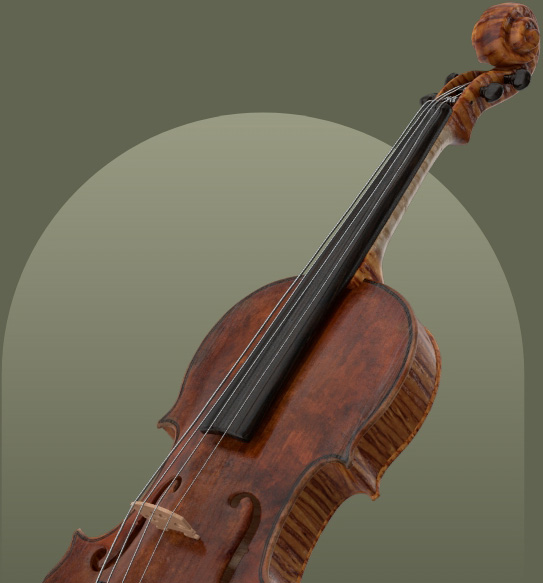
(Giovanni) Francesco. Stradivari
1671–1743
(Giovanni) Francesco. Stradivari (1671-1743) was the eldest son and pupil of the renowned Antonio Stradivari, born in Cremona, Italy. He was apprenticed to his father from around 1685 and was considered his chosen successor. After Antonio's death, Francesco continued the workshop, often in collaboration with his brother Omobono. While his instruments, such as the 'ex-Salabue' violin of 1742, are noted for their powerful and rich tone and beautiful varnish, their overall finish and certain design elements like soundholes and purfling mitres are often considered less refined than his father's work. His handwriting has been identified on some later Stradivari paper patterns in the Museo Stradivariano, indicating his independent contributions. Despite not fully matching his father's meticulousness, his instruments achieved significant value, sometimes selling for prices comparable to Antonio's.
Request an expert valuation or learn how our global auctions achieve the highest prices for your instruments.
Auction Price History
Highest auction price
| Type | Details | Auction house | Sold | Price |
|---|---|---|---|---|
| Violin | 35.2 cm with Literature Ascribed to | — | October 2008 | £20,866 |
No results match those filters.
Maker Overview
Life
(Giovanni) Francesco. Stradivari (1671-1743) was born on February 1, 1671, in Cremona, Italy, and died on May 11, 1743. He was the eldest son of Antonio Stradivari, and presumably apprenticed to his father from approximately 1685, being his chosen successor according to Antonio's will in The Brompton's Book of Violin & Bow Makers. After his father's death, he continued to run the shop in company with his brother Omobono in Italian violin makers. Willibald Leo Lütgendorff in Die Geigen- und Lautenmacher vom Mittelalter bis zur Gegenwart also confirms that he worked with his brother Omobono for a time after his father's death. in A Dictionary of Violin Makers, he worked in his father's workshop until Antonio's death and then continued with his brother. He began to affix labels with his own name to his works only after his father's death. John Dilworth notes that Francesco himself was already 71 when he made the very fine 'ex-Salabue' violin of 1742, and he died the following year, having outlived his father by only six years. George Hart, in The Violin, states that Lancetti recorded Francesco's death at the end of 1742, the same year Omobono died, though Hart clarifies that the actual date was May 11, 1743, aged 72 years, noting that Lancetti's date was incorrect by some months but showed care in rendering information.
Characteristics
- Workmanship
- His workmanship is difficult to distinguish from that of his father, Antonio Stradivari, but it is generally considered less careful and not perfectly imitating his father's work. George Hart states that his work is altogether less finished but still shows the hand of the master, with a bold and original design. Henri Poidras, in Critical & Documentary Dictionary Of Violin Makers Old & Modern, also notes that his workmanship, design, and cut of the soundholes were inferior to his father's.
- Soundholes
- John Dilworth detected several distinct soundhole settings on his instruments, including sloping, widely disposed soundholes with narrow wings. Karel Jalovec describes them as upright and rather open after the Amati brothers' fashion, with the right sound-hole in a more inclined position. George Hart notes that the sound-hole is quite unlike that of Antonio.
- Purfling
- His purfling is described as not so handsome by Karel Jalovec, and John Dilworth notes rather mis-managed purfling mitres.
- Scrolls
- The scrolls of his instruments are beautifully carved. However, John Dilworth notes a slightly cramped and crudely finished terminus to the volutes of the scroll on the 'ex-Salabue' violin. Cecie Stainer describes the scroll as heavy.
- Varnish
- The varnish is rich and fully up to the best work of Antonio, though the materials are decidedly plain. Karel Jalovec states he applied orange-yellow varnish of fairly good quality, but it falls short of that used by Antonio. Willibald Leo Lütgendorff describes the lacquer as brownish-orange-yellow. Cecie Stainer notes the varnish is very beautiful, though quite different from Antonio's, and of a brownish hue. Henri Poidras mentions a dark orange-yellow varnish.
- Materials & Edges
- The materials used were decidedly plain. Karel Jalovec notes that violins by Francesco have broad edges.
- Models
- He made several violins and violas, often imitating the large violin model of his father from 1708.
- Tone
- His instruments have a very good, powerful tone. George Hart notes that the tone of Francesco's instruments is invariably very rich and telling. Henri Poidras highlights the exceptional tone qualities of his instruments as their best recommendation.
- Labels
- Some instruments bear the label (or signs of a label) stating 'sotto la Disciplina d'Antonio Stradiuari', though these are rare, as per John Dilworth. Cecie Stainer provides an example: 'Franciscus Stradivarius Cremonensis filius Antonii faciebat, anno 1742.' Other labels include 'Francesco Stradivarius Cremonensis / Filius Antonii faciebat Anno 1742' and 'Franciscus Stradivarius sub disciplina / A. Stradivarii 1700', as cited by Rosengard & Chiesa in Dilworth's text.
- Specific Instruments
- The 'ex-Salabue' violin of 1742 is considered a reliable example of his work.
- Francesco Stradivarius Cremonensis
Filius Antonii faciebat Anno 1742John Dilworth - Franciscus Stradivarius sub disciplina
A. Stradivarii 1700John Dilworth
Influence and legacy
- Mentorship: He was the son and pupil of Antonio Stradivari, and Henri Poidras.
- Apprenticeship: He was presumably apprenticed to his father from approximately 1685 and worked in his father's workshop until Antonio's death.
- Collaboration: After his father's death, he continued to run the shop in company with his brother Omobono, and Cecie Stainer. George Hart also mentions he worked with his brother Omobono for several years.
- Schooling: His work shows the excellent school in which he had been trained.
- Value: Karel Jalovec states that his instruments had a price of 160,000 Kc, with some fetching as much as 320,000 Kc. George Hart notes that instruments made in 1740 and 1742 were sold at the same price as his father's, as mentioned in correspondence between Count Cozio and Paolo.
- Notable Owners: A violin from 1735 by Francesco Stradivari was owned by Karl Prill in Leipzig.
- Archival Holdings: His handwriting has been tentatively identified on some of the later Stradivari paper patterns stored in the Museo Stradivariano, including details of the 'Picola B' cello.
Further Information
- Workshop Location: He was born and died in Cremona, Italy.
- Archival Evidence: His handwriting has been tentatively identified on some of the later Stradivari paper patterns stored in the Museo Stradivariano, including details of the 'Picola B' cello, suggesting he achieved some independence within the workshop, as per John Dilworth.
- Labels: Examples of labels include 'Franciscus Stradivarius Cremonensis filius Antonii faciebat, anno 1742' and 'Francesco Stradivarius Cremonensis / Filius Antonii faciebat Anno 1742' or 'Franciscus Stradivarius sub disciplina / A. Stradivarii 1700'.
Biographies
The overview above is drawn from the following published accounts. Read them in the original:
John Dilworth+
STRADIVARI, (Giovanni) Francesco. Born 1671, died 1743 Cremona Italy. Eldest son of Antonio Stradivari, above. Presumably apprenticed to his father from c.1685 and his chosen successor to judge from Antonio’s will. His workmanship is difficult to distinguish from that of his father, but several distinct soundholes settings can be detected on instruments from the ‘golden period’ and beyond. His handwriting has been tentatively identified on some of the later Stradivari paper patterns stored in the Museo Stradivariano (including details of the ‘Picola B’ cello), so it may be assumed that he achieved some independence within the workshop. Some instruments are known to bear the label (or signs of a label) stating ‘sotto la Disciplina d’Antonio Stradiuari’ but these are rare. The most reliable example of his work is the very fine ‘ex-Salabue’ violin of 1742. Its most striking aspects are the sloping, widely disposed soundholes with narrow wings, a slightly cramped and crudely finished terminus to the volutes of the scroll, and rather mis-managed purfling mitres. The varnish is rich and fully up to the best work of Antonio but the materials are decidedly plain. It is worth noting that Francesco himself was already 71 when the instrument was made and he died the following year having outlived his father by only six years. Francesco Stradivarius Cremonensis / Filius Antonii faciebat Anno 1742 Franciscus Stradivarius sub disciplina / A. Stradivarii 1700 [Rosengard & Chiesa]
Cecie Stainer+
Son of Antonio Stradivari; b Feb. 1, 1671, Cremona; d. May 11, 1743. Was a pupil of his father and worked in his workshop until Antonio’s death; he then continued to work with his brother Omobono. He made several violins and violas, in which he placed his own label, from about 1725 to 1740; his work shows the excellent school in which he had been trained, and has genuine merit, but is much inferior to that of his father. The varnish is very beautiful, though quite different from that of Antonio, it is of brownish hue; the scroll is heavy, the work not very carefully finished, but the tone rich and penetrating. Label : ” Franciscus Stradivarius Cremonensis filius Antonii faciebat, anno 1742.”
George Hart+
Son of Antonio Stradivari. Worked with his brother Omobono for several years. Many of the later works of Antonio Stradivari have been attributed to his sons. The character of the work is wholly distinct. I can well understand the error of attributing the instruments of Francesco Stradivari to Carlo Bergonzi, there being many points in common, but that so many marked specimens of the works of Antonio should be deemed apocryphal is beyond my comprehension. The work of Francesco is altogether less finished, but at the same time it shows the hand of the master. The design is bold and original. The sound-hole is quite unlike that of Antonio. The tone of Francesco’s instruments is invariably very rich and telling. Lancetti states—speaking of Francesco Stradivari—”After the death of his father, he made several Violins and Tenors, to which he put his own name. Although he did not succeed in perfectly imitating the works of his father, the instruments which he made in the years 1740 and 1742, and which remained after his death in the possession of his brother Paolo, were sold at the same price as those of his father, as mentioned in the correspondence between Count Cozio and Paolo. Francesco died at the end of 1742, the year Omobono died, and in which he made the Violins bought by Count Cozio.” The date of death as given by Lancetti, though incorrect by some months, he having died May nth, 1743, aged 72 years, shows the care and trouble taken to render the information as complete as possible, these dates having been given without reference to registers, but simply as stated by Paolo.
Willibald Leo Lütgendorff+
Sohn und Schüler von Antonio Stradivari. Nach dem Tode seines Vaters arbeitete er eine Zeit lang mit seinem Bruder Omobono zusammen. Zettel mit seinem Namen klebte er in seine Arbeiten erst nach dem Tode seines Vaters ein. Seine Geigen haben noch das Gepräge des Stradivari’schen Geistes und sind herrlich im Ton, aber bei Weitem weniger sorgfältig ausgeführt als die seines Vaters, den er so wenig erreichte, als er seinen besseren Mitschüler gleichkam. Der Lack ist bräunlich-orangegelb und die Schnecke recht hübsch. Eine Geige von ihm aus dem Jahre 1735 besitzt Karl Prill in Leipzig.
Henri Poidras+
Son of Antonio Stradivarius. Make of great value which is however not equal to that of his father, the workmanship, design and cut of the sound holes being inferior. The exceptional tone qualities of his instruments are their best recommendation. Dark orange-yellow varnish. His scrolls are admirably carved.
Karel Jalovec+
Cremona, Born Feb. 1, 1671, died May 11, 1743. Son and pupil of Antonio Stradivari. After his father’s death he continued to run the shop in company with his brother Omobono. His works are imitations of the large violin model of his father in 1708; they have a very good, powerful tone, though lacking the careful finish of instruments built by his father. Violins by Francesco have broad edges, their purfling is not so handsome, the sound-holes are upright, rather open after the Amati brothers’ fashion and the right sound-hole is in a more inclined position. He applied orange-yellow varnish, which is of fairly good quality, but falls short of that used by Antonio. The scrolls of his instruments are beautifully carved. Even without Antonio, Francesco would have become very famous. Price 160.000 Kc; some of his instruments fetched, however, as much as 320.000 Kc.
Sell your instrument with Amati
Get started by uploading photos of your instrument for our experts to review.
Sell your instrument with Amati
Get started by uploading photos of your instrument for our experts to review.