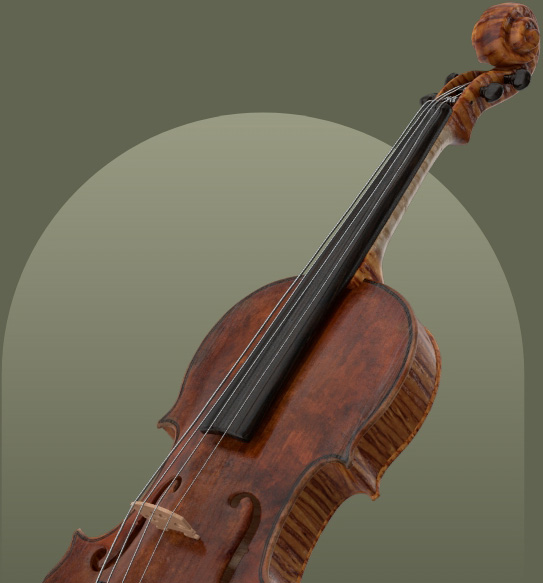
Antonio Casini
Modena, 1630–1690
Antonio Casini (1630-1690) was a notable and industrious luthier active in Modena, Italy, from approximately 1660 to 1700, serving as luthier to the ducal court. Though his instruments are rare, he is recognized for his good workmanship, clean ebony inlay, and well-formed F-holes and scrolls. He crafted large violoncellos and violins often based on the Amati model, with a clear chestnut or brown varnish. His court position likely exposed him to leading makers of his era, and his style shows resemblances to both Amati and Giuseppe Guarneri 'filius Andreae'. He used various labels throughout his career.
Auction Price History
Highest auction price
5 results
| Type | Details | Auction house | Sold | Price |
|---|---|---|---|---|
| Viola | Illustrated on pages 142 and 143 of Meister italienischer Geigenbaukunst by Walter Hamma, 1965 Lot 137 | Brompton’s | November 2015 | £180,000 |
| Double Bass | Bearing an original label Antonio : Casini - Modena 1685 Lot 174 | Brompton’s | October 2012 | £48,000est. £ 40,000-50,000 |
| Violin | 35.4 cm 18th C. Ascribed to | — | October 2007 | £5,531 |
| Cello | Italy, 1700 c. | — | April 2005 | £100,256 |
| Cello | 1670 | — | November 2001 | £12,000 |
No results match those filters.
Maker Overview
Life
Antonio Casini (1630-1690) was a prominent maker active in Modena, Italy, from approximately 1660 to 1700. Born in 1630 and dying in 1690, he was considered a fine and interesting maker, though his instruments are rare. Willibald Leo Lütgendorff identifies him as the best-known Modenese violin maker of his era and a highly industrious master. Casini held an appointment as luthier to the ducal court of Modena, which, as John Dilworth suggests, would have provided him with knowledge of many principal makers of the period. Sources contain conflicting information regarding his death date; while John Dilworth states 1690, Willibald Leo Lütgendorff mentions instruments bearing his label with the year 1710.
Characteristics
- Workmanship
- Cecie Stainer describes his workmanship as fair, while John Dilworth notes a slightly coarse finish despite a rich varnish. Willibald Leo Lütgendorff states that his work is good, with clean ebony inlay, and F-holes and scrolls of good form. Due to the large quantity of instruments produced, Lütgendorff suggests he worked in a very craftsmanlike manner.
- Models
- His violoncellos were made on a large pattern, a characteristic noted by both Cecie Stainer and John Dilworth. Willibald Leo Lütgendorff indicates that his better violins were based on the Amati model. John Dilworth also observes that his style is reminiscent of Giuseppe Guarneri 'filius Andreae'.
- Varnish
- The varnish on his instruments is described by Cecie Stainer as a clear chestnut or brown colour. John Dilworth refers to it as a rich varnish, and Willibald Leo Lütgendorff specifies it as chestnut brown.
- Antonio Casini
Modena 1673John Dilworth - Antonio Casini
Modena 1658John Dilworth - Antonio Casini fecit
Muttinae anno 1683John Dilworth - Antonius Cassinus fecit
Mutinae anno 1687John Dilworth
Influence and legacy
- Training: Although his apprenticeship remains unknown, John Dilworth suggests that his position as luthier to the ducal court of Modena would have afforded him knowledge of the principal makers of his time.
- Stylistic Influences: Willibald Leo Lütgendorff notes that his finer violins followed the Amati model, leading some to speculate that he might have been a pupil of the Amati family. John Dilworth also identifies a stylistic resemblance to Giuseppe Guarneri 'filius Andreae'.
Further Information
- Labels: Antonio Casini utilized various labels. Examples include "Antonio Casini / Modena 1658", "Antonio Casini / Modena 1673", "Antonio Casini, fecit Muttinae, anno 1683", and "Antonius Cassinus fecit / Mutinae anno 1687".
Biographies
The overview above is drawn from the following published accounts. Read them in the original:
John Dilworth+
CASINI, Antonio Born 1630, died 1690 Modena Italy. A fine and interesting maker, although rare. Stylistically reminiscent of Giuseppe Guarneri ‘filius Andreae’, with a rich varnish but slightly coarse finish. Although his apprenticeship is unknown, he held an appointment as luthier to the ducal court of Modena, and would therefore have had some knowledge of most of the principal makers of the period. Cellos also known, of large pattern. Antonio Casini / Modena 1673 Antonio Casini / Modena 1658 Antonio Casini fecit / Muttinae anno 1683 Antonius Cassinus fecit / Mutinae anno 1687
Cecie Stainer+
A maker in Modena about 1660 to 1700. His violoncellos were made on a large pattern, the varnish a clear chestnut or brown colour, the workmanship fair.
the same in a violoncello dated 1665;
“Antonio Casini, fecit Muttinae, anno 1683 ” (in a violoncello);
Willibald Leo Lütgendorff+
Der bekannteste modenesische Geigenmacher seiner Zeit, ein viel beschäftigter
Meister, der auch in Diensten seines Herzogs stand. Bei der grossen Masse
seiner Geigen, Violoncelli und Bässe ist es nicht zu verwundern, dass er sehr
handwerksmässig arbeitete. Seine besseren Geigen gehen auf das Amatimodell
zurück, wesshalb ihn auch Einige zu einem Amatischüler machen wollten. Die
Arbeit ist gut, die Ebenholzeinlage sauber, F-Löcher und Schnecke von guter
Form, der Lack kastanienbraun. Nach Valdrighi soll er zwar nach 1690 gestorben
sein, doch kommen noch Geigen mit seinem Zettel und der Jahreszahl
1710 vor. Er verwendete verschiedene Zettel.
Sell your instrument with Amati
Get started by uploading photos of your instrument for our experts to review.
Sell your instrument with Amati
Get started by uploading photos of your instrument for our experts to review.