Johann Gottlob (I) Ficker
Markneukirchen, Neukirchen, 1744–1832
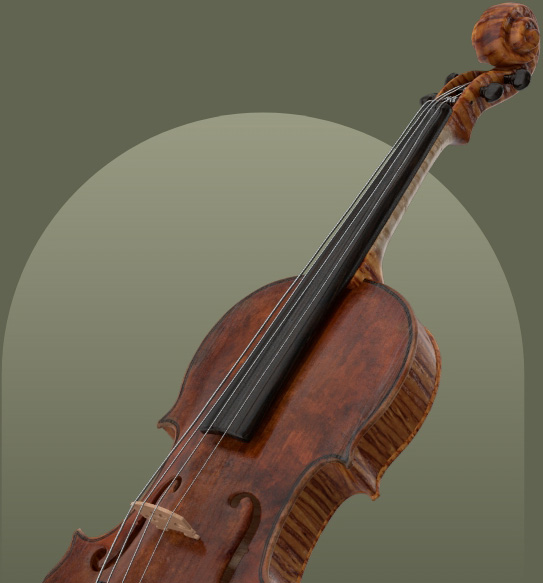
Johann Gottlob (I) Ficker (1744-1832) was a highly regarded German violin maker from Markneukirchen, the son and pupil of Johann Caspar Ficker. Admitted to the guild in 1764, he was known for his superior craftsmanship, often working on the Stainer model, characterized by well-cut scrolls and a distinctive swan-neck pegbox. His instruments featured good wood, clean execution, and a noble tone, though his varnish was typically thin and brittle. Ficker frequently used internal branding and, like others in his family, sometimes employed labels suggesting a Cremonese origin, despite his work being stylistically distinct. His diligence and long life ensured that his instruments remain relatively common.
Auction Price History
Highest auction price
13 results
| Type | Details | Auction house | Sold | Price |
|---|---|---|---|---|
| Violin | 35.2 cm Markneukirchen, 1800 c. | — | April 2010 | £4,109 |
| Violin | Markneukirchen, 1812 | — | July 2004 | £4,780 |
| Violin | Neukirchen, 1777 | — | April 2004 | £2,020 |
| Viola | 39.3 cm 1785 | — | March 2000 | £2,530 |
| Violin | 1795 | — | November 1999 | £1,380 |
| Violin | 1789 | — | May 1996 | £601 |
| Violin | 1809 | — | November 1995 | £2,300 |
| Violin | 1830 c. | — | April 1993 | £1,725 |
| Violin | 1798 c. | — | March 1992 | £2,640 |
| Violin | 1780 | — | July 1988 | £418 |
| Violin | 1790 c. | — | November 1987 | £550 |
| Violin | 1809 | — | June 1984 | £317 |
| Violin | 1780-99 | — | January 1984 | £455 |
No results match those filters.
Maker Overview
Life
Johann Gottlob (I) Ficker (1744-1832) was born in 1744 and died in 1832. He was the son and pupil of Johann Caspar Ficker, as noted in The Brompton's Book of Violin & Bow Makers by John Dilworth. Ficker was admitted to the violin makers' guild in 1764. Die Geigen- und Lautenmacher vom Mittelalter bis zur Gegenwart, he was considered one of the best violin makers in Vogtland. His instruments were already valued during his lifetime, and due to his diligence and long life of 88 years, 4 months, and 5 days, his violins are still frequently encountered.
Characteristics
- Model
- His work is described as superior and in the usual Ficker style, often based on the Stainer model.
- Scroll and Pegbox
- John Dilworth notes his instruments feature a very well-cut scroll with a concentric volute, characterized by an extended last turn behind the eye, and a swan-neck pegbox.
- Varnish
- The varnish used was typically thin and brittle, appearing yellow or sometimes a darker red-brown.
- Materials and Execution
- Willibald Leo Lütgendorff highlights his use of good wood, clean execution, and noble tone.
- Internal Brand
- He branded his instruments internally with "*I * G * F *".
- Labels
- His manuscript labels sometimes mischievously suggested a Cremonese origin, despite his instruments being stylistically distant from Cremonese work. Examples include "Johann Gottlob Ficker Violino / correspontent Romani Cremona 1793" and "Johann Gottlob Ficker probe violino / cor-Respont Romani Cremona 1786", as cited by Hamma. Cecie Stainer also notes in A Dictionary of Violin Makers that he felt it necessary to use "Cremona" labels.
- Johann Gottlob Ficker Violino
correspontent Romani Cremona 1793John Dilworth - Johann Gottlob Ficker probe violino
cor-Respont Romani Cremona 1786John Dilworth
Influence and legacy
- Mentorship: Johann Gottlob (I) Ficker was the son and pupil of Johann Caspar Ficker.
- Reputation: His violins were considered excellent by Cecie Stainer and stated as being valued during his lifetime.
- Misconception: Despite the stylistic differences, many people genuinely believed him to be a Cremonese master due to his labels, a point acknowledged even by Niederheitmann, who conceded that the violins bore little resemblance to the Cremonese school.
- Prevalence: Due to his long and diligent career, his violins are still frequently found.
Further Information
- Label Variations: The wording on his labels was highly variable, often employing the same nonsensical Latin typical of many of his contemporaries and predecessors, as detailed by Willibald Leo Lütgendorff.
Biographies
The overview above is drawn from the following published accounts. Read them in the original:
John Dilworth+
Johann Gottlob (I) Born 1744, died 1832. Son and pupil of Johann Caspar Ficker, above. Admitted to the violin makers guild 1764. Superior work of the usual Ficker style on Stainer model. Very well-cut scroll, concentric volute with charactersitic extended last turn behind the eye, and swan-neck pegbox. Thin brittle yellow or sometimes darker red-brown varnish. Like others of the family, sometimes mischievously suggested a Cremonese origin on his labels, although any violin more distant from the Cremonese style would be hard to imagine. Branded internally: *I * G * F *. Manuscript labels: Johann Gottlob Ficker Violino / correspontent Romani Cremona 1793 Johann Gottlob Ficker probe violino / cor-Respont Romani Cremona 1786 [Hamma]
Cecie Stainer+
Of Markneukirchen, b. 1744 ; d. 1832. His violins were excellent, but he also thought it necessary to use ” Cremona ” labels.
Willibald Leo Lütgendorff+
Sohn von Johann Caspar F., wurde 1764 Meister und gehört zu den besten
Geigenmachern des Vogtlandes. Seine Arbeiten zeichnen sich durch gutes
Holz, saubere Durchführung und edlen Ton aus. Seine Violinen, die jetzt
durchschnittlich 200 Mark und darüber werth sind, waren schon zu seinen Lebzeiten
geschätzt; trotzdem fühlte auch er sich veranlasst, wiederholt auf seinen
Zetteln bei Unkundigen den Schein zu erwecken, als hätte man es mit Cremoneser
Geigen zu thun. Er thut dies in demselben sinnlosen Latein, das für viele seiner
Zeitgenossen und Vorgänger typisch ist. Ein Beweis für die Güte seiner Geigen
mag es sein, dass ihn Viele wirklich für einen Cremoneser Meister hielten; noch
Niederheitmann hat dies, wenn er auch zugiebt, dass die Geigen nur wenig der
Cremoneser Schule entsprechen. Da er fleissig war und 88 Jahre 4 Monate
und 5 Tage alt wurde, kommen seine Geigen noch häufig vor. Er gebrauchte
oft eine, übrigens auch von anderen Mitgliedern der Familie in ähnlicher Form verwendete Brandmarke: «I * G* F«. Die Schreibweise seines Zettel ist sehr schwankend.
Sell your instrument with Amati
Get started by uploading photos of your instrument for our experts to review.
Sell your instrument with Amati
Get started by uploading photos of your instrument for our experts to review.