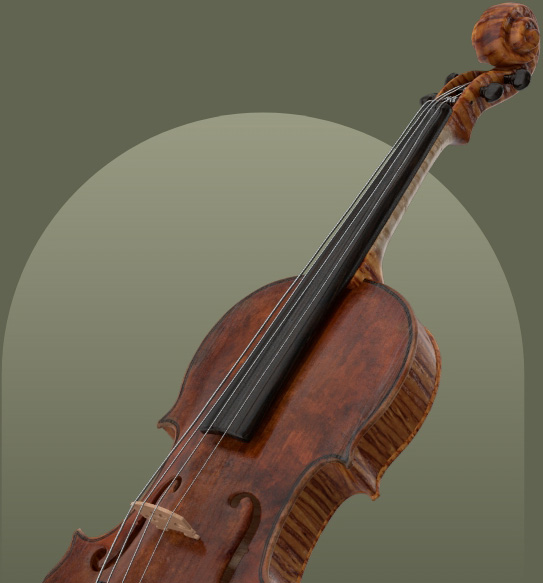
Lorenzo Guadagnini
Lorenzo Guadagnini is a historically significant figure in violin making, traditionally recognized as a pupil of Antonio Stradivari and the father of Giovanni Battista Guadagnini. He is often associated with working in Cremona, Piacenza, and Milan, producing instruments noted for their bold design, beautiful golden-red varnish, and powerful, rich tone. His craftsmanship is characterized by a small, slightly arched pattern, good quality wood, and F-holes influenced by both Stradivari and Guarneri. While his scrolls are considered original, their aesthetic appeal is debated among historians. Instruments attributed to him are rare and highly valued. However, recent research by Rosengard, challenges his status as an independent maker, suggesting that labels bearing his name are false, indicating conflicting scholarly opinions on his direct involvement in instrument production.
Auction Price History
Highest auction price
3 results
| Type | Details | Auction house | Sold | Price |
|---|---|---|---|---|
| Violin | 1744 | — | October 1995 | £78,500 |
| Violin | 1742 | — | November 1992 | £198,000 |
| Violin | 1740 | — | November 1988 | £68,200 |
No results match those filters.
Maker Overview
Life
Lorenzo Guadagnini (c. 1665-c. 1740) is a figure whose historical attribution as a violin maker is subject to conflicting scholarly views. Traditionally, he has been considered a significant maker, often listed in dictionaries and regarded as the father of Giovanni Battista Guadagnini., he was a pupil of Stradivari, with whom he worked for a long time, returning to his native town after 1730. George Hart notes that Lorenzo was born at Piacenza and, after leaving his master's workshop, returned there, remaining until about 1695, at which point he is said to have moved to Milan, working there until about 1740. Cecie Stainer also states he was born at Piacenza around 1665, worked as a pupil of Antonio Stradivari at Cremona for many years, later went to Milan about 1730, and then to Piacenza, working until about 1740.
However, recent research by Rosengard, as cited by John Dilworth in The Brompton's Book of Violin & Bow Makers, suggests that Lorenzo Guadagnini was not a violin maker in his own right. Dilworth states that labels reproduced in various publications, such as "Laurentius Guadagnini Pater / & alumnus Antoni Stradivari / fecit Placentiae. Anno 1743" and "Laurentius Guadagnini Cremonae / Alumnus Stradivari fecit, anno Domini / 17.." are false. Sources contain conflicting information regarding his actual role as a maker.
Characteristics
- Design & Model
- His instruments are described by George Hart as "exceedingly bold in design," with a model inclined to flatness and a broad design. Cecie Stainer notes they are generally made on a small pattern, slightly arched, and of good proportions. Willibald Leo Lütgendorff mentions a "ziemlich kleines Patron von schöner mittlerer Wölbung" (a rather small pattern with beautiful medium arching).
- Wood & Workmanship
- The wood used is consistently described as very beautiful or of good quality. Lütgendorff states the execution is "musterhaft" (exemplary) and the outlines are "schwungvoll" (sweeping).
- F-holes
- George Hart observes that Lorenzo frequently changed the form of his sound-hole, sometimes giving it the pointed character of Giuseppe Guarneri and at other times retaining the type perfected by his master. Lütgendorff similarly notes that the F-holes are cut sometimes after Guarneri and sometimes after Stradivari.
- Scroll
- George Hart states the scroll is "certainly not an imitation of that of Stradivari;" it possesses considerable originality, being more attractive for its uniqueness than for its beauty. Cecie Stainer, however, notes the scroll is "not so well cut as that of Stradivari." Lütgendorff finds the scroll characteristic for him, though not as beautiful as Stradivari's.
- Varnish
- His varnish is described by Lütgendorff as a "goldrother Lack ist wundervoll" (wonderful golden-red varnish), unsurpassed in fire by any Guadagnini except Giambattista. George Hart notes his varnish is "not so brilliant as that of Giovanni Battista, but possesses a mellowness foreign to the other members of the family." Cecie Stainer describes it as "very beautiful golden-red varnish."
- Purfling & Corners
- Cecie Stainer mentions the purfling and corners are "rather heavy."
- Tone
- The tone is consistently praised as rich and powerful. George Hart describes it as "powerful, tempered with a rich quality." Cecie Stainer notes the tone is "rich and powerful."
- Unique Features
- Lütgendorff mentions that there are violins by him that, similar to those of Maggini, have double purfling.
- Laurentius Guadagnini Pater
& alumnus Antoni Stradivari
fecit Placentiae. Anno 1743John Dilworth - Laurentius Guadagnini Cremonae
Alumnus Stradivari fecit, anno Domini
17..John Dilworth
Influence and legacy
- Teacher: Lorenzo Guadagnini is widely considered to have been a pupil of Antonio Stradivari. Willibald Leo Lütgendorff states he was a "Schüler von Stradivari, bei dem er lange arbeitete" (pupil of Stradivari, with whom he worked for a long time). George Hart notes the "association of his name with that of Antonio Stradivari." Cecie Stainer identifies him as a "well-known pupil of Antonio Stradivari at Cremona," where he worked for many years.
- Family Continuity: He is recognized as the father of the renowned maker Giovanni Battista Guadagnini.
- Market Value: George Hart notes that the instruments made by the Guadagnini family are "rapidly increasing in value." He also states that the works of Lorenzo are "rare, and eagerly sought for in England." Willibald Leo Lütgendorff observes that prices for his violins are "jetzt fortwährend" (constantly increasing) due to their captivating tone. Cecie Stainer adds that his instruments, when in good condition, are of "a high commercial value."
- Historical Standing: He was long considered equal in merit to the Amati family. George Hart suggests that Lorenzo was likely seen as the principal maker due to his association with Antonio Stradivari.
Further Information
- Workshop Locations: Lorenzo Guadagnini is associated with several locations. He was born at Piacenza. After working with Stradivari in Cremona, he is said to have returned to Piacenza. George Hart suggests he moved to Milan around 1695 and worked there until about 1740. Cecie Stainer also mentions he worked in Cremona, then Milan (about 1730), and later Piacenza. Willibald Leo Lütgendorff notes claims of him working in Milan, but suggests this might be based on a confusion.
- Labels: Labels attributed to him include "Laurentius Guadagnini Pater / & alumnus Antoni Stradivari / fecit Placentiae. Anno 1743" and "Laurentius Guadagnini Cremonae / Alumnus Stradivari fecit, anno Domini / 17.." Cecie Stainer also mentions "Laurentius Guadagnini pater. Alumnus Antoni Stradivari fecit Placentiae, anno 1743" and similar labels dated 1742 and 1743. However, John Dilworth, citing Rosengard, states these labels are false.
Biographies
The overview above is drawn from the following published accounts. Read them in the original:
John Dilworth+
GUADAGNINI, Lorenzo Father of Giovanni Battista Guadagnini, above. Previously considered to be a violin maker in his own right and listed in most dictionaries, but recent research by Rosengard has shown this not to be the case. Labels reproduced in various publications are false. Laurentius Guadagnini Pater / & alumnus Antoni Stradivari / fecit Placentiae. Anno 1743 Laurentius Guadagnini Cremonae / Alumnus Stradivari fecit, anno Domini / 17.. [Rosengard]
George Hart+
The instruments made by the Guadagnini family are rapidly increasing in value. No matter to which of the Guadagnini the instrument may owe its origin ; if it bears the name, importance is attached to it, often without due regard to the merits of the particular specimen. The later members of the family have thus received attention measured by the excellence of the works of their forefathers. That this should be so to a certain extent can scarcely excite surprise, nor is it singular in the Italian branch of the art. The great makers of the Guadagnini family were Lorenzo and Giovanni Battista. The former has been considered the chief maker; but if the merits of each be duly weighed, they will be found to be nearly equal. It is probable that Lorenzo has been looked upon as the principal maker from the association of his name with that of Antonio Stradivari, a fact which, it must be granted, lends to it a certain degree of importance. The instruments of Lorenzo are exceedingly bold in design, and differ in this respect from those of Giovanni Battista, which retain much of the delicate form of Stradivari. Lorenzo frequently changed the form of his sound-hole, giving it the pointed character of Giuseppe Guarneri in some instances, and in others retaining the type of soundhole perfected by his master. The model is inclined to flatness, the declivity being of the gentlest kind: the breadth of the design commands admiration. The scroll is certainly not an imitation of that of Stradivari; it has considerable originality, and is more attractive on that account than for its beauty. The varnish is not so brilliant as that of Giovanni Battista, but possesses a mellowness foreign to the other members of the family. The tone is powerful, tempered with a rich quality. The works of this maker are rare, and eagerly sought for in England. Lorenzo Guadagnini was born at Piacenza, and upon leaving the workshop of his master, returned to his native town, where he remained until about the year 1695, at which period he is said to have removed to Milan. In the last-named city he continued to work until about the year 1740.
Cecie Stainer+
b. at Piacenza (?) about 1665; worked till about 1740. A well-known pupil of Antonio Stradivari at Cremona, he worked there for many years; later went to Milan (about 1730) and then to Piacenza. His instruments are much liked, especially the violins; generally made on a small pattern, slightly arched, of good proportions, the wood of good quality, with very beautiful golden-red varnish; the purfling and corners rather heavy, the scroll not so well cut as that of Stradivari, the tone rich and powerful. His instruments, when in good condition, are of a high commercial value.
and Laurentius Guadagnini pater. Alumnus Antoni Stradivari fecit Placentiae, anno 1743 ” ; similar labels are dated 1742 and 1743-
His son, Giambattista, was also a maker.
Willibald Leo Lütgendorff+
Schüler von Stradivari, bei dem er lange arbeitete. Er kehrte nach 1730
in seine Vaterstadt zurück. In seiner Arbeit strebt er mit Glück seinem Lehrer
nach und gebrauchte ein ziemlich kleines Patron von schöner mittlerer Wölbung.
Das Holz ist sehr schön, die Ausführung musterhaft, die Umrisslinien schwungvoll.
Die F-Löcher sind bald nach Guarneri, bald nach Stradivari geschnitten.
Characteristisch für ihn ist die Schnecke, die allerdings nicht so schön ist, als
die von seinem Lehrer Stradivari. Sein goldrother Lack ist wundervoll und
wird von keinem Guadagnini ausser von Giambattista an Feuer übertroffen. Es
soll auch Geigen von ihm geben, die ähnlich wie die von Maggini, doppelte
Einlagen haben. Er wurde lange den Amati’s als gleichwerthig geachtet, doch
steigen die Preise für seine Violinen wegen ihres bestrickenden Tons jetzt fortwährend.
Dass er auch in Mailand gearbeitet haben soll, wird zwar behauptet,
scheint aber auf einer Verwechslung zu beruhen.
Sell your instrument with Amati
Get started by uploading photos of your instrument for our experts to review.
Sell your instrument with Amati
Get started by uploading photos of your instrument for our experts to review.